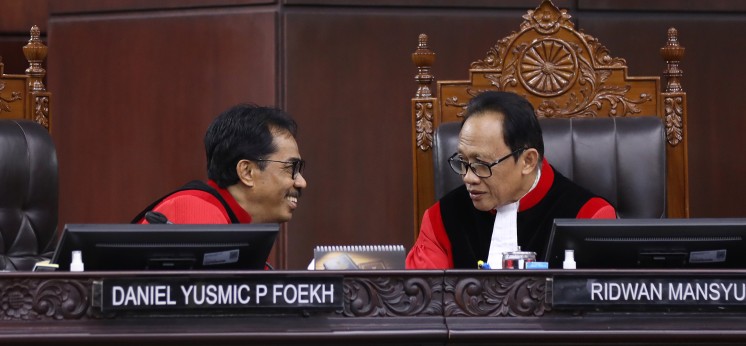
Constitutional Justices Daniel Yusmic P. Foekh and Ridwan Mansyur at the ruling hearing for the material judicial review of the Higher Education Law, Friday (1/30/2026). Photo by MKRI/Ifa.
JAKARTA (MKRI) — Article 31 paragraph (3) of Law No. 12 of 2012 on Higher Education has clearly accommodated and regulated mandatory guarantee of quality assurance and the national standards for higher education, while continuing to respect academic freedom, academic lectern, and academic autonomy of higher education institutions as providers of higher education, including distance education.
Such is the Constitutional Court’s legal considerations presented by Constitutional Justice Daniel Yusmic P. Foekh for the material judicial review of Article 31 paragraph (3) of Law No. 12 of 2012 on Higher Education. Decision No. 243/PUU-XXIII/2025 for the petition filed by the Bernita Matondang, Susi Lestari, M. Imelda Novita S., Nova Syafariyanto Prambudi, Indah Lidiyani, Ananda Putri Puspita, Lely Diana Hatan, Ariyanto Zalukhu, Karwana Sakahou, Ame Mira Putri Pramesti, Evita Mulyani, Ikke Nurjanah, and Mahira Azzahra Widiani was handed down on Friday, January 30, 2026.
Therefore, Justice Foekh continued, the absence of more detailed technical elaboration regarding minimum normative standards ensuring graduate quality in Law No. 12 of 2012—in casu Article 31 paragraph (3)—does not, according to the Court, automatically give rise to a constitutional problem with Article 31 paragraph (3) as alleged by the Petitioners. In the Court’s view, the Petitioners’ petition is excessive, because the matters requested have in fact already been accommodated through various provisions within the Higher Education Law.
“Based on the foregoing legal considerations, the Petitioners’ argument challenging the constitutionality of the phrase ‘an assessment system that ensures the quality of graduates in accordance with the National Standards for Higher Education’ in Article 31 paragraph (3) of Law No. 12 of 2012, on the ground that it allegedly fails to stipulate minimum normative standards guaranteeing graduate quality, is unfounded in law,” Justice Foekh concluded.
Minister’s Domain
The Court further explained the substance of Article 31 paragraph (3) within the overall framework of Article 31 of the Higher Education Law, which forms part of the regulation of distance education. In this context, when read carefully, Article 31 paragraph (3) cannot be understood in isolation from Article 31 paragraph (4), because it has been clearly stated, in essence, that the organization of distance education falls within the domain of the minister, or the minister responsible for higher education administration.
Moreover, with respect to Article 31 paragraph (3) of the Higher Education Law challenged by the Petitioners, which regulates, inter alia, an assessment system that ensures graduate quality in accordance with the national standards for higher education, the provision does not stand alone. Rather, it is closely connected to the subsequent provision, Article 31 paragraph (4), which delegates the regulation of the implementation of distance education to implementing regulations in the form of a ministerial regulation, in order to ensure national standardization of distance education that must be complied with by higher education institutions.
This is because, Justice Foekh continued, the minister responsible for education bears responsibility for the administration of higher education, including higher education conducted through distance education. Such ministerial responsibility encompasses regulation, planning, supervision, monitoring and evaluation, as well as guidance and coordination.
“With the delegation to implementing regulations to further regulate Law No. 12 of 2012, in fact this does not apply only to distance education, but also to various other subject matters contained in the Law. In other words, the delegation of regulatory authority concerning the implementation of distance education to a ministerial regulation—particularly one enacted pursuant to a statutory mandate—is permissible,” Justice Foekh explained.
Based on these legal considerations, the Court, in the verdict of the decision read out by Chief Justice Suhartoyo, declared that the Petitioners’ petition was rejected in its entirety.
Also read:
UT Students Question Legal Limits of Proportionality in Distance Learning Assessment System
Indonesia Open University Students Submit Evidence on Distant Learning Assessment
At the preliminary hearing on Tuesday, December 16, 2025, the Petitioners argued that Article 31 paragraph (3) of the Higher Education Law is in conflict with Article 28D paragraph (1), Article 31 paragraphs (1) and (3), and Article 28C paragraph (1) of the 1945 Constitution. They contended that the article does not provide clear legal limits regarding the proportionality of the distance learning assessment system. The lack of clarity in this norm opens up room for varied implementation of policies between institutions. This places the Petitioners in a position where they do not have legal certainty and equal protection, compared to distance learning students at other universities.
They claimed that the right to education as guaranteed in Article 31 paragraph (1) of the 1945 Constitution shall not only be interpreted as the right to be registered as a student administratively. Rather, it includes the right to obtain a fair, rational, meaningful, and holistic education process oriented towards the development of students’ abilities, ranging from learning activities, academic counseling, lecturer-student interactions, to a proportional and fair evaluation system.
The Petitioners also presented a comparison of the implementation of learning and assessment systems at four other universities offering distance learning. They observed that all of those institutions conduct learning within a one-semester time frame, but there are significant variations in the effective duration of lectures, midterm exams, the weight of final exams, remedial mechanisms, and assessment systems.
These differences essentially reflect the academic autonomy of each university, which should be appreciated as a form of innovation in the implementation of distant learning. However, excessive variation in fundamental aspects such as the weighting of final exams, mid-semester evaluations, and access to remedial tests also indicates that the norms in the law have not yet provided uniform minimum standards as instruments for protecting student rights.
Based on these arguments, the Petitioners requested that the Court declare Article 31 paragraph (3) of Law No. 12 of 2012 on Higher Education constitutional, provided that the phrase “an assessment system that ensures the quality of graduates” be interpreted to mean that technical regulations regarding the proportionality of process and outcome assessments shall be further regulated in implementing regulations that guarantee legal certainty, academic justice, and the protection of student rights.
Explore case No. 243/PUU-XXIII/2025 (in Indonesian).
Author : Sri Pujianti
Editor : N. Rosi
Translator : Yuniar Widiastuti (NL)
Disclaimer: The original version of the news is in Indonesian. In case of any differences between the English and the Indonesian versions, the Indonesian version will prevail.
Friday, January 30, 2026 | 13:21 WIB 212