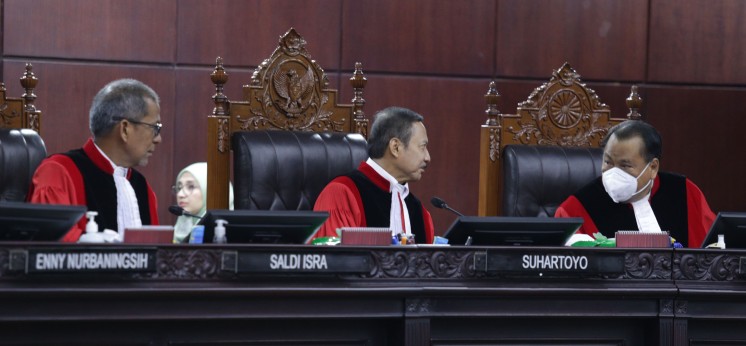
The ruling hearing for the judicial review of Law No. 8 of 1981 on the Criminal Procedure Code, Friday (1/30/2026). Photo by MKRI/Bayu.
JAKARTA (MKRI) — The Constitutional Court approved the withdrawal of the material judicial review petition No. 4/PUU-XXIV/2026 filed by Fatur Rizqi Ramadhan, Zain Amruzikin, and Abdul Hadi (Petitioners I-III). The ruling hearing for the judicial review of Law No. 8 of 1981 on the Criminal Procedure Code (KUHAP), chaired by Chief Justice Suhartoyo, took place on Friday, January 30, 2026 in the plenary courtroom.
The Chief Justice stated that on January 20, 2026, the Court held a preliminary hearing to confirm the withdrawal of the petition, which was attended by the Petitioners, who confirmed the withdrawal at said hearing.
At the justice deliberation meeting (RPH) on the same day, the justices concluded that the withdrawal of Petition Number 4/PUU-XXIV/2026 was legally justified. Accordingly, the Petitioners may not resubmit the petition.
“The Court adjudicates: to grant the withdrawal of the petition by the Petitioners; to declare that Petition No. 4/PUU-XXIV/2026 withdrawn; to declare that the Petitioners may not refile the petition a quo; and to order the Chief Registrar of the Constitutional Court to record the withdrawal of Petition No. 4/PUU-XXIV/2026 in the electronic constitutional case registration book and to return copies of the petition files to the Petitioners,” said Chief Justice Suhartoyo.
Also read: Withdrawal of Petition Against Criminal Procedure Code Confirmed
In their petition, the Petitioners challenged several provisions, including Article 17, Article 50, Article 52, Article 54, Article 55, Article 56, Article 72, Article 77, Article 79, Article 80, Article 143 paragraph (4), Article 184 paragraph (1), and Article 189 of the Criminal Procedure Code. They claimed these provisions potentially violate the principle of due process of law, restrict their right to legal assistance at the investigation stage, and weaken judicial oversight mechanisms in the investigation process.
In addition, the Petitioners argued that these provisions do not include a prohibition on the use of confessions obtained through torture, coercion, or inhuman or degrading treatment; impose limitations on access by suspects and legal counsel to case files, particularly at the investigation stage, thereby hindering the Petitioners’ right to mount an effective defense; and even contain a lack of clarity regarding standards for the protection of suspects’ rights as subjects of law.
Accordingly, the Petitioners requested the Court to declare those articles unconstitutional. They also requested the Court to declare these provisions conditionally legally binding insofar as they are not interpreted as “in accordance with the principles of due process of law, a fair trial, the protection of human rights, and a democratic state governed by the rule of law.”
Explore case No. 4/PUU-XXIV/2026 (in Indonesian).
Author : Sri Pujianti
Editor : N. Rosi
Translator : Yuniar Widiastuti (NL)
Disclaimer: The original version of the news is in Indonesian. In case of any differences between the English and the Indonesian versions, the Indonesian version will prevail.
Friday, January 30, 2026 | 10:35 WIB 164