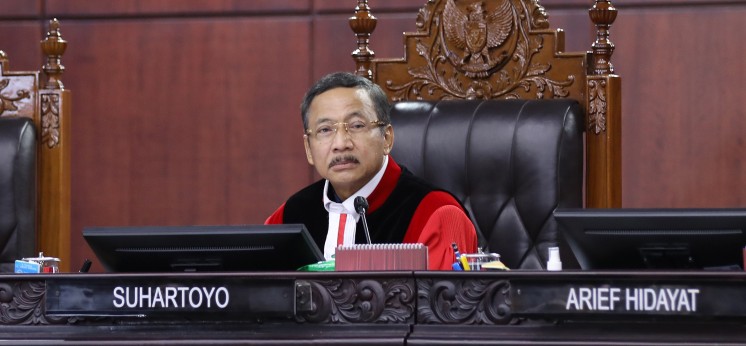
Chief Justice Suhartoyo chairing the ruling hearing on the judicial review of the Law on Social Worker and Law on the Handling of the Poor and Needy, Friday (1/30/2026). Photo by MKRI/Ifa.
JAKARTA (MKRI) — The Constitutional Court rejected the petition filed by Alif Rahman and Usyman Affan on the material judicial review of Articles 2 and 7 of Law No. 14 of 2019 on Social Workers; as well as Article 2, Article 5, Article 12 paragraph (1), Article 13, Article 14, Article 15 paragraph (1), Article 16, Article 17, and Article 18 paragraph (1) of Law No. 13 of 2011 on the Handling of the Poor and Needy. The case was ruled at a ruling hearing to read Decision No. 218/PUU-XXIII/2025 on Friday, January 30, 2026 in the plenary courtroom.
“The Court rejects the Petitioners’ petition in its entirety,” declared Chief Justice Suhartoyo reading out the verdict.
However, in the legal considerations read by Constitutional Justice M. Guntur Hamzah, the Court emphasized that even though the principles of neutrality and independence are not explicitly stated, social workers, in carrying out social work practice services, are bound by the obligations stipulated in Article 42 of Law No. 14 of 2019. One such obligation is to act objectively and in a non-discriminatory manner toward clients in the performance of their professional duties, without distinction based on gender, religion, ethnicity, race, family background, disability, or socioeconomic status.
“The norm of the provision a quo in fact provides legal certainty regarding the foundation and guidelines for social workers in carrying out social work practice, which is aimed at realizing social justice for all Indonesian people through the administration of social welfare,” he stated.
Social workers are not limited to volunteers who distribute social assistance to those in need. Rather, the scope is broader and includes social workers employed by government institutions or non-governmental organizations (NGOs). Social work practice is carried out in accordance with standard operating procedures, social worker competency standards, and service standards, and is subject to regulatory oversight.
In the event of abuse of social work practice through the distribution of social assistance, which may also involve the use of state budget (APBN) during an election period, the resolution of such abuse falls within the authority of the Elections Supervisory Body (Bawaslu) and the Integrated Law Enforcement Center (Gakkumdu). Such resolution must be carried out optimally in accordance with the Election Law and the Criminal Code (KUHP) in order to ensure elections that are honest, fair, and conducted with integrity.
Furthermore, Justice Guntur explained that in the context of handling the poor and needy, even though there is no explicit provision requiring the Government to account for the use of the state budget in facilitating social work practice as a form of poverty alleviation free from political interests, as alleged by the Petitioners, the Government is in fact bound by comprehensive responsibilities in addressing poverty. Such responsibilities are carried out based on the principles of humanity, social justice, non-discrimination, welfare, solidarity, and empowerment, and are subject to duties and authorities, including prohibitions against the misuse of funds for poverty alleviation and related criminal provisions as regulated in the Law on the Handling of the Poor and Needy.
Moreover, the provisions challenged by the Petitioners have in fact regulated the Government’s responsibility in implementing measures to address poverty, including the development of individual potential, provision of adequate food and clothing assistance, housing services, health services, provision of educational assistance or scholarships, access to employment and entrepreneurial opportunities, and social services. By contrast, the additional interpretation or meaning sought by the Petitioners would instead narrow the scope of social work practice itself.
The Court further emphasized that, as a matter of fact, the handling of poverty under Law No. 13 of 2011 is not permitted to be used as a political instrument. Rather, it constitutes a manifestation of the State’s responsibility to promote general welfare through poverty alleviation measures carried out by both the central and regional governments in a directed, integrated, and sustainable manner. Accordingly, the arguments advanced by the Petitioners were deemed not to give rise to any issue of constitutional validity of the norms.
Also read:
Two Citizens Challenge Exploitation of Social Workers for Campaign
Petitioners Want Neutrality to Apply to Social Workers During Campaign Season
According to the Petitioners, during general elections as well as regional head elections, social workers are often exploited for campaign purposes in relation to the distribution of social assistance. Yet in carrying out activities involving the broader public, whether social work by social workers or the handling of the poor, it is mandatory to adhere to and apply the principles of neutrality and independence, which form part of the implementation of values based on law and legal certainty.
The Petitioners, who are employees as well as students, stated that the absence of provisions regulating the principles of neutrality and independence in the Social Workers Law and the Law on the Handling of the Poor and the Needy may open a legal gap that can be exploited by certain parties to engage in covert image-building or to carry out the handling of the poor outside the campaign period. Regulating the principles of neutrality and independence can strengthen the legal basis for the social work profession and create legal certainty.
According to the Petitioners, the articles being reviewed in this petition are contrary to Article 1 paragraph (2), Article 1 paragraph (3), Article 22E paragraph (1), Article 23 paragraph (1), and Article 28D paragraph (1) of the 1945 Constitution. They therefore request the Court to reinterpret each of the articles being reviewed in accordance with their petitums.
Explore case No. 218/PUU-XXIII/2025 (in Indonesian).
Author : Mimi Kartika
Editor : Lulu Anjarsari P.
PR : Andhini S.F.
Translator : Yuniar Widiastuti (NL)
Disclaimer: The original version of the news is in Indonesian. In case of any differences between the English and the Indonesian versions, the Indonesian version will prevail.
Friday, January 30, 2026 | 11:31 WIB 136