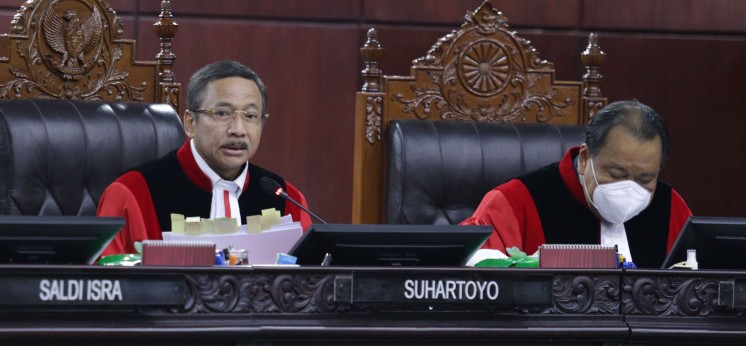
The ruling hearing for Case No. 11/PUU-XXIV/2026 on the judicial review of Law No. 1 of 2025 on State-Owned Enterprises, Friday (1/30/2026). Photo by MKRI/Bayu.
JAKARTA (MKRI) — The Constitutional Court handed down Decree No. 11/PUU-XXIV/2026 on the material judicial review petition of Article 71 paragraph (1) of Law No. 1 of 2025 on the Amendment to Law No. 19 of 2003 on State-Owned Enterprises (BUMN Law). In the decree, the Court ruled the case filed by Hertikawati Sihotang dismissed in absentia, as she had failed to attend the preliminary hearing on Wednesday, January 21, 2026 at 14:30 WIB.
Chief Justice Suhartoyo stated that through the Registrar’s Office, the Court had summoned the Petitioner duly and properly with an official letter. The Court had even summoned her right before the session commenced, but she remained absent without any explanation.
“The Court declared the Petitioner’s petition No. 11/PUU-XXIV/2026 dismissed in absentia,” the chief justice said at the ruling hearing for the case on Friday, January 30, 2026 in the plenary courtroom.
Also read: Appointment of Public Accountants to Audit State-Owned Enterprises Challenged
In her petition, the Petitioner challenged the provision that grants authority to the Minister, as a representative of the government, to appoint public accountants to audit SOEs without involving the BPK (Audit Board of Indonesia) as an independent state institution. According to the Petitioner, the minister’s appointment power under Article 71 paragraph (1) of the BUMN Law indirectly shifts the constitutional authority of the BPK.
Given that the capital of SOEs wholly or predominantly originates from separated state assets, audits of SOE finances should, in substance, be inseparable from audits of state financial management. Conceptually, financial audits conducted by public accountants are fundamentally different from state financial audits carried out by a state institution vested with constitutional authority.
The Petitioner argued that audits conducted by a constitutionally authorized state institution are inherently more independent than those conducted by public accountants. Public accountants are professionals who operate based on contractual relationships, and their independence largely depends on the party that appoints and remunerates them.
In the context of Article 71 paragraph (1) of the BUMN Law, public accountants are appointed by the minister, thereby placing them structurally in a relationship of dependence on executive power. When audits of SOEs are fully delegated to a ministerial appointment mechanism, such audits risk losing objectivity and independence, as they may be influenced by executive interests and discretion, thereby giving rise to conflicts of interest.
For reference, Article 71 paragraph (1) of the BUMN Law reads: “In order to safeguard the interests and business continuity of State-Owned Enterprises, the Minister may appoint public accountants to conduct audits of State-Owned Enterprises.” In the petitums, the Petitioner requested the Court to declare Article 71 paragraph (1) of the BUMN Law contrary to Article 23E paragraph (1) of the 1945 Constitution and to have no binding legal force.
Explore case No. 11/PUU-XXIV/2026 (in Indonesian).
Author : Mimi Kartika
Editor : N. Rosi
Translator : Yuniar Widiastuti (NL)
Disclaimer: The original version of the news is in Indonesian. In case of any differences between the English and the Indonesian versions, the Indonesian version will prevail.
Friday, January 30, 2026 | 09:58 WIB 164