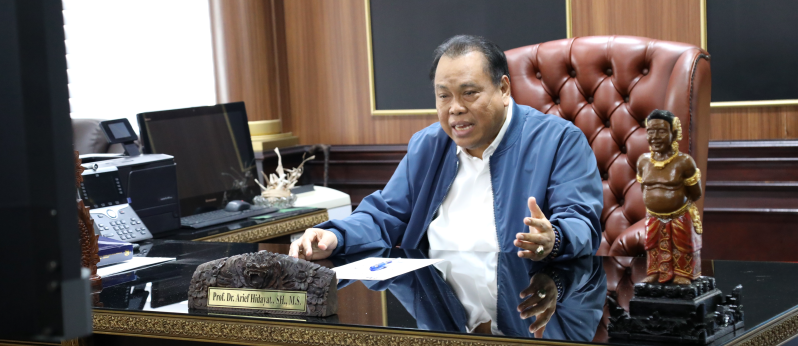
Arief Hidayat delivering a keynote speech at the webinar on the Constitution,“Indonesia's National Vision and Efforts to Realize State Administration Based on Pancasila” on Friday (1/30/2026). Photo by MKRI/Fauzan
JAKARTA (MKRI) – The Constitutional Court of the Republic of Indonesia (MK RI), in collaboration with the University of Jember, held a webinar entitled “Indonesia's National Vision and Efforts to Realize State Administration Based on Pancasila” on Friday, January 30, 2026. Constitutional Justice Arief Hidayat was present as the keynote speaker.
Arief expressed his appreciation and emphasized the implementation aspect. "This nation is already very good in terms of its ideological structure, but its implementation is still lacking," he said.
This statement implies the real challenge of embodying the noble values of Pancasila in the practice of state administration and daily life, a theme that was at the heart of the webinar discussion.
On that occasion, Law Professor at the University of Jember, Dominikus Rato, delivered a discussion on the national vision and implementation of Pancasila. In his presentation, he emphasized that Pancasila is a binding "grand agreement of the nation."
"Pancasila is the moral, historical, and cultural consensus of the nation. It binds the state and its citizens. If the state violates it, it is in breach of its constitutional promise," Rato asserted.
Furthermore, Rato explained the organic relationship between the Proclamation, Pancasila, and the 1945 Constitution as an "equilateral triangle" that reinforces each other and cannot be separated. "The Preamble to the Constitution cannot be amended. If the Preamble is amended, then the Proclamation, Pancasila, and the Constitution are also amended. There is no longer a state," he asserted.
In the context of law enforcement, Rato stated that Indonesia adheres to the Pancasila Constitutional State, which is not merely the rule of law, but the rule of justice. "Indonesia is not a liberal, socialist, or even statist state. But it is a state based on moral law (ethical constitutionalism)," he explained. He also warned of the dangers of law without morality, which can produce legal products that are "legal but unjust" and ultimately move away from the ideals of social justice.
The webinar, moderated by Christo Sumurung Tua Sagala, concluded with the affirmation that Pancasila is not a slogan, but rather a "shared moral responsibility" for all components of the nation, including judges, academics, and citizens. This activity is expected to strengthen the collective commitment to realizing state governance that is truly rooted in the values of Pancasila.
Author : Adriana A.Y.
Editor : Lulu Anjarsari P.
Translator : N. Valentino Rahadityo
Disclaimer: The original version of the news is in Indonesian. In case of any differences between the English and the Indonesian versions, the Indonesian version will prevail.
Friday, January 30, 2026 | 19:19 WIB 134