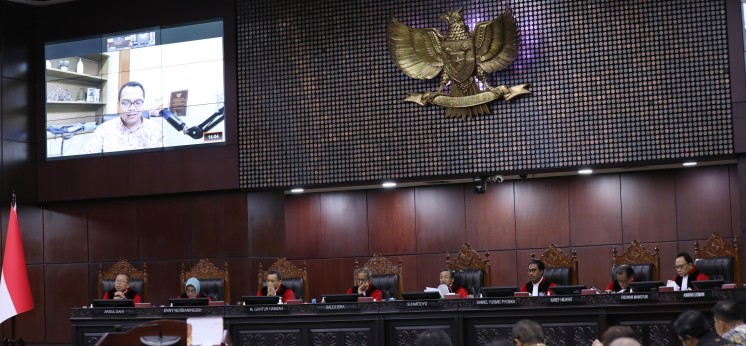
The judicial review hearing of the KUP Law, Thursday (29/01) at the Constitutional Court. Photo by MKRI/Ifa.
Jakarta (MKRI) – The House of Representatives (DPR) and the Petitioners’ Expert/Witness delivered their statements at a judicial review hearing of Article 34 paragraphs (1) and (2) of Law No. 6 of 1983 on General Provisions and Tax Procedures (KUP Law), as amended by Law No. 6 of 2023 on Job Creation (Job Creation Law), on Thursday, January 29, 2026, in the Plenary Courtroom. Jony, a forensic tax auditor appearing as an Expert for the Petitioner, stated that taxpayers should be encouraged to record conversations as evidence in the event of racketeering or improper conduct by rogue officials.
“To assist the leadership of the Directorate General of Taxes (DJP) in conducting internal checks, taxpayers should ‘be allowed’ or, better yet, ‘be advised’ to record conversations with tax officials so that such recordings can serve as strong evidence if they experience any improper treatment,” Jony told the panel of justices.
In his view, tax information must not be kept secret from the taxpayers themselves insofar as it relates to the exercise of their tax rights and obligations. Classifying taxpayers as a “third party” in relation to their own data constitutes a legal logical fallacy, he argued, because a data owner cannot logically be treated as a “third party” to information they themselves own.
Jony stated that taxpayers have a constitutional right to document (record) audio-visual footage of their own activities at tax offices as a form of legal self-protection and to promote transparency in public services. Without such documentation, taxpayers are vulnerable to intimidation, extortion, or abuse of authority by unscrupulous officials, due to the absence of equivalent evidentiary tools in the event of disputes or maladministration.
“A prohibition on recording imposed on taxpayers can be understood as an attempt to deprive them of the right to self-protection,” Jony said.
He went on to argue that Article 34 of the KUP Law should be interpreted as protecting the confidentiality of substantive data (such as turnover figures or financial statements), rather than as a means of concealing the conduct of tax officials in the public interest. The government’s interpretation, relying on Article 28G of the 1945 Constitution of the Republic of Indonesia to prohibit taxpayers from making recordings, is, he contended, misplaced, because what is being recorded are official acts of state officials in public offices carried out in the implementation of legislation, not private matters.
Protection of taxpayer data
Meanwhile, representing the DPR, a member of Commission III of the DPR RI, M. Nasir Djamil, said that the provisions being challenged are, in essence, an application of the principle of taxpayer protection. All information regarding a taxpayer’s identity, income, assets, financial transactions, and/or financial condition obtained by the tax authorities constitutes the taxpayer’s private property, is confidential in nature, and may not be disclosed to other parties without a clear legal basis.
“Such regulation has logical consequences for the national taxation system and, further, implications for ensuring openness and honesty on the part of taxpayers with respect to reporting their income and assets clearly, accurately, and comprehensively when paying and reporting taxes,” Nasir said.
He added that the implementation of examinations to test compliance with tax obligations, including audio-visual recording, is further regulated through various technical provisions issued by the government. One such regulation issued by the DJP requires that meetings between tax auditors and taxpayers be held in designated rooms equipped with audio and visual recording devices.
Recording, he argued, is therefore an integral part of tax audit procedures, provided that several requirements stipulated in technical regulations are met. Article 34 paragraphs (1) and (2) of the KUP Law, he emphasized, are not concerned with whether recording is permitted or prohibited during tax examinations conducted by authorized tax officials.
Also read:
Ban on Taxpayers Recording Audio-Visual of Tax Meeting Challenged
Questioning the Ban on Taxpayers Making Audio-Visual Recordings During Meetings with Tax Officials
House and Govt Not Ready, KUP Law Review Hearing Postponed
Govt: Freedom to Record May Risk Taxpayers Data Leaks
Article 34 paragraphs (1) and (2) read: “(1) Every official is prohibited from informing any other party of any matter known or disclosed to them by the taxpayer by virtue of their position or work in implementing tax regulations. (2) The same prohibition as refered to in paragraph (1) applies to experts appointed by the Director General of Taxes to assist in implementing tax regulations.”
Petition No. 211/PUU-XXIII/2025 was filed by Fungsiawan, who argued that the norms under review have given rise to excessive multiple interpretations, which, in turn, have resulted in a prohibition on taxpayers and/or their legal representatives from making audio-visual recordings during meetings with tax officials (fiskus) or other tax authorities. He further contended that these norms are vague, thereby depriving him of his constitutional right to obtain and retain information related to his own defense or that of his clients in tax proceedings.
The Petitioner claimed to have suffered actual losses in the form of the refusal to allow recording of meetings discussing the final results of tax audits (at Tamansari Tax Office in 2023 and Cengkareng Tax Office in 2025); expulsion from tax office premises on the grounds of “confidentiality” even though he had been officially summoned, was legally obliged to appear, and the matter concerned his own tax affairs; refusal to provide copies of recordings made by the Directorate General of Taxes (DJP) of official meetings between taxpayers and tax officials (with such internal documents deemed “confidential even to the taxpayer concerned”); as well as the DJP’s inability to preserve documentary evidence of the audit process and the loss of documentation media of communications that are crucial for the taxpayer’s defense. These actions, he argued, directly violate the Petitioner’s rights guaranteed under Article 28F of the 1945 Constitution of the Republic of Indonesia.
Case tracking: Case No. 211/PUU-XXIII/2025 (in Indonesian)
Author: Mimi Kartika
Editor: Lulu Anjarsari P.
PR: Tiara Agustina
Translator: Rizky Kurnia Chaesario
Disclaimer: The original version of the news is in Indonesian. In case of any differences between the English and the Indonesian versions, the Indonesian version prevails.
Thursday, January 29, 2026 | 15:11 WIB 80