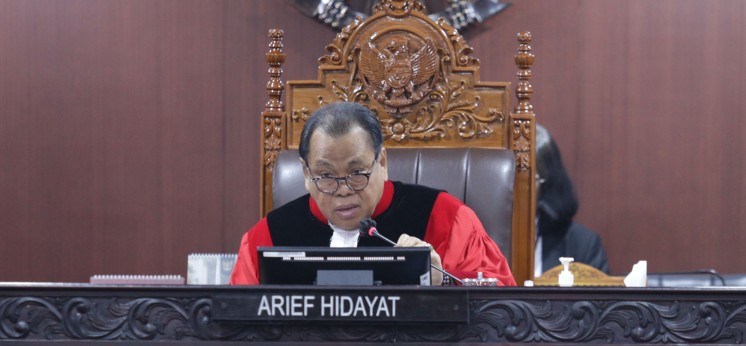
Constitutional Justice Arief Hidayat chairing the preliminary hearing for Case No. 36/PUU-XXIV/2026, Thursday (1/29/2026). Photo by MKRI/Bay.
JAKARTA (MKRI) — A citizen, Subhan, has filed a petition for judicial review of Law No. 7 of 2023 on the Stipulation of Government Regulation in Lieu of Law No. 1 of 2022 Amending Law No. 7 of 2017 on General Elections (General Elections Law). The petition is registered as Case No. 36/PUU-XXIV/2026.
The Constitutional Court held a preliminary hearing for the case on Thursday, January 29, 2026. In his petition, Subhan (the Petitioner) challenges the constitutionality of Article 169 of the Election Law, arguing that the provision engenders legal uncertainty as it does not expressly mandate authentication and/or factual verification of the subjective requirements for candidates for public office, particularly presidential and vice-presidential candidates.
“The Petitioner, as an Indonesian citizen living under the rule of law, does not obtain legal certainty from the enactment of Article 169, which applies without prior authentication and/or factual verification of the requirements stipulated therein,” he stated before Constitutional Justice Arief Hidayat, who chaired the panel hearing.
The Petitioner contends that he has suffered constitutional impairment in connection with a lawsuit he previously filed with the Central Jakarta District Court concerning the fulfillment of candidacy requirements for presidential candidate Anies Rasyid Baswedan and vice-presidential candidate Gibran Rakabuming Raka. According to him, the continued application of Article 169 without authentication or factual verification has adversely affected his constitutional rights.
“The enforcement of Article 169 without authentication or factual verification has demonstrably created legal uncertainty within society,” he asserted.
In his petition, Subhan explained that he had filed a lawsuit with the Central Jakarta District Court challenging the citizenship status of the 2024–2029 presidential candidate, Anies Rasyid Baswedan. He also submitted an unlawful act claim (perbuatan melawan hukum/PMH) against Gibran Rakabuming Raka in his capacity as a 2024–2029 vice-presidential candidate, alleging that Gibran did not satisfy the educational requirement as stipulated in Article 169 letter r of the Election Law.
Furthermore, the Petitioner alluded to an issue involving the 7th President of the Republic of Indonesia, Joko Widodo, who has been alleged to have used a falsified diploma in several public office contests, from his tenure as Mayor of Surakarta to his presidency. The Petitioner argued that the absence of definitive legal certainty regarding the authenticity of the diploma underscores the urgency of imposing factual verification of the subjective requirements for candidates for state office.
On the basis of these arguments, the Petitioner requests the Court to declare Article 169 of the Election Law contrary to the 1945 Constitution of the Republic of Indonesia insofar as it is not construed to require mandatory authentication and/or factual verification. He also petitions the Court to order the lawmakers to incorporate an explicit norm on factual verification into Article 169 in order to avert legal uncertainty, as well as to order the publication of the ruling in the State Gazette of the Republic of Indonesia.
Justice’s Advice
Responding to the petition, Constitutional Justice Enny Nurbaningsih advised the Petitioner to clearly elaborate the constitutional losses he claims to have suffered.
“This must be explained in detail: what constitutional rights are guaranteed by the Constitution, and what specific losses have arisen. Is Mr. Subhan arguing as an advocate or as an individual citizen? What exactly is flawed in this norm? If you refer to Article 28D paragraph (1), which aspect fails to provide legal certainty? There are numerous norms related to Article 169. Are all of them problematic? What evidence supports the existence of such a problem?” Justice Enny emphasized.
At the conclusion of the hearing, the panel of constitutional justices granted the Petitioner 14 days to revise his petition. The revised petition must be submitted no later than Wednesday, February 11, 2026.
Explore case No. 36/PUU-XXIV/2026 (in Bahasa Indonesia).
Author : Utami Argawati.
Editor : N. Rosi.
Translator : N. Valentino Rahadityo/Yuanna Sisilia
Disclaimer: The original version of the news is in Indonesian. In case of any differences between the English and the Indonesian versions, the Indonesian version will prevail.
Thursday, January 29, 2026 | 18:36 WIB 73