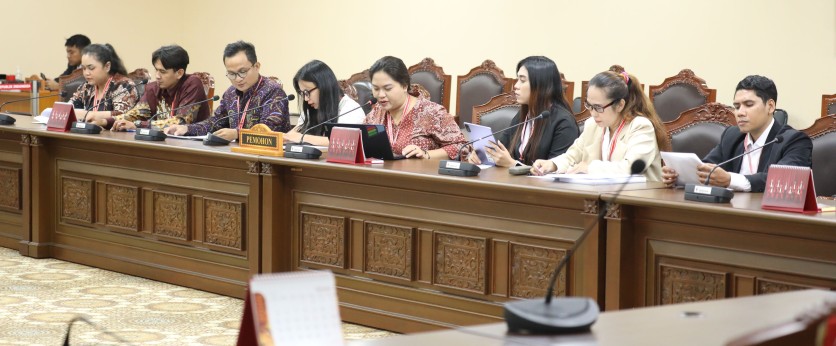
Petitioners and their legal counsels delivering a revised petition for judicial review of Law No. 1 of 2023 on the Criminal Code (KUHP), on Tuesday (1/27/2026). Photo by MKRI/Panji.
JAKARTA (MKRI) – Ten Petitioners for Petition No. 280/PUU-XXIII/2025 have added the articles being challenged to Article 411 paragraph (1) and paragraph (2) and Article 412 paragraph (1) and paragraph (2) of Law No. 1 of 2023 on the Criminal Code (KUHP). This was conveyed in the petition revision hearing on Tuesday, January 27, 2026, in the Courtroom.
The norms of Article 411 paragraphs (1) and (2) and Article 412 paragraphs (1) and (2) give parents or children the authority to report the personal relational activities of the Petitioners, which results in state intervention through criminal law instruments into areas that should be private and personal. This complaint offense mechanism creates a fundamental imbalance of power in family relations.
"An adult who engages in consensual intimate relations with a partner of their choice without parental consent is at risk of being criminalized when the parents use Article 411 paragraphs (1) and (2) and Article 412 paragraphs (1) and (2) as instruments to enforce their will. In this situation, the state transforms a family dispute that should be resolved through private dialogue and negotiation into a criminal matter that threatens individual freedom," said the Petitioners' legal counsel, Lala Komalawati.
Also read:
Students Question the New Criminal Code’s Provisions on Adultery
The Petitioners, namely Susi Lestari, Vendy Setiawan, Kristin Karlina, Valentina Ryan M, Luciana Ary Sibarani, Nur Jannatul Ma'wa, Yeren Limone, Priski Haryadi, Pungky Juniver, and Retno Wulandari. The Petitioners, as students of Law at the Open University, have the constitutional right to obtain education and the benefits of knowledge.
Meanwhile, the ambiguity of norms (vague of norm) in Article 411 paragraphs (1) and (2), and Article 412 paragraphs (1) and (2) hampers the learning process, legal research, and case analysis due to the absence of definite legal parameters regarding the crime of adultery and its complaint mechanism. Article 411 paragraphs (1) and (2) and Article 412 paragraphs (1) and (2) do not provide a mechanism for the person being complained about to reject the complaint or prove that the complaint was made with a motive of revenge or abuse of authority. An adult individual has the fundamental right to make decisions about his or her personal life.
The Petitioners in their petition requested the Court to declare Article 411 paragraph (1) of the Criminal Code contrary to the 1945 Constitution of the Republic of Indonesia (UUD NRI) and not have binding legal force as long as it is not interpreted as "Any person who is bound in marriage and has sexual intercourse with a person who is not his husband or wife, shall be punished for adultery, with a maximum imprisonment of 1 (one) year or a maximum fine of category II". And stated that Article 411 paragraph (2) of the Criminal Code contrary to the 1945 UUD NRI and not have binding legal force as long as it is not interpreted as "Against the Criminal Act as referred to in paragraph (1) no prosecution shall be carried out except upon complaint from the husband or wife"; states that Article 412 paragraph (1) of the Criminal Code is contrary to the 1945 Constitution of the Republic of Indonesia and does not have binding legal force as long as it is not interpreted as "Any person who lives together as husband and wife outside of marriage, even though they are bound by a marital relationship, shall be punished with a maximum prison sentence of 6 (six) months or a maximum penalty of category II, And declares Article 411 paragraph (2) of the Criminal Code Law is contrary to the 1945 Constitution of the Republic of Indonesia and does not have binding legal force as long as it is not interpreted as "Against Criminal Acts as referred to in paragraph (1) no prosecution shall be carried out except upon a complaint from the husband or wife"; declares Article 412 paragraph (1) of the Criminal Code Law is contrary to the 1945 Constitution of the Republic of Indonesia and does not have binding legal force as long as it is not interpreted as "Any person who lives together as husband and wife outside of marriage even though they are bound in a marital relationship, shall be punished with imprisonment for a maximum of 6 (six) months or a maximum of category II, and declares Article 412 paragraph (2) of the Criminal Code Law is contrary to the 1945 Constitution of the Republic of Indonesia and does not have binding legal force as long as it is not interpreted as "Against Criminal Acts as referred to in paragraph (1) no prosecution shall be carried out except upon a complaint from the husband or wife". (*)
Explore case No. 280/PUU-XXIV/2025 (in Indonesian).
Author : Mimi Kartika
Editor : Lulu Anjarsari P.
Translators : Donny Yuniarto
Disclaimer: The original version of the news is in Indonesian. In case of any differences between the English and the Indonesian versions, the Indonesian version will prevail.
Tuesday, January 27, 2026 | 18:20 WIB 282