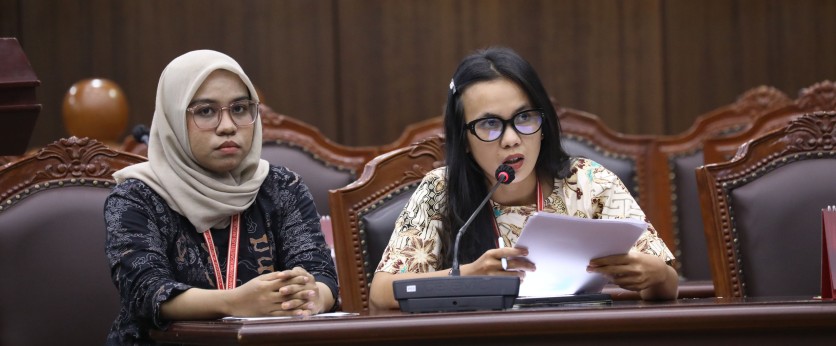
Petitioners’ legal counsel, Bernita Matondang, delivering the main points of the revised petition on the judicial review of the Criminal Code at the Panel Courtroom, Monday (26/1/2026). Photo by MKRI/Panji.
Jakarta (MKRI) - The Constitutional Court (MK) held a hearing to examine the revised petition of a material judicial review of Article 302 paragraph (1) of Law No. 1 of 2023 on the Criminal Code (new Criminal Code) against the 1945 Constitution of the Republic of Indonesia on Monday, January 26, 2026, in the Plenary Courtroom.
In Petition No. 274/PUU-XXIII/2025, Bernita Matondang, acting as legal counsel for the Petitioners, stated that the challenged provision had been amended to cover both Article 302 paragraphs (1) and (2) of the Criminal Code, which she argued were inconsistent with Article 28D paragraph (1), Article 28E paragraphs (1) and (2), and Article 28I paragraph (1) of the 1945 Constitution.
“On page six, there is a correction stating that Petitioner V adheres to a minority religion in Indonesia. The operation of the a quo provision affects the entire petition because it opens up the risk of restrictions on the exercise of religious belief in the Republic of Indonesia,” Bernita said.
Also read:
Testing the Criminal Code, Students Question the Word “Incite” Someone to Not Have a Religion
The Petitioners question the provision criminalizing anyone who publicly incites others to renounce their religion or beliefs, without further definition of the term “incite.”
"The prevailing norm regulates the punishment of anyone who publicly incites others to become irreligious or non-believers without providing a clear definition and limitation of the phrase ‘incite’. This ambiguity creates legal uncertainty and opens up room for broad and subjective interpretation, thereby contradicting the principle of legality," said Petitioner II Nissa Sharfina Nayla during the preliminary hearing of Petition No. 274/PUU-XXIII/2025 on Tuesday, January 13, 2026.
In addition to Nissa, the other Petitioners are Rahmat Najmu (Petitioner I), Wahyu Eka Jayanti (Petitioner III), Scholastica Asyana Eka Putri P (Petitioner IV), Reni Rianti (Petitioner V), Alliffah Wahyu Sanyoto T (Petitioner VI), Rifky Andy Darmawan (Petitioner VII), Safira Gita Rahmawati (Petitioner VIII), and Rizka Aliya Putri (Petitioner IX). Petitioner I is a student of the Law Program at Universitas Malikussaleh, while the other Petitioners are students of the Law Program at Universitas Terbuka.
They challenged Article 302 paragraph (1) of the Criminal Code, which states: “Any person who publicly incites others with the intention of causing them to renounce their religion or beliefs as practiced in Indonesia shall be punished with a maximum imprisonment of two (2) years or a maximum fine of category III.” The Petitioners stated that they are adherents of the majority religion in Indonesia and are actively involved in public discourse, activism, and research on religion, democracy, and constitutional law.
According to them, the phrase “incites” in the article being challenged is not clearly and explicitly defined, either in the article itself or in the explanatory notes to the Criminal Code, thus creating legal uncertainty regarding the limits of acts that can be classified as “incite.” With the enactment of Article 302 paragraph (1) of the Criminal Code, the Petitioners claim they are vulnerable to criminalization when exercising their constitutional right to express their opinions, thoughts, and beliefs in public.
In the revised petitum, the Petitioners request the Court to declare that Article 302 paragraphs (1) and (2) of the Criminal Court contradict the 1945 Constitution and have no legally binding force.
Author: Utami Argawati
Editor: Lulu Anjarsari P.
PR: Fauzan Febriyan
Translator: Rizky Kurnia Chaesario
Disclaimer: The original version of the news is in Indonesian. In case of any differences between the English and the Indonesian versions, the Indonesian version will prevail.
Monday, January 26, 2026 | 16:46 WIB 103