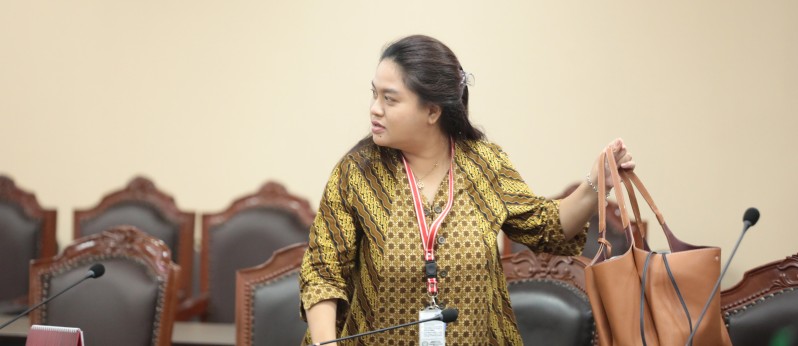
Petitioner’s legal counsel for the judicial review of the Criminal Court leaving the Courtroom after attending the Preliminary Hearing to examine the petition, Monday (26/1/2026). Photo by MKRI/IlhamWM.
Jakarta (MKRI) - For the umpteenth time, Law No. 1 of 2023 on the Criminal Code is being materially reviewed before the Constitutional Court (MK). An advocate named Zico Leonard Djagardo Simanjuntak is challenging Article 100, Article 218 paragraphs (1) and (2), Article 219, Article 237 letters b and c, Article 240 paragraph (1), Article 241 paragraph (1), Article 256, Article 302 paragraph (1), Article 411 paragraph (2), Article 433 paragraph (3) and Article 434 paragraph (2), as well as Article 509 letters a and b of the new Criminal Code. The preliminary hearing in Case No. 29/PUU-XXIV/2026 was held in the Constitutional Court’s panel courtroom. The hearing was chaired by Constitutional Court Deputy Chief Justice Saldi Isra together with Justices Ridwan Mansyur and Arsul Sani on Monday, January 26, 2026.
The Petitioner, represented by legal counsel Priskila Oktaviani, argued that Article 100 of the Criminal Code, as a unified norm, fails to meet the requirements of clarity and precision mandated by Article 28J paragraph (2) of the 1945 Constitution. The a quo provision uses phrases that are not normatively defined, namely “sense of remorse”, “hope for self-improvement”, and “commendable conduct and behaviour”, without providing conceptual boundaries, objective indicators, or measurable assessment mechanisms.
The lack of clarity, she said, renders the resulting restriction of rights incalculable and unpredictable. In the context of limiting a right that touches on the right to life, this vagueness constitutes a serious constitutional defect because it opens the door to arbitrary and discriminatory interpretation. She added that, even in technical regulations that should comprehensively govern the evaluation mechanism for the behaviour of death-row inmates during the probation period, the Criminal Code provides only a general framework, without operational guidance on behavioural indicators, assessment criteria, or the authority responsible for carrying out the evaluation. This uncertainty risks inconsistent implementation and creates room for subjectivity that could harm either the convict or the public.
Consequently, Article 100 of the Criminal Code as a whole does not satisfy the requirement of being “prescribed by law in clear terms” as required by Article 28J paragraph (2) of the 1945 Constitution, and thus the rights-restricting effect of the a quo norm lacks constitutional legitimacy.
“Furthermore, the Petitioner also considers that Article 256 of the Criminal Code fails to uphold demonstrations as an essential element in nation-building and carries a potential chilling effect. In essence, Article 256 can criminalize demonstrations themselves. Therefore, it is deemed incompatible with the principles of a democratic state as guaranteed by the 1945 Constitution,” Priskila explained.
Touchstone
Concerning the challenged provisions, Justice Arsul Sani advised the Petitioner regarding overlap with previous cases and suggested that Article 100 be excluded from this petition to avoid redundancy.
“In this petition, Article 100 consists of six paragraphs, so its designation should be made consistent. Will you be challenging the entire article or only certain paragraphs? The most frequently corrected issue concerns how the articles are cited,” Justice Arsul said.
Deputy Chief Justice Saldi added that, if the Petitioner wishes to proceed, several aspects must be refined, such as posita that are not reflected in the petitum, so that the petition can be made more precise. “This is to avoid ambiguities. The Petitioner must also ensure which provisions on insulting the Government are at issue and, in our view, should focus only on specific norms. Identify which norms will be challenged; for example, if you take a thematic approach, there are nine norms being reviewed here, so if there is only one ground of review, you must provide nine separate explanations, especially if there are two or more bases of review. Set out each conflict one by one,” Deputy Chief Justice Saldi said.
At the close of the hearing, Deputy Chief Justice Saldi stated that the Petitioner has 14 days to revise the petition. The revised petition must be submitted to the Court by Monday, February 9, 2026, at 12.00 Western Indonesian Time, after which the Court will schedule a second hearing to examine the main points of the revised petition.
Case tracking: Petition No. 29/PUU-XXIV/2026 (in Indonesian)
Author: Sri Pujianti
Editor: Lulu Anjarsari P.
PR: Andhini S.F.
Translator: Rizky Kurnia Chaesario
Disclaimer: The original version of the news is in Indonesian. In case of any differences between the English and the Indonesian versions, the Indonesian version will prevail.
Monday, January 26, 2026 | 16:07 WIB 103