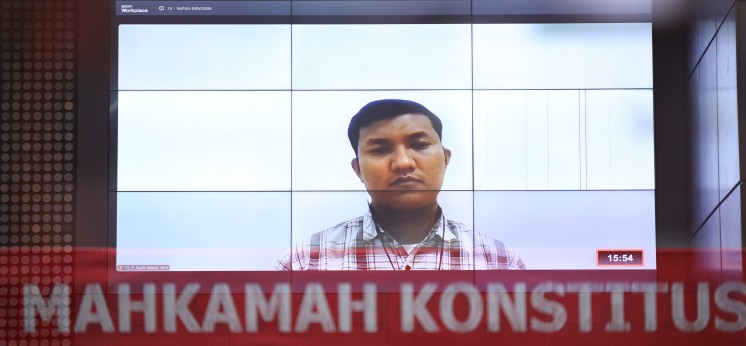
Petitioner Syah Wardi attending the material judicial review hearing of Law No. 22 of 2009 on Road Traffic and Transport on Thursday (22/1) online. Photo by MKRI/Ifa.
Jakarta (MKRI) - The Constitutional Court (MK) held a preliminary hearing on Petition No. 13/PUU-XXIV/2026 on a material judicial review of Law No. 22 of 2009 on Road Traffic and Transport (Traffic Law) against the 1945 Constitution on Thursday, January 22, 2026. The petition was filed by Syah Wardi, who challenges the constitutionality of Article 106 paragraph (1), particularly the phrase “full concentration”, and Article 283 of the Traffic Law.
Article 106 of the Traffic Law imposes an obligation on motor vehicle drivers to operate their vehicles reasonably and with full concentration, while Article 283 provides criminal sanctions for violations of this obligation.
Article 106 paragraph (1) states, “Every person driving a motor vehicle on the road must drive the vehicle reasonably and with full concentration.” Article 283 states, “Every person driving a motor vehicle on the road unreasonably and engaging in other activities or being influenced by a condition that disrupts concentration while driving as referred to in Article 106 paragraph (1) shall be subject to imprisonment for up to 3 (three) months or a fine of up to Rp750,000.00 (seven hundred and fifty thousand rupiah).”
At the hearing, the Petitioner, appearing online, argued that as a citizen and active road user, he finds the “full concentration” requirement in Article 106 paragraph (1) to lack clear limits. In his view, the norm is abstract and open to multiple interpretations, creating potential legal uncertainty and inconsistent enforcement.
“This norm has serious implications because traffic is a high-risk public space directly related to the right to life, the right to security, and the right to legal certainty,” the Petitioner told the Panel of Justices.
In essence, the Petitioner requested that the Court declare Article 106 paragraph (1) conditionally unconstitutional unless it is explicitly interpreted to mean that the obligation to drive reasonably and with full concentration absolutely prohibits any conduct that endangers the safety, health, and comfort of other road users, including smoking while operating a motor vehicle.
He argued that the phrase “full concentration” remains too general and fails to provide legal certainty, and that the absence of an explicit ban on smoking while driving is a concrete example of a normative gap. He pointed out that smoking while driving is potentially dangerous because it requires the driver to release one hand from the steering wheel and creates risks of distraction from ash, embers, or cigarette butts.
Regarding Article 283, the Petitioner asked the Court to declare it conditionally unconstitutional unless interpreted to require the imposition of the maximum fine and prison sentence on offenders who smoke while driving. He also proposed that the article be construed to include additional sanctions, such as community service (e.g., street cleaning) or the temporary revocation of driving licences.
According to the Petitioner, the current criminal sanctions in Article 283 do not create a sufficient deterrent effect, do not adequately protect the right to life, and are inconsistent with the traffic law’s objective of ensuring road safety and security.
In response, Justice Daniel Yusmic P. Foekh advised the Petitioner to consult Constitutional Court Regulation No. 7 of 2025 on Procedures in Constitutional Review of Law (PMK 7/2025), which is available on the Court’s website, as it sets out the structure for filing petitions in material and formal review cases.
The Panel granted the Petitioner 14 days to revise the petition. The improved petition must be received by the Constitutional Court no later than Wednesday, February 4, 2026, at 12.00 Western Indonesian Time.
Case tracking: Petition No. 13/PUU-XXIV/2026
Author: Utami Argawati.
Editor: N. Rosi
PR: Raisa Ayuditha Marsaulina.
Translator: Rizky Kurnia Chaesario
Disclaimer: The original version of the news is in Indonesian. In case of any differences between the English and the Indonesian versions, the Indonesian version prevails.
Thursday, January 22, 2026 | 18:55 WIB 145