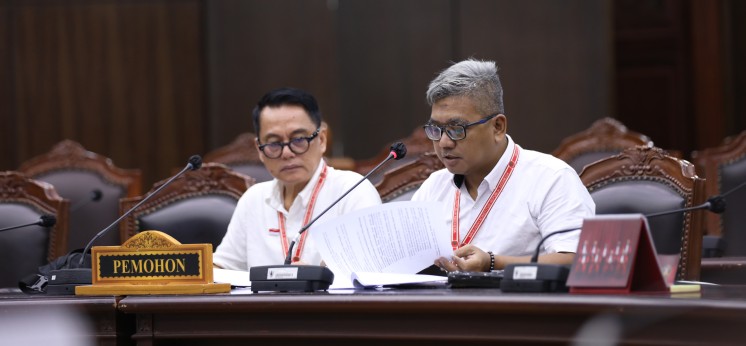
The representatives of the Petitioner of Case No. 16/PUU-XXIV/2026 at the preliminary hearing for the material judicial review of the Mineral and Coal Mining Law, Wednesday (1/22/2026). Photo by MKRI/Ifa.
JAKARTA (MKRI) — An NGO called Lembaga Swadaya Masyarakat (LSM) Pro Rakyat (lit. Pro-People) has filed a material judicial review petition of Article 4 paragraphs (2) and (3), Article 35 paragraph (1), Article 46 paragraph (1), Article 47, Article 92, Article 162, Article 168, and Article 169A of Law No. 3 of 2020 on the Amendment to Law No. 4 of 2009 on Mineral and Coal Mining (Minerba Law) before the Constitutional Court. The Petitioner is represented by chairman Aqrobin A. M., secretary Johan Alamsyah, and treasurer Fitri Nur Asiah Kesuma.
“The Petitioner’s constitutional losses can be remedied through the strengthening of the state’s role as the primary manager of natural resources, the reopening of space for public participation, and the protection of community rights and the environment,” said secretary Johan, who appeared before the Court alongside chairman Aqrobin, at the preliminary hearing for Petition No. 16/PUU-XXIV/2026 on Thursday, January 22, 2026.
The Petitioner argued that the challenged provisions of the Mineral and Coal Mining Law are in violation of Article 33 paragraphs (2), (3), and (4), Article 28H paragraph (1), and Article 28D paragraph (1) of the 1945 Constitution. Article 33 paragraphs (2) and (3) of the 1945 Constitution affirm that branches of production that are important to the State and that affect the livelihood of the people at large, as well as land, water, and the natural resources contained therein, must be controlled by the state and utilized to the greatest extent for the prosperity of the people.
However, Article 4 paragraphs (2) and (3) of the Mineral and Coal Mining Law instead narrow the meaning of the “state” to the Central Government alone. Moreover, these provisions limit the role of the State merely to the issuance of administrative permits, thereby directly contradicting the constitutional interpretation of state control.
The Petitioner also believe Articles 35 through 47 create liberalization of the mineral and coal mining sector by granting long-term certainty and dominance to large corporations. Furthermore, they view Articles 7 and 8 as potentially leading to the criminalization of citizens who seek to defend their rights to a healthy environment and their sources of livelihood.
In the petitums, the Petitioner requested the Court to declare the challenged provisions conditionally unconstitutional and not legally binding insofar as they are interpreted as limiting the role of the State solely to that of an administrative licensing authority. The Petitioner also asked the Court to declare these norms unconstitutional insofar as they are not interpreted to mean that the State is obliged to act as an active manager of mining activities.
The petition was heard by a panel consisting of Chief Justice Suhartoyo (chief) and Constitutional Justices Daniel Yusmic P. Foekh and M. Guntur Hamzah. In his advice, Justice Foekh stated that the Petitioner must demonstrate that the three individuals representing it are authorized to file the petition before the Constitutional Court in accordance with the organization’s articles of association and bylaws.
“Furthermore, in this regard, the Petitioner must also present comprehensive arguments concerning the existence of the norms a quo. If possible, these should be elaborated with reference to relevant theories, principles, or doctrines so as to persuade the justices,” he said.
Before adjourning the session, Chief Justice Suhartoyo announced that the Petitioner would have 14 days to revise the petition. The revised softcopy or hardcopy of the petition must have been received by the Court no later than 12:00 WIB on Wednesday, February 4, 2026.
Explore case No. 16/PUU-XXIV/2026 (in Indonesian).
Author : Mimi Kartika
Editor : Lulu Anjarsari P.
PR : Adriana Airlia Yusrin
Translator : Yuniar Widiastuti (NL)
Disclaimer: The original version of the news is in Indonesian. In case of any differences between the English and the Indonesian versions, the Indonesian version will prevail.
Thursday, January 22, 2026 | 17:11 WIB 130