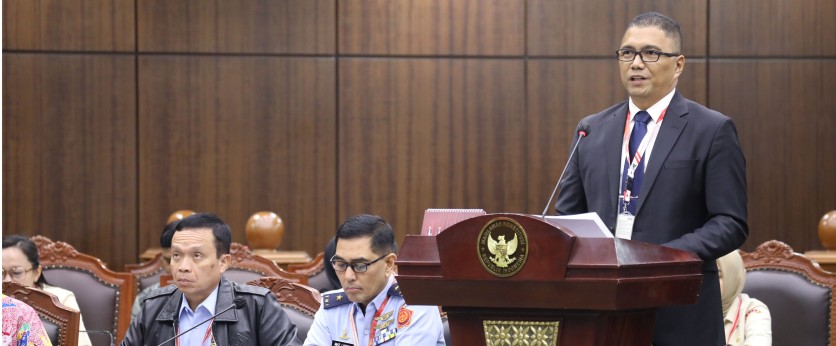
DPR Expert Fritz Edward Siregar delivering his testimony at a judicial review hearing on Law No. 3 of 2025 on the Indonesian National Armed Forces (TNI Law). Thursday (1/22/2026). Photo by MKRI/Panji.
JAKARTA (MKRI) — The Constitutional Court (MK) held another hearing on the material judicial review of Law No. 3 of 2025 on the Amendment to Law No. 34 of 2004 on the Indonesian National Armed Forces (TNI) and Law No. 34 of 2004 on the Indonesian National Armed Forces (TNI) on Thursday (1/22/2026). The fifth hearing for Case No. 197/PUU-XXIII/2025 was held to hear testimonies from House of Representatives (DPR) Expert Fritz Edward Siregar; Government/Presidential Experts I Gde Pantja Astawa and Achmad Redy; as well as Government/Presidential Witnesses Edy Prasetyono and Kresno Guntoro.
Fritz Edward Siregar explained that Article 30 paragraph (3) of the 1945 Constitution mandates the TNI to defend, protect, and preserve the integrity and sovereignty of the state. This constitutional mandate indicates that the function of the TNI is not confined to conventional warfare alone, but also encompasses broader state protection functions across a wider spectrum of threats. Such an understanding, he noted, is consistent with modern international legal doctrines that recognize national defense as extending beyond traditional armed conflict.
Accordingly, the involvement of the TNI in military operations other than war (OMSP), including in the cyber domain, is intended to safeguard the state against strategic threats without undermining the principle of civilian supremacy in law enforcement. Furthermore, the deployment of TNI personnel within the National Narcotics Agency (BNN) is designated as strategic capacity support for the state in specific areas requiring military expertise, including intelligence, logistics, and operations in border regions vulnerable to smuggling. This involvement is complementary in nature and does not place the TNI as the primary executor of criminal law enforcement. TNI personnel assigned to the BNN operate in coordination with civilian institutions and remain under the authority of the BNN leadership.
“Likewise, the placement of TNI personnel in certain structural positions, particularly those related to the function of the Deputy Attorney General for Military Crimes, is intended to maintain the coherence of the prosecution system within the framework of the principle of a single and integrated prosecution system. This is necessary to effectively and efficiently handle connectivity cases involving both civilian and military legal subjects,” Fritz stated.
Dual Accountability Mechanism
With regard to Article 47 paragraph (3) of the TNI Law, Fritz observed the existence of a dual accountability mechanism, whereby the assigned personnel are accountable to the leadership of the civilian institution in which they serve, while at the same time remaining subject to military law and discipline. This dual accountability mechanism ensures that deployed TNI personnel cannot act independently, but must comply with the directives of the civilian institution’s leadership in accordance with applicable laws.
He further explained that the transitional provision under Article 74 of the TNI Law ensures that, during the process of drafting a new military justice law, law enforcement against TNI personnel can continue to operate under the existing legal framework, namely Law No. 31 of 1997. This approach ensures that legal reform is conducted in a planned manner, avoids legal vacuums, and remains consistent with the rule of law, which requires all government actions to be grounded in clear and predictable legal norms.
“The norms under review in Case No. 197/PUU-XXIII/2025 reflect a constitutional design intended to manage the state’s defense apparatus in a robust, controlled, and accountable manner within the framework of a state governed by the rule of law,” Fritz concluded.
Presidential Authority
During the hearing, I Gde Pantja Astawa explained that the phrase “in accordance with needs” in Article 53 paragraph (4) of Law No. 3 of 2025 constitutes the full authority of the President to determine whether such needs exist. This consideration serves as the basis for the President’s decision on whether to extend the special retirement age limit for four-star generals, a matter that falls entirely within the President’s discretionary power.
“Thus, the provision of Article 53 paragraph (4) of Law No. 3 of 2025 is closely related to the President’s discretionary authority as a holder of state administrative office, both in issuing Presidential Decrees of a beschikking nature and in assessing whether the extension of the special retirement age for four-star generals is necessary,” Pantja explained.
Philosophy of National Defense
Achmad Redy emphasized that, philosophically, the existence of the TNI cannot be separated from the concepts of state sovereignty and national security. Article 30 paragraph (3) of the 1945 Constitution positions the TNI as a state instrument tasked with defending, protecting, and preserving the integrity and sovereignty of the nation. In Indonesia’s constitutional tradition, the concept of national defense is comprehensive and cannot be narrowly understood as merely conventional military defense. The total defense and security system (Sishankamrata) adopted by Indonesia recognizes that threats to the state arise not only from external military aggression, but also from various non-military threats that may disrupt national stability and sovereignty.
Accordingly, he continued, in a democratic state, the concept of national defense supports civilian supremacy as a fundamental principle, placing the military fully under civilian control. This philosophy aims not only to prevent abuses of power by the military, but also to ensure that national defense policies align with the will of the people as represented by the civilian government.
“The concept of national defense is comprehensive in nature. It is not limited to conventional military defense, but also encompasses various forms of threats that require measured and proportional responses,” said Redy, a lecturer in the Doctoral Program of Law at Borobudur University, Jakarta.
Debate on OMSP
Government Witness Edy Prasetyono explained three key issues: OMSP, the placement of TNI personnel outside TNI institutions, and the extension of the retirement age. During the initial deliberations of the TNI Law in 2003–2004 and subsequent discussions on OMSP provisions, debates emerged over whether OMSP should be detailed into specific operational items or merely categorized in a more flexible manner. Such categorization could include disaster management operations, humanitarian assistance, support for government duties, security operations, and international peacekeeping missions.
“However, it was ultimately agreed in the TNI Law that OMSP would be specified in various forms of operations. I need to emphasize that the spirit of the OMSP provisions is that all such operations must be carried out based on decisions of political authorities, except in emergency situations, such as disasters, that require swift action to rescue victims. I have consistently emphasized this in academic studies, in the DPR, and in various ministries and agencies,” Edy stated.
Involvement of Active-Duty Personnel
In his testimony, Government/Presidential Witness Kresno Guntoro stated that the issue of TNI duties reflects an effort to clearly and firmly separate defense and security concepts. “The issue that arose at the time was whether the types of military involvement should be explicitly and limitatively stipulated, or regulated in general terms. Ultimately, it was agreed that the types of involvement would be set out in a limitative manner, while the details would be further regulated in lower-level laws and through political decisions of the state,” Kresno explained.
Regarding the involvement of active-duty TNI personnel in ministries/agencies or other institutions, he noted that such arrangements had already been regulated under earlier legislation, namely Law No. 2 of 1988 on Soldiers, which was later followed up by Government Regulation No. 15 of 2001 on the Transfer of Status of TNI and National Police Members to Civil Servants for Structural Positions.
As additional information, Case No. 197/PUU-XXIII/2025 was filed by the Initiative for Participatory Society for a Just Transition (Imparsial/Petitioner I), the Indonesian Legal Aid Foundation (YLBHI/Petitioner II), the Commission for the Disappeared and Victims of Violence (KontraS/Petitioner III), the Alliance of Independent Journalists of Indonesia (Petitioner IV), and the Jakarta Legal Aid Institute for Women (LBH APIK Jakarta/Petitioner V). The petition was also submitted by three individual citizens: Ikhsan Yosarie (Petitioner VI), Mochamad Adli Wafi (Petitioner VII), and Muhammad Kevin Setio Haryanto (Petitioner VIII).
At the Court’s first hearing on Tuesday (11/4/2025), the Petitioners argued that Article 7 paragraph (2) letter b numbers 9 and 15; Article 7 paragraph (4); Article 47 paragraph (1); Article 53 paragraph (2) letters b, c, d, and e; Article 53 paragraph (4); and Article 74 paragraphs (1) and (2) of the TNI Law are contrary to the 1945 Constitution. They contended, among others, that the TNI’s OMSP duties to assist regional government tasks contradict Article 28E paragraph (3) and Article 28D paragraph (1) of the Constitution, and that the inclusion of the phrase “communal conflict” potentially deviates from the established legal regime on social conflict management, thereby threatening citizens’ constitutional rights.
The Petitioners also argued that the TNI’s role in addressing cyber defense threats under OMSP is inconsistent with Article 30 paragraph (3) and Article 28D paragraph (1) of the Constitution, asserting that cyber defense should fall entirely within the scope of military operations of war. Furthermore, they emphasized the need for DPR involvement in decisions on OMSP as a preventive measure against potential abuse of power by the President as the supreme commander of the Armed Forces, similar to the decision-making mechanism for military operations of war.
Author : Sri Pujianti
Editor : N. Rosi
PR : Raisa Ayuditha Marsaulina
Translator : Yuanna Sisilia
Disclaimer: The original version of the news is in Indonesian. In case of any differences between the English and the Indonesian versions, the Indonesian version will prevail.
Thursday, January 22, 2026 | 17:21 WIB 97