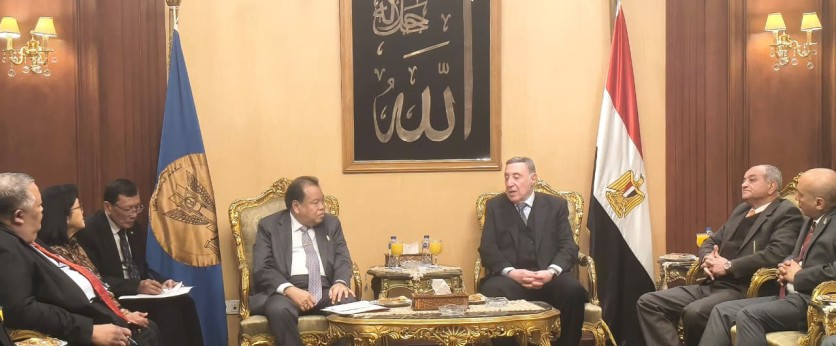
Justice Arief Hidayat meeting the President of the Egyptian Constitutional Court, Boulos Fahmy Iskandar, during an official visit on Monday (1/19/2026). Photo: MKRI
KAIRO (MKRI) – A delegation from the Constitutional Court of the Republic of Indonesia (MKRI) met with the leadership of the Supreme Constitutional Court of Egypt in Cairo on Monday, January 19, 2026. The meeting, led by Constitutional Justice Arief Hidayat, marked an important milestone in strengthening bilateral diplomatic relations in constitutional justice.
The President of the Supreme Constitutional Court of Egypt, Boulos Fahmy Iskandar, welcomed the Indonesian delegation. Also present at the meeting were Vice President Adel Omar Sherif, Vice President Muhammad Imad Al-Naggar, and Chairman of the Board of Commissioners, Emad El-Bishry.
The main agenda of the meeting was to explore cooperation between the two institutions, including Indonesia's support for Egypt's hosting of the World Conference on Constitutional Justice (WCCJ) in 2028. Boulos Fahmy warmly welcomed this commitment. "We greatly appreciate Indonesia's support. The success of the 2022 WCCJ in Bali is an inspiration for us," he said.
Indonesia's appreciation also came from two constitutional justices who had been Egyptian delegates to the WCCJ congress in Bali: Abdel Aziz Mohamed Salman and Tarek Abdel Gawad Shabl. Both openly stated that the congress in Bali far exceeded expectations, even being considered better organized than other WCCJ congresses.
This testimony seems to strengthen Egypt's commitment to collaborating with Indonesia in preparations for the 2028 WCCJ. Boulos Fahmy then asked the Indonesian Constitutional Court to open a space for intensive communication in preparation for the congress in Egypt. He also expressed his desire to draft a Memorandum of Understanding (MoU) with the Indonesian Constitutional Court to cover legal development and the exchange of judicial knowledge.
The meeting also featured an in-depth discussion on the functions and authorities of each court. The two sides exchanged views on several landmark decisions on human rights within the framework of a modern rule of law.
Justice Arief Hidayat took the opportunity to present the proposed theme for the 2028 WCCJ Congress. He assessed that the world is facing major, intertwined challenges, including digital transformation, geopolitical tensions, and the climate crisis, and no country can address them alone.
"We propose the theme 'Justice Beyond Borders: Constitutional Supremacy for a Better World.' Constitutional justice knows no national boundaries. Constitutional courts around the world have a shared responsibility to create a better world," said Justice Arief.
He also extended an official invitation to Boulos Fahmy and the justices to visit Indonesia. The reciprocal visit is expected to provide an opportunity to share experiences, particularly in Islamic law and zakat, where Egypt excels.
Interest in Joining the AACC
During the meeting, which lasted approximately two hours, a surprise came when Boulos Fahmy openly expressed the Egyptian Court's interest in joining the Association of Asian Constitutional Courts and Equivalent Institutions (AACC). This desire was not without merit. Boulos Fahmy admitted to being impressed by the active participation of constitutional courts across Asia in various global activities, both in the WCCJ forum and other international events.
He explained that, geographically, Egypt has the right to join the AACC, as the Sinai Peninsula (part of Egyptian sovereignty) lies on the Asian continent. Although the Supreme Constitutional Court currently serves as the Permanent Secretariat of the Union of Arab Constitutional Courts and Councils (UACCC) and as a member of the Conference of Constitutional Jurisdictions of Africa (CCJA), it still seeks to become part of the Association of Asian Constitutional Courts.
In response, the Indonesian Constitutional Court, as the Permanent Secretariat of the AACC, welcomed this interest. Justice Arief stated Indonesia's readiness to facilitate communication and coordination with the President of the Association and AACC member countries.
Visit to the Indonesian Embassy in Cairo
The previous day, Saturday, January 18, 2026, the Indonesian Constitutional Court delegation also paid a working visit to the Indonesian Embassy (KBRI) in Cairo. The delegation was received directly by the Charge d'Affaires ad Interim (KUAI), M. Zaim A. Nasution.
During the meeting, Zaim affirmed the Indonesian Embassy's full support for the MKRI's judicial diplomacy agenda. He stated that the relationship between Indonesia and Egypt has been strong since the era of President Soekarno, and that cooperation in constitutional justice will further strengthen the bonds between the two nations.
"We are ready to ensure that all planned cooperation runs smoothly," said Zaim.
The MKRI's meeting with the Supreme Constitutional Court of Egypt marks a new chapter in the Indonesia-Egypt relationship, which dates back to 1947. Two nations with deep historical roots are now growing closer through constitutional diplomacy. Also participating as delegates from the Constitutional Court of Indonesia were Immanuel Hutasoit (Head of the Permanent Secretariat of the AACC and Foreign Cooperation), Hasri Puspita Ainun (Head of the Foreign Cooperation Subdivision), and Muh. Radhi Zhafari (Constitutional Justices Secretariat).
Author : HPA-NL
Editor : Lulu Anjarsari P.
Translator : N. Valentino Rahadityo (Rizky Kurnia Chaesario)
Disclaimer: The original version of the news is in Indonesian. In case of any differences between the English and the Indonesian versions, the Indonesian version will prevail.
Thursday, January 22, 2026 | 07:57 WIB 693