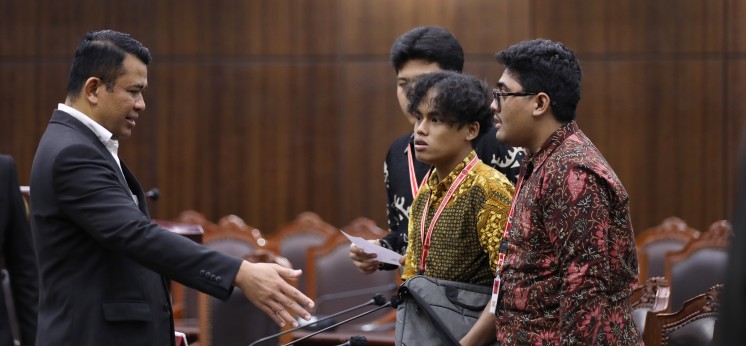
The Petitioners entering the courtroom for the judicial review of Law No. 20 of 2025 on the Criminal Procedure Code, Wednesday (1/21/2025). Photo by MKRI/Ifa.
JAKARTA (MKRI) — The Constitutional Court held the preliminary hearing for the material judicial review of Law No. 20 of 2025 on the Criminal Procedure Code (KUHAP) against the 1945 Constitution on Wednesday, January 21, 2026.
The Case No. 10/PUU-XXIV/2026 was filed by Fatur Rizqi Ramadhan alongside his two fellow university students. They challenge several provisions of the new Criminal Procedure Code (KUHAP), which they argue could potentially violate the principles of a state governed by the rule of law and threaten citizens’ constitutional rights in the criminal justice process.
At the hearing chaired by Chief Justice Suhartoyo, Fatur explained that Article 22 paragraph (1) of the KUHAP grants investigators the authority to summon or visit a person to obtain information without first determining that person’s legal status as either a witness or a suspect. The Petitioners believe this provision opens the possibility of examinations being conducted without certainty as to legal status.
As a result, the individual has not had the right to legal counsel, because they have not been formally designated as a suspect. “This is contrary to the principle of due process of law. Consequently, the constitutional rights of the Petitioners, as referred to in the provision a quo, are potentially violated from the very early stage of the criminal process,” he stated.
The Petitioners also challenge Article 32 point 32 of the KUHAP, which defines arrest as being based on a minimum of two pieces of evidence. They argued that this norm emphasizes only the quantitative aspect of evidence, without providing clarity regarding its quality or probative strength. Such a condition, they stressed, may lead to arbitrary arrests and fails to provide adequate protection for individual liberty.
In addition, they question Article 60 paragraph (3) and Article 65 letter c, which regulate the authority to extend detention through coordination between investigators and public prosecutors. They believe this mechanism could result in detention being carried out without judicial control from the outset, thereby failing to position judges as the authority determining the deprivation of a person’s liberty. This, they argued, is inconsistent with the principle of judicial control as part of the guarantee of human rights protection.
Furthermore, the Petitioners contended that Article 7 paragraph (1) letter j and Article 24 paragraph (2) grant authority to terminate investigations based on reasons that lack objective standards, including through restorative justice mechanisms. They believe these norms excessively broaden investigators’ discretion, thereby potentially giving rise to impunity, injustice, and the disregard for the principle of equality before the law.
Based on all of these arguments, the Petitioners requested the Constitutional Court to declare Article 22 paragraph (1), Article 32 point 32, Article 60 paragraph (3), Article 65 letter c, Article 7 paragraph (1) letter j, and Article 24 paragraph (2) of Law No. 20 of 2025 on the Criminal Procedure Code conditionally unconstitutional and not legally binding.
Responding to the petition, Constitutional Justice Daniel Yusmic P. Foekh advised the Petitioners to carefully observe the Constitutional Court Regulations (PMKs) in drafting their petition so that it conforms to the applicable format. “Each point needs to be clearly elaborated. This relates to Constitutional Court Regulation No. 7 of 2025,” he stated.
Justice Foekh also suggested that the Petitioners study the Court’s previous decisions, particularly those concerning the fulfillment of legal standing. “Please elaborate in greater detail to demonstrate the alleged constitutional harm, whether it is actual or potential,” he said.
The panel of justices gave the Petitioners 14 days to revise the petition, which must be received by the Court no later than 12:00 WIB on Tuesday, February 3, 2026.
Explore case No. 10/PUU-XXIV/2026 (in Indonesian).
Author : Utami Argawati
Editor : N. Rosi
PR : Fauzan F.
Translator : Yuniar Widiastuti (NL)
Disclaimer: The original version of the news is in Indonesian. In case of any differences between the English and the Indonesian versions, the Indonesian version will prevail.
Wednesday, January 21, 2026 | 18:24 WIB 381