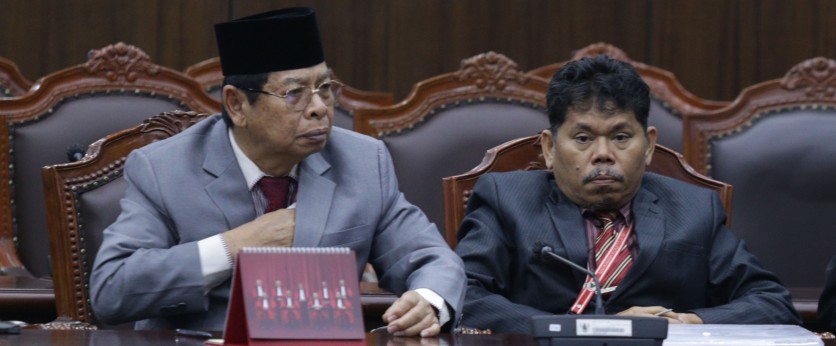
Petitioner attending the Decision Pronouncement Hearing of Case No. 216/PUU-XXIII/2025, Monday (19/1/2026). Photo by MKRI/Bay.
Jakarta (MKRI) – The Constitutional Court (MK) ruled that it could not accept the petition for judicial review of Article 169 letter r of Law No. 7 of 2017 on General Elections as amended by Law No. 7 of 2023. The petition was submitted by Bonatua Silalahi.
The hearing for Decision No. 216/PUU-XXIII/2025 was held at the Constitutional Court on Monday (19/1/2026). The hearing was presided over by Chief Justice Suhartoyo, with seven other Justices in attendance.
In its legal considerations, the Court stated that the Petitioner's petition was not structured in accordance with the systematic structure of a petition for judicial review of a law. The Court found that the petition for judicial review of the law contained additions or new structures in the form of an unusual statement of facts.
In addition, the norm being challenged is deemed incomplete and does not fully reflect the provisions of Article 169 letter r of the General Election Law. The petitioner was also deemed to have failed to provide adequate constitutional arguments regarding the conflict between the norm being tested and the 1945 Constitution of the Republic of Indonesia. According to the Constitutional Court, the petitioner focused more on describing specific events than on explaining the constitutional conflict between the norms.
“The Petitioner did not set out sufficient and convincing arguments for the Constitutional Court regarding any contradiction between the norm being challenged for its constitutionality and the constitutional grounds in the 1945 Constitution of the Republic of Indonesia. In this case, the Petitioner mostly elaborated on concrete events related to the norm being challenged,” Deputy Chief Justice Saldi said as he read out the Court’s legal considerations.
The Court also stated that it did not understand the Petitioner’s intention in setting this norm against Law No. 43 of 2009 on Archives and the 2023 Regulation of the Head of the National Archives of the Republic of Indonesia on Guidelines for the Authentication of Static Archives, because they were not clearly linked to the constitutional review grounds under the articles of the 1945 Constitution. In addition, the Court considered that the Petitioner’s claims in points 4, 5, and 6 were formulated in an unusual manner, making them difficult to comprehend in the context of a judicial review of a law.
Based on these considerations, the Court concluded that there was a lack of precision in the drafting of the petition, resulting in ambiguity between the basis of the petition (posita) and the reliefs sought (petitum), as regulated in Article 30 letter a and Article 31 paragraph (1) of the Constitutional Court Law, as well as Article 10 paragraph (3) and Article 36 paragraph (1) of Constitutional Court Regulation No. 7 of 2025. Therefore, the Court declared the Petitioner’s application to be vague, or obscuur.
Also read:
Verification of Candidates for Public Office Academic Certificates on the General Election Law Questioned
Petitioner Asks for Factual Authentication of Presidential Candidates’ Educational Certificates
During the first hearing, Bonatua Silalahi questioned the absence of an obligation to authenticate the original certificate of public official candidates in prevailing laws and regulations. He contended that the regulation only requires the submission of legalized copies of certificates. Meanwhile, the Election Commission’s (KPU) authority to clarify the real certificate is optional, as indicated by the use of the phrase “may” or “if necessary”.
The Petitioner explained that the norms in Article 18 paragraph (1) letter m and Article 19 paragraph (2) of the KPU Regulation (PKPU) No. 19 of 2023 jo. PKPU No. 23 of 2023 and Article 9 paragraph (1) letter m and Article 17 paragraph (2) of the PKPU No. 13 of 2010, treat public official candidates differently from those of ordinary citizens. He noted that in various public administrations, from job applications to university submissions, professional certifications, and legal processes such as notarization, people must present original certificates when submitting legalized copies.
In manpower practice, several institutions hold job seekers’ original certificates as administrative verification to ensure the authenticity of the documents. However, according to the Petitioner, candidates for public office, such as the president, regional heads, and members of parliament, are not required to present original certificates and may submit legalized copies without the KPU's factual verification.
In his petitum, the Petitioner requested the Court to declare Article 169 letter r of the General Election Law to be conditionally unconstitutional. The Petitioner asked that the provision be interpreted to require that educational certificates or documents used as a requirement for the presidential candidacy must be authenticated by the Election Commission and/or by the Indonesian National Archive or Local Archive, based on their respective authorities. The authentication result must then be documented as the State’s Authentic Archive.
Case tracking: Petition No. 216/PUU-XXIII/2026 (in Indonesian)
Decision No. 216/PUU-XXIII/2026 (in Indonesian)
Author: Utami Argawati
Editor: Nur R.
Translator: Rizky Kurnia Chaesario
Disclaimer: The original version of the news is in Indonesian. In case of any differences between the English and the Indonesian versions, the Indonesian version will prevail.
Monday, January 19, 2026 | 13:13 WIB 73