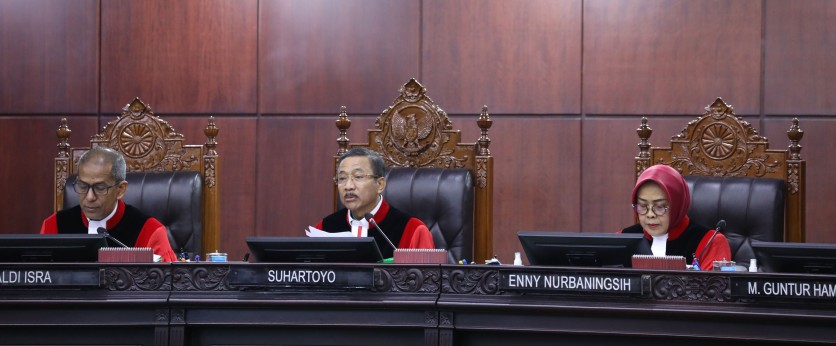
The constitutional justices at the ruling hearing for the judicial review of No. 20 of 2003 on the National Education System for case No. 248/PUU-XXIII/2025, Monday (1/19/2026). Photo by MKRI/Panji.
JAKARTA (MKRI) — The Constitutional Court declared the material judicial review petition of Law No. 20 of 2003 on the National Education System (Sisdiknas Law) against the 1945 Constitution filed by Beryl Hamdi Rayhan inadmissible. The Petitioner challenged provisions of the national education curriculum on the grounds that they have not adequately regulated environmental education as a compulsory component of the education system.
The ruling hearing for Decision No. 248/PUU-XXIII/2025 took place on Monday, January 19, 2026. At the hearing, Chief Justice Suhartoyo explained that after carefully examining the petition, the Court had found that the Petitioner’s evidence in the form of a letter lacked a stamp duty, rendering it null and void.
Article 7 paragraph (3) of the Constitutional Court Regulation (PMK) No. 7 of 2025 on the procedure for judicial review requires that documentary evidence be affixed with stamp duty in accordance with the applicable statutory regulations. In addition, the petition failed to satisfy the formal requirements for filing a judicial review petition.
“Whereas, although the Constitutional Court has the authority to adjudicate the petition a quo, due to the petition’s failure to meet the formal requirements for submission, the Court did not proceed to further consider the Petitioner’s petition,” stated the chief justice when reading out the legal considerations.
Also read:
Petitioner Seeks to Make Environmental Education a Compulsory Subject
Petitioner Absent from Second Hearing of Law on National Education System
At the preliminary hearing, the Petitioner argued that the current primary and secondary education curricula do not sufficiently provide students with knowledge and awareness regarding the importance of protecting the environment. Accordingly, he requested that the Constitutional Court require environmental education to be made a compulsory subject within the national curriculum.
He believed that environmental education is essential to raising public awareness of issues such as climate change, environmental sustainability, biodiversity conservation, waste management, and waste reduction. In addition, making the subject compulsory is expected to foster environmentally-friendly behavior among students and to improve the overall quality of life of society.
The Petitioner also proposed that environmental education also be made compulsory at the higher education level. He believed higher education institutions play a strategic role in producing human resources with strong environmental awareness who are prepared to face global challenges.
Moreover, he requested that career and entrepreneurship courses be designated as compulsory subjects in higher education. This, he contended, is important to enhance students’ entrepreneurial skills and to better align graduates with the needs of industry and the labor market.
Explore Case No. 248/PUU-XXIII/2025 (in Indonesian).
Author : Utami Argawati
Editor : Nur R.
Translators : Yuniar Widiastuti (NL)
Disclaimer: The original version of the news is in Indonesian. In case of any differences between the English and the Indonesian versions, the Indonesian version will prevail.
Monday, January 19, 2026 | 11:16 WIB 120