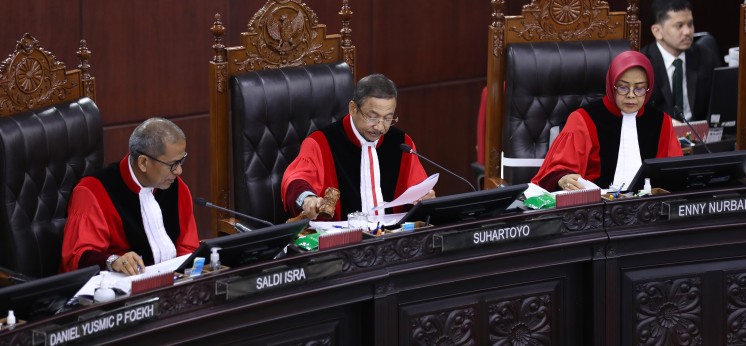
Chief Justice Suhartoyo leading the Decision Pronouncement Hearing on the judicial review of Law No. 20 of 2011 on Apartment, Monday (19/01). Photo by MKRI/Ifa.
Jakarta (MKRI) - The Constitutional Court (MK) has partially granted a petition for judicial review of Law No. 20 of 2011 on Apartments (Apartment Law). The petition was filed by PT Pasaraya International Hedonisarana, the developer of Menara Sentraya in Kebayoran Baru, South Jakarta. The company challenged the constitutionality of Article 50 of the Apartment Law, arguing that it creates a legal vacuum regarding the use of apartments for non-residential or commercial purposes.
The pronouncement of Decision Number 198/PUU-XXIII/2025 was delivered in a hearing at the Constitutional Court on Monday, January 19, 2026. The session was chaired by Chief Justice Suhartoyo, accompanied by seven other constitutional justices.
In its legal considerations, the Court held that the use of apartment units for non-residential purposes, such as condotels or other business models, is not entirely consistent with the definition of an apartment under the Apartment Law. Philosophically, the law positions the primary function of flats as housing or residential dwellings. Therefore, if the Court were to interpret Article 50 by directly adding a “non-residential” function as requested by the Petitioner, such an interpretation would risk creating disharmony within the norms of the Apartment Law.
The Court underlined that apartments with a non-residential function have so far been accommodated only in mixed-use buildings, namely as a combination of residential and non-residential apartments. However, the absence of clear regulation on the use of non-residential apartments risks causing greater constitutional harm to citizens, particularly regarding the certainty of ownership rights and the utilization of apartment units.
The legal vacuum is also seen as potentially having a negative impact on economic balance and development. Such constitutional harm and negative impacts will persist as long as there is no legislation specifically regulating apartments with non-residential functions.
According to the Court, this legal vacuum concerning the use of non-residential apartments is not solely caused by the absence of the phrase “non-residential” in Article 50 of the Apartment Law. It also arises because there is no single provision in the entire law that specifically regulates the management mechanisms and requirements for using apartments with such a function.
“The absence of such a norm has resulted in a legal vacuum that violates the principle of fair legal certainty with respect to the rights inherent in the use of apartments with a non-residential function,” Justice Enny Nurbaningsih said while reading out the Court’s legal considerations.
Regulation within a Maximum of Two Years
The Court held that this legal vacuum must be addressed by providing a specific interpretation of Article 50 of the Apartment Law. For the time being, that provision can serve as a legal basis to cover the use of apartments with a non-residential function until a separate law is enacted or the Apartment Law is amended to add a special chapter regulating such use.
The Court then interpreted Article 50 of the Apartment Law to read: “the use of apartments with a non-residential function shall be regulated by or in a law.” This interpretation is intended to reaffirm the Court’s position as previously stated in Constitutional Court Decision Number 62/PUU-XX/2022, given that the legislature has yet to follow up on that ruling.
The Court found that the absence of regulation has created legal uncertainty that may conflict with Article 1 paragraph (3) and Article 28D paragraph (1) of the 1945 Constitution of the Republic of Indonesia. Therefore, in order to realize fair legal certainty and prevent negative impacts on the economy, the Court ordered the legislature to formulate rules on apartments with a non-residential function no later than two years from the pronouncement of this decision.
With these considerations, the Court declared that the Petitioner’s arguments regarding Article 50 of the Apartment Law causing legal uncertainty are well-founded in law in part.
Also read:
PT Pasaraya Challenges Apartment Law in Constitutional Court
PT Pasaraya Revises Petition on the Apartment Law Review
The Petitioner explained that Menara Sentraya Building is a commercial apartment tower developed by PT Pasaraya International Hedonisarana on an 8,605-square-meter plot based on Land Use Certificate (HGB) No. 01616. The project broke ground in 2012 and has been marketed since 2013 under a joint-ownership scheme. Of 263 total apartment units, 107 have been sold, while 156 remain under the developer’s control.
The petitioner stated that sales transactions between developers and buyers are formalized in Sale and Purchase Binding Agreements (PPJBs), which guarantee legal certainty regarding shared ownership of common elements and land, using the Proportional Comparison Value (NPP) as the basis. However, required government approvals for unit delineation and separation deed – prerequisites for issuing Strata Title Certificates (SHM Sarusun) – have yet to be obtained.
“The Petitioner cannot obtain a valid Strata Title Certificate for an apartment unit – SHM Sarusun – which constitutes recognized legal proof of ownership,” Christine stated.
The Petitioner argued that this obstacle exists because Article 50 of the Apartment Law only governs residential and mixed-use apartments, and does not accommodate non-residential projects, such as Menara Sentraya. As a result, the developer is unable to complete the paperwork for SHM Sarusun, leading to legal uncertainty and potential constitutional harm for both the company and its buyers.
The Petitioner contended that the provision risks causing a range of harms, including the potential for breach-of-contract suits from consumers, declining business credibility, and the loss of the ability for unit owners to use their apartments as collateral. According to the Petitioner, these problems underscore unequal regulatory enforcement, as local authorities previously approved delineation for other commercial apartments, such as Menara Pertiwi and Sinar Mas Land Plaza Sudirman, through a 2021 Jakarta Governor’s Decree.
The Petitioner believed that the absence of clear statutory guidance contravenes Article 28D, paragraph (1), and Article 1, paragraph (3), of the 1945 Constitution, which guarantee legal certainty and the rule of law. On that basis, PT Pasaraya International Hedonisarana requested that the Court declare Article 50 of the Apartment Law unconstitutional insofar as it fails to address non-residential apartments.
Case tracking (in Indonesian)
Decision No. 198/PUU-XXIII/2025 (in Indonesian)
Author: Utami Argawati
Editor: N. Rosi.
PR: Raisa Ayuditha Marsaulina.
Translator: Rizky Kurnia Chaesario
Disclaimer: The original version of the news is in Indonesian. In case of any differences between the English and the Indonesian versions, the Indonesian version will prevail.
Monday, January 19, 2026 | 15:58 WIB 109