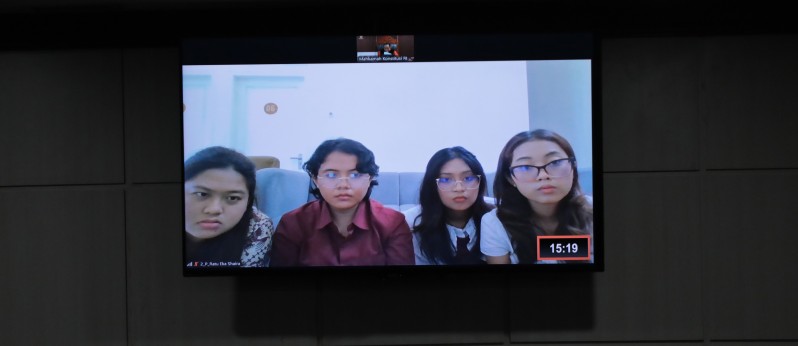
The Petitioners listening to the panel’s advice at the preliminary hearing for the judicial review of the Criminal Procedure Code, Monday (1/19/2026). Photo by MKRI/Ilham W. M.
JAKARTA (MKRI) — Two citizens, Lina and Sandra Paramita (Petitioners I and II, respectively), have filed a petition for judicial review of Article 16, Article 19 paragraph (1), Article 22 paragraph (1), and Article 23 paragraph (5) of Law No. 20 of 2025 on the Criminal Procedure Code (KUHAP) to the Constitutional Court. The preliminary hearing for Petition No. 2/PUU-XXIV/2026 on Monday, January 19, 2026 was presided over Deputy Chief Justice Saldi Isra alongside Constitutional Justices Ridwan Mansyur and Asrul Sani.
At the hearing, the Petitioners, represented by counsel Gusti Putu Agung Cinta Arya Diningrat, argued that the provisions of Article 16, Article 19 paragraph (1), Article 22 paragraph (1), and Article 23 paragraph (5) of the KUHAP are contrary to the principle of equality before the law as guaranteed by Article 27 paragraph (1) of the 1945 Constitution of the Republic of Indonesia. That constitutional provision affirms that all citizens are equal before the law and government, without exception.
“This provision grants rights and protection only to the reporting party by obliging the Investigator or Inquirer to issue a receipt for the report or complaint to the reporting party, without providing an equivalent guarantee of rights to the reported party to be informed, to be heard, or to defend themselves at the same stage. As a result, the reported party is placed in a highly disadvantageous position because they do not have access to the same information as the reporting party. All of these conditions, in a real and fundamental manner, violate and undermine the principle of equality before the law as guaranteed by Article 27 paragraph (1) of the 1945 Constitution of the Republic of Indonesia,” they stated.
The Petitioners also challenge Article 16 paragraph (1) of the KUHAP, which provides that an investigation “may be conducted,” inter alia, through interviews. They believe the use of the term “may” is facultative and lacks clear standards or conditions as to when and to whom interviews should be conducted. This situation, they stressed, allows investigators to have discretion that could potentially give rise to unequal treatment between the reporting party and the reported party from the very outset of case handling.
“In the case a quo, the interview provision as referred to in Article 16 paragraph (1) of the KUHAP was in fact not implemented with respect to [us]. In the absence of any interview process, [we] were never given the opportunity to provide information, clarification, or an initial defense regarding the reported incident. Nevertheless, [we] suddenly received notification that the case had been escalated to the investigation stage. Such practice demonstrates that the norm a quo has been applied in a manner that disregards its own purpose of legal protection,” the Petitioners explained.
In addition, they argued that Article 16 paragraph (1) of the KUHAP fails to regulate, in a limitative manner or at least minimally, the subjects to be interviewed at the investigation stage. This lack of clarity, they emphasized, allows an investigation to rely solely on one-sided statements from the reporting party, without any normative obligation to hear statements from the reported party or other parties of interest. As a consequence, the reported party may lose an early opportunity to provide clarification.
The Petitioners further highlighted Article 19 paragraph (1) of the KUHAP, which grants investigators the authority to conduct a case presentation to determine whether an event constitutes a criminal offense. Although such authority is acknowledged, the Petitioners argued that the absence of regulation regarding the mechanism and the parties involved in the case presentation may render the process internal and closed, without participation by or notification to either the reporting party or the reported party.
Furthermore, the Petitioners pointed to a lack of synchronization between the KUHAP and Regulation of the Chief of Police No. 6 of 2019 concerning the implementation of case presentations. In practice, such inconsistency is deemed often resulting in closed case presentations that do not involve the reported party, thereby giving rise to unequal legal treatment.
The Petitioners also contended that Article 22 paragraph (1) of the KUHAP, which grants investigators the authority to summon or visit a person in order to obtain information, could potentially create legal uncertainty and inequality if it is not accompanied by clear limitations and procedures.
On the basis of these arguments, the Petitioners requested the Court to declare the articles under review unconstitutional and not legally binding insofar as they are not interpreted as “in a fair and balanced manner in accordance with the principle of equality before the law.”
In response to the petition, Constitutional Justice Ridwan Mansyur advised the Petitioners to further elaborate, sharpen, and substantiate their legal standing and their posita (reason behind the petition). “To prove [legal standing] and to ensure that the posita are truly well-founded, your explanations should be more complete and more elaborated, so that later the petitums, its points, will become more precise in line with what has been set out,” he explained.
The panel of justices gave the Petitioners 14 days to revise the petition, which must be re-submitted no later than 12:00 WIB on February 2, 2026.
Explore case No. 2/PUU-XXIV/2026 (in Indonesian).
Author : Utami Argawati
Editor : N. Rosi
Translator : Yuniar Widiastuti (NL)
Disclaimer: The original version of the news is in Indonesian. In case of any differences between the English and the Indonesian versions, the Indonesian version will prevail.
Monday, January 19, 2026 | 19:55 WIB 226