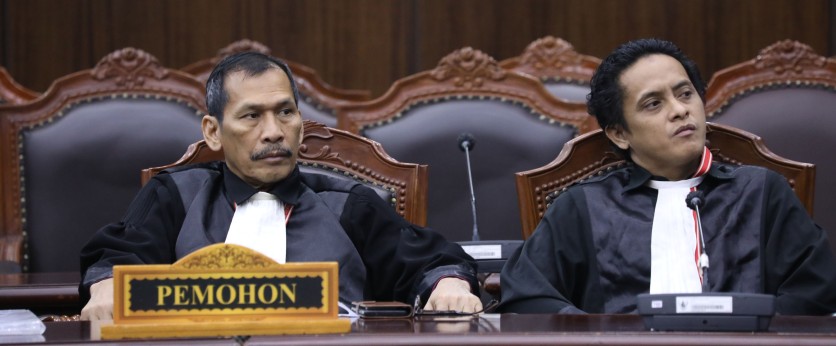
Petitioner Komardin (left) attending the ruling hearing for the judicial review of Law No. 8 of 1981 on the Criminal Procedure Code. Monday (1/19/2026). Photo by MKRI/Panji.
JAKARTA (MKRI) — The Constitutional Court (the Court) ruled Petition No. 204/PUU-XXIII/2025 concerning the material judicial review of Article 5 of Law No. 8 of 1981 on the Criminal Procedure Code (KUHAP) inadmissible. The Court held that the grounds of the petition (posita) and the petitum as presented by the Petitioner were unclear or vague (obscuur).
“There is a lack of precision in the drafting of the a quo petition which results in ambiguity and inconsistency between the arguments set forth in the grounds of the petition (posita) and the petitum, as required under Article 30 letter a and Article 31 paragraph (1) of the Constitutional Court Law, as well as Article 10 paragraph (3) and Article 36 paragraph (1) of Constitutional Court Regulation No. 7 of 2025,” said Deputy Chief Justice Saldi Isra while delivering the ruling at the plenary hearing on Monday (1/19/2026).
In the Court’s legal considerations, Saldi explained that the Petitioner’s posita failed to elaborate on the alleged contradiction between the challenged norm and the constitutional provisions used as the basis of review. The Petitioner also did not provide adequate arguments as to how the norms contained in Article 5 of the KUHAP contradict Article 28H paragraph (2), Article 28I paragraph (1) and paragraph (5), as well as Article 28J paragraph (2) of the 1945 Constitution.
Furthermore, petitum items 2, 3, and 4 indicate that the object of the review is Article 5 of the KUHAP. However, Article 5 of the KUHAP consists of two paragraphs, with paragraph (1) further divided into letters a and b, each of which is detailed into several sub-points.
Petitum items 2 and 3, which are accompanied by different conditional formulations, request different standards of constitutionality with respect to the same norm, namely Article 5 of the KUHAP. Meanwhile, petitum item 4 seeks to maintain the applicability of Article 5 of the KUHAP, whereas the spirit underlying petitum items 2 and 3 is to declare the same norm unconstitutional.
“Accordingly, there is no doubt for the Court to conclude that the Petitioner’s petition is unclear or vague, or obscuur,” Saldi stated.
Also read:
Advocate Revises Petition on Absence of Time Limit for Criminal Investigation
Advocate Challenges Absence of Time Limit for Criminal Investigation
For information, the petition was filed by an advocate and entrepreneur named Komardin. He argued that the provision in question does not stipulate a time limit for inquiry and investigation processes, nor does it provide sanctions on investigators who fail to perform their duties in a timely manner. As a result, according to the Petitioner, he has suffered losses because the report he filed regarding an alleged criminal offense has remained unresolved for years.
In his petitum, the Petitioner requested the Court to declare Article 5 of the KUHAP contrary to Article 28H paragraph (2), Article 28I paragraph (1) and paragraph (5), and Article 28J paragraph (2) of the 1945 Constitution insofar as it does not regulate time limits for inquiry and investigation, nor sanctions against investigators who fail to conduct such processes within the prescribed time frame; to declare Article 5 of the KUHAP as having no binding legal force insofar as it is not interpreted to mean that “inquiry and investigation must be completed within a reasonable, proportional, and accountable period of time, and that investigators who intentionally or negligently fail to conduct inquiry or investigation within such period shall be subject to administrative, disciplinary, or other sanctions in accordance with statutory laws and regulations”; and to order the lawmakers to further regulate time limits for inquiry and investigation as well as sanctions against investigators in the law, while declaring that Article 5 of the KUHAP remains applicable insofar as it is interpreted in accordance with the aforementioned meaning.
Author : Mimi Kartika
Editor : Lulu Anjarsari P.
PR : Raisa Ayuditha M.
Translator : Yuanna Sisilia
The full ruling: Decision of Case No. 204/PUU-XXIII/2025
Disclaimer: The original version of the news is in Indonesian. In case of any differences between the English and the Indonesian versions, the Indonesian version will prevail.
Monday, January 19, 2026 | 13:06 WIB 71