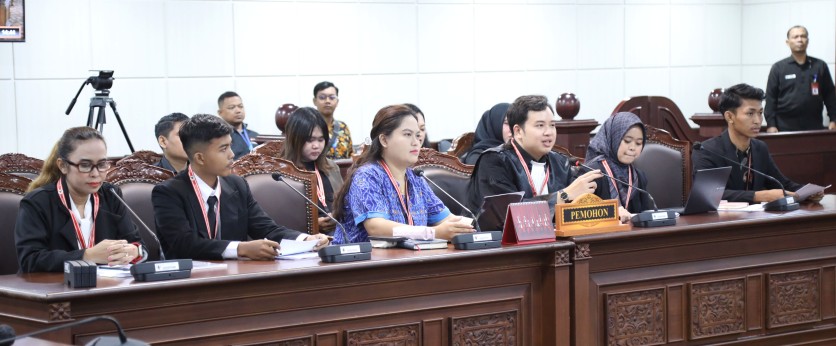
Petitioners’ legal counsel attending the preliminary hearing on the judicial review of Law No. 1of 2023 on the Criminal Code, delivering the main points of the petition, Wednesday (14/1/2026). Photo by MKRI/Panji.
Jakarta (MKRI) - Eleven students from the Universitas Terbuka Law Program filed a petition for judicial review of Article 411 paragraph (2) of Law No. 1 of 2023 concerning the Criminal Code (KUHP) to the Constitutional Court (MK). According to the Petitioners, the article being challenged creates a chilling effect on personal life because the Petitioners are afraid to engage in consensual intimate relationships outside of legal marriage for fear that their parents or children will report them.
“The ambiguity of Article 411 paragraph (2) of the Criminal Code has a chilling effect on academic freedom and clearly violates the Petitioners' rights to self-development and communication,” said Valentina Ryan M during the Preliminary Hearing of Petition No. 280/PUU-XXIII/2025 on Wednesday, January 14, 2026 in the Constitutional Court's courtroom in Jakarta.
In addition to Ryan, other petitioners include Susi Lestari, Vendy Setiawan, Kristin Karlina, Luciana Ary Sibarani, Sopyan Haris, Nur Jannatul Ma'wa, Yeren Limone, Priski Haryadi, Pungky Juniver, and Retno Wulandari. They consider Article 411 paragraph (2) of the Criminal Code is contrary to Article 28B paragraph (1), Article 27 paragraph (1), Article 28C paragraph (1), Article 28D paragraph (1), and Article 28G paragraph (1) of the 1945 Constitution of the Republic of Indonesia.
Article 411 paragraph (1) of the Criminal Code states that “Any person who commits sexual intercourse with someone who is not their husband or wife shall be punished for adultery with a maximum imprisonment of 1 year or a maximum fine of category II.” This is followed by paragraph (2), which reads: “The criminal offense referred to in paragraph (1) shall not be prosecuted unless a complaint is filed by: a. The husband or wife of a person who is married; b. The parents or children of a person who is not married.”
According to the Petitioners, Article 411 paragraph (2) of the Criminal Code creates a paradoxical and distressing situation because the state denies them access to the right to legal marriage, but at the same time criminalizes their personal relational and sexual lives through this article, which prohibits sexual relations outside of legal marriage. The Petitioners contend that the state simultaneously prevents them from marrying and punishes them for not doing so.
They say that this is a fundamental contradiction and violates the principle of legal justice. In this context, Article 411 paragraph (2) of the Criminal Code is a form of punishment for situations that are not entirely within the control of the person concerned.
The Petitioners continue, Article 411 paragraph (2) of the Criminal Code creates a different complaint system depending on the marital status of the individual and provides unequal legal treatment based on marital status and family relationships without adequate rational justification. For married persons, adultery can be reported by the husband or wife, while for unmarried persons, adultery can be reported by parents or children.
According to the Petitioners, unmarried people are more vulnerable to criminalization because there are more parties with the authority to report them. Parents or children report the private sexual activities of adults who are legally independent without any clear relationship of harm.
The Petitioners also argued that the article criminalizes consensual sexual relations and cohabitation without strong justification based on the harm principle and creates a disproportionate chilling effect that contradicts the Constitutional Court's precedent regarding the limits of state intervention in the private sphere. Therefore, in their petition, the Petitioners request the Court to declare Article 411 paragraph (2) of the Criminal Code to be contrary to the 1945 Constitution of the Republic of Indonesia and to have no binding legal force.
This petition was heard by a Panel of Justices led by Deputy Chief Justice Saldi Isra, accompanied by Justices Ridwan Mansyur and Arsul Sani. During the advisory session, Justice Ridwan stated that the Petitioners had not elaborated on the grounds or reasons for the petition in sufficient detail.
“I think that when linked to the petition, it is not yet connected. Try to look at it again, especially the inclusion of the source, and also to further convince the Court that what you have described is indeed based on fact, and that the posita and the petitum are indeed connected,” said Justice Ridwan.
Before closing the hearing, Deputy Chief Justice Saldi said that the Petitioners had 14 days to revise their petition. Both soft copy and hard copy of the revised petition must be received by the Court no later than Tuesday, January 27, 2026, at 12:00 p.m. Western Indonesian Time. (*)
Auhtor: Mimi Kartika
Editor: Lulu Anjarsari P.
PR: Fauzan Febriyan
Translator: Rizky Kurnia Chaesario
Disclaimer: The original version of the news is in Indonesian. In case of any differences between the English and the Indonesian versions, the Indonesian version will prevail.
Wednesday, January 14, 2026 | 16:16 WIB 1522