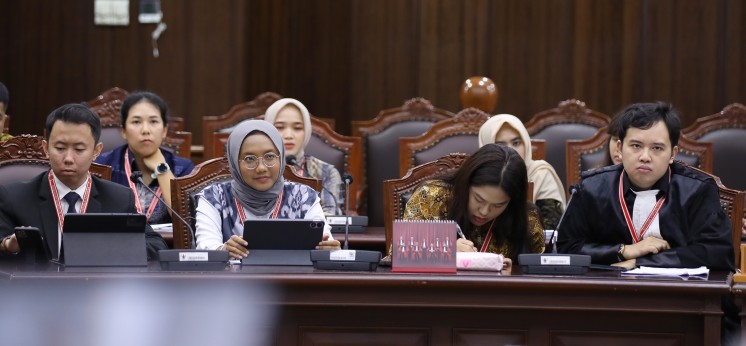
The Petitioners challenging Law No. 1 of 2023 on Criminal Code attending the preliminary hearing alongside their counsels, Tuesday (1/13/2026). Photo by MKRI/Ifa.
JAKARTA (MKRI) — Twelve Indonesian citizens have filed a petition for judicial review of Article 218 paragraphs (1) and (2) of Law Number 1 of 2023 on the Criminal Code (Kitab Undang-Undang Hukum Pidana, KUHP) with the Constitutional Court (MK). The Petitioners argue that the provisions contravene the 1945 Constitution of the Republic of Indonesia (UUD NRI 1945), particularly the constitutional guarantees of freedom of expression, equality before the law, and legal certainty.
The preliminary hearing for Case No. 275/PUU-XXIII/2025 took place on Tuesday, January 13, 2026 and presided over by Chief Justice Suhartoyo, accompanied by Constitutional Justices Daniel Yusmic P. Foekh and M. Guntur Hamzah.
The Petitioners are Afifah Nabila Fitri, Dimas Fathan Yuda Armansyah, Farhan Dwi Saputra, Feony Gita Safitri, Idham Hakim, Inka Sofia Rahayu, Merry Hana Nathalina, Olivia Jane, Rina Amelia Ika Saputra, Siti Rohmah, Suryadi, and Tjhin Okky Graswi (Petitioners I-XII).
During the hearing, counsel Tandya Adyaksa argued that Article 218 of the Criminal Code places the president and vice president in a legal position that is not equal to that of other citizens. According to the Petitioners, this treatment is inconsistent with Article 27 paragraph (1) of the 1945 Constitution, which guarantees equality before the law.
The Petitioners further contended that Article 218 paragraphs (1) and (2) of the Criminal Code, which prohibit acts deemed to “attack the honor or dignity of the president or the vice president,” could potentially restrict freedom of opinion and expression as guaranteed under Article 28E paragraphs (2) and (3), as well as Article 28F of the 1945 Constitution. They argued that the provision creates a fear effect within society, discouraging citizens from expressing criticism, opinions, or other forms of expression in the public sphere.
The Petitioners also criticized the exception set out in Article 218 paragraph (2) of the Criminal Code, which provides that an act is not punishable if committed in the public interest or in self-defense. They argued that this exception fails to provide legal certainty because it is ambiguous and open to multiple interpretations. As a result, it does not eliminate fear, particularly among journalists, academics, activists, and the general public, when conveying criticism of the president and/or the vice president.
Furthermore, the Petitioners asserted that Article 218 of the Criminal Code creates unequal legal treatment by affording special criminal-law protection to the president and/or the vice president. Such preferential treatment, they argued, is contrary to the principle of equality before the law as enshrined in Article 27 paragraph (1) of the 1945 Constitution.
The Petitioners also recalled that, through Decision No. 013-022/PUU-IV/2006, the Constitutional Court had previously annulled provisions on insults against the president in the old Criminal Code. In their view, Article 218 of the new Criminal Code effectively revives these norms, which had already been declared unconstitutional, albeit with modified wording.
Moreover, the Petitioners argued that Article 218 of the Criminal Code impedes the right to communication and information, thereby contravening Article 28F of the 1945 Constitution. The provision was also said to carry the risk of criminalizing citizens, including in the context of academic discourse, scholarly publications, and evaluative discussions of government policies.
From the perspective of legal certainty, the Petitioners maintained that the phrase “attacking the honor or dignity” is abstract and subjective, and therefore fails to satisfy the lex certa principle in criminal law. Accordingly, they requested the Court to declare Article 218 paragraphs (1) and (2) of the Criminal Code unconstitutional and not legally binding.
In response to the petition, Constitutional Justice Daniel Yusmic P. Foekh advised the Petitioners to strengthen their arguments concerning constitutional harm, particularly by clarifying whether such harm is actual or potential. “This needs to be reinforced—whether the harm is actual or potential. Each Petitioner should elaborate on whether their alleged harm is actual or potential, or whether it applies to all of them,” he emphasized.
The panel of justices gave the Petitioners 14 days to revise the petition, which must be received by the Court no later than January 27, 2026.
Explore case No. 275/PUU-XXIII/2025 (in Indonesian).
Author : Utami Argawati
Editor : Lulu Anjarsari P.
PR : Fauzan Febriyan
Translators : Yuniar Widiastuti (NL)
Disclaimer: The original version of the news is in Indonesian. In case of any differences between the English and the Indonesian versions, the Indonesian version will prevail.
Tuesday, January 13, 2026 | 17:35 WIB 2304