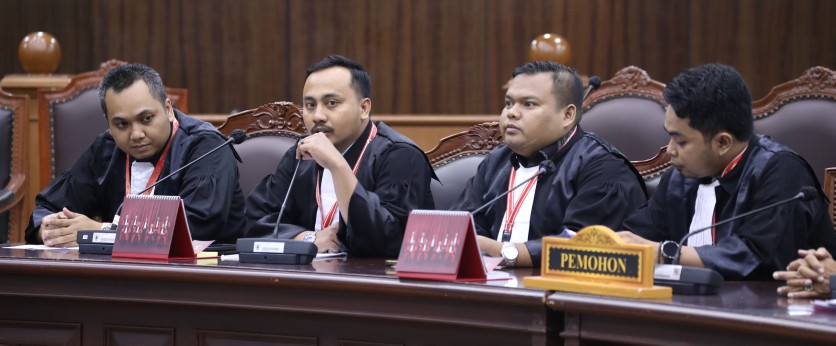
The Petitioners’ counsels delivering the petition merits at the preliminary hearing for the material judicial review of the Teacher-Lecturer Law, Monday (1/12/2026). Photo by MKRI/Panji.
JAKARTA (MKRI) — The Constitutional Court held the preliminary hearing for Case No. 277/PUU-XXIII/2025 on Monday, January 12, 2026. Chief Justice Suhartoyo chaired the panel with Constitutional Justices Daniel Yusmic P. Foekh and M. Guntur Hamzah as members.
The petition was filed by lecturer Rega Felix, researcher/activist A. Fahrur Rozi, and university student Arga Prianggara. They challenge several provisions in Law No. 11 of 2019 on the National Science and Technology System (Sisnas Iptek Law) and Law No. 14 of 2005 on Teachers and Lecturers, which they believe has led to legal uncertainty and discrimination against researchers, especially of social sciences.
According to the Petitioners, research outputs from the social sciences are not recognized as a basis for innovation because they are restricted by norms in the Sisnas Iptek Law. As a result, the Petitioners do not have access to innovation incentives or guarantees of sustainable welfare. This condition, they argued, has rendered their constitutional right to benefit from science and technology as well as special treatment ineffective.
The Petitioners argued that limiting basic research solely to natural phenomena is contrary to the 1945 Constitution. The Elucidation to Article 34 paragraph (3) letter a of the Sisnas Iptek Law restricts basic research to those that explain or predict natural phenomena. In fact, Article 1 points 2 and 6 of the same Law recognizes science and research as encompassing both natural and social phenomena.
“This limitation is legally problematic because it is systemically inconsistent. The Elucidation to Article 34 paragraph (3) letter a in fact narrows the meaning of basic research and contradicts its parent norm,” said Sipghotulloh Mujaddidi, counsel for the Petitioners.
Furthermore, the Petitioners contended that the provision is discriminatory against social sciences and humanities. This restriction causes research in the fields of law, language, religion, and the humanities not to be recognized as a basis for innovation. They believe this to be contrary to Article 28H paragraph (2) of the 1945 Constitution, which guarantees special treatment in order to achieve substantive justice.
As a result, there is unequal legal treatment between researchers of natural sciences and social sciences in terms of access to innovation and invention incentives when, in fact, both are equally guaranteed the right to develop science and technology as stipulated in Article 31 paragraph (5) of the 1945 Constitution.
The Petitioners also highlighted the lack of state support for individual researchers and for the development of rare fields of knowledge. This, they stressed, is a non-retrogression in the fulfillment of the right to education and the development of science, thus is contrary to Article 31 paragraphs (4) and (5) of the 1945 Constitution.
In addition, the Petitioners challenge Article 59 paragraph (1) of the Teacher and Lecturer Law, which they believe do not clearly affirm the state’s obligation to allocate funding for the development of rare fields of knowledge through the State Budget (APBN). They maintained that the absence of such regulation has created a legal vacuum that results in the non-fulfillment of constitutional rights in the field of education.
In their petition, the Petitioners also advocated a paradigm shift in research from being institution-based to researcher-based. They argued that the provisions in the Sisnas Iptek Law still place incentives on institutions rather than on researchers as the primary subjects of innovation, in contrast to practices in several developed countries.
Based on all of the foregoing arguments, the Petitioners requested that the Constitutional Court declare the phrase “Basic Research, Applied Research, and Development” in Article 34 paragraph (3) letter a; the word “natural” in the Elucidation to Article 34 paragraph (3); Article 57 paragraph (2); and the Elucidation to Article 57 paragraph (2) of the Sisnas Iptek Law conditionally unconstitutional and not legally binding.
In response to the petition, Constitutional Justice Daniel Yusmic P. Foekh provided several pieces of advice to the Petitioners to strengthen their legal standing. “Each Petitioner may have different losses,” he stated.
In addition, he also requested that the Petitioners further clarify the causal relationship between the challenged norms and the alleged constitutional losses.
The panel gave the Petitioners 14 days to revise the petition, which must be received by the Court no later than 12:00 WIB on Monday, January 26, 2026.
Explore case No. 277/PUU-XXIII/2025 (in Indonesian).
Author : Utami Argawati
Editor : Lulu Anjarsari P.
PR : Fauzan Febriyan
Translators : Yuniar Widiastuti (NL)
Disclaimer: The original version of the news is in Indonesian. In case of any differences between the English and the Indonesian versions, the Indonesian version will prevail.
Monday, January 12, 2026 | 17:01 WIB 94