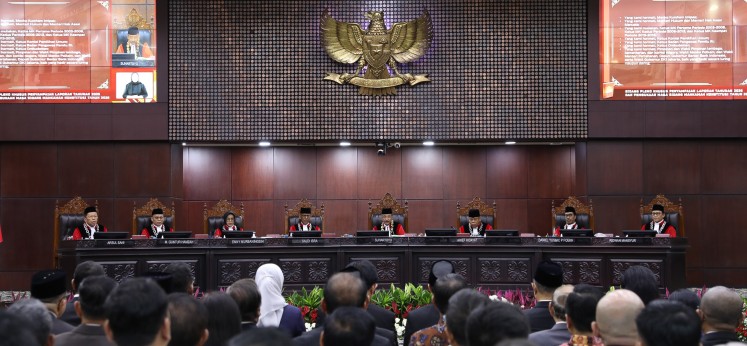
Court holding a Special Plenary Hearing on the 2025 Performance Report in the Courtroom on Wednesday (1/7/2026). Photo by MKRI/Ifa.
In order to open the 2026 hearing and submit the annual report, Court held a Special Plenary Hearing with the agenda of Delivering the 2025 Court Annual Report, which was attended by a number of invitees.
JAKARTA (MKRI) – The Constitutional Court (MK) understands that public trust is the primary foundation of the judiciary. This trust can only be maintained through consistency, transparency, accountability, and integrity
"We are also grateful that public trust in the Constitutional Court is quite high and continues to increase. Based on a Kompas Research and Development survey in November 2025, the Court achieved a public trust rating of 72.4%. We believe that public trust is the Court's primary asset in examining, adjudicating, and deciding various constitutional cases. Therefore, we remain committed to maintaining this public trust," said Chief Justice Suhartoyo in a Special Plenary Hearing on the agenda of delivering the Constitutional Court's 2025 Annual Report and opening the 2026 Constitutional Court Hearing.
The Plenary Hearing was held on Wednesday, January 7, 2026, in the Plenary Courtroom of the Court in Jakarta. The Special Plenary Hearing was held in a hybrid format, both in-person and online, with the participation of state institution leaders and the Court's domestic and international partners. The public could also follow the proceedings live on the mkri.id website and the Constitutional Court's YouTube channel.
In his remarks, Chief Justice Suhartoyo stated that throughout 2025, the Court faced significant dynamics and challenges, along with the increasing intensity of case handling. The surge in petitions, particularly regarding Regional Head Election Results Disputes (PHPU) and Judicial Review (PUU), demonstrates the Court's continued importance at the heart of Indonesia's democracy and constitutional life.
According to Chief Justice Suhartoyo, this situation aligns with the mandate of the 1945 Constitution of the Republic of Indonesia, which affirms Indonesia as a state based on the rule of law with sovereignty vested in the people. Within this framework, the Court has a fundamental and strategic role and position as an exercise of judicial power in upholding the constitution and safeguarding democracy. However, Chief Justice Suhartoyo emphasized that the Court does not work alone in realizing constitutional supremacy. The Indonesian constitutional system divides authority proportionally among the executive, legislative, and judicial branches of government, which work together synergistically while upholding the principle of checks and balances.
In carrying out its duties as guardian and interpreter of the constitution, as well as protector of citizens' constitutional rights, the Court consistently upholds judicial independence as a non-negotiable principle. Throughout 2025, Chief Justice Suhartoyo continued, the Court will continue to strive to close the door to intervention and ensure that every decision is based on legal considerations based on constitutional values and principles. He also emphasized that the law should not be a tool of power, but rather a means to deliver justice. The Court is committed to making the 1945 Constitution of the Republic of Indonesia a living constitution that is relevant in addressing contemporary legal issues.
Case Handling
Chief Justice Suhartoyo further explained that, in its 22 years of existence, the Court has handled 4,747 petitions, resulting in a total of 4,644 decisions, or 97.83 percent of its total. Of these decisions, 2,160 were judicial review decisions, 30 were disputes over the authority of state institutions (SKLN), 984 were PHPU cases, and 1,470 were PHPU cases involving regional head election disputes. Based on the decisions, 569 petitions were granted, 1,823 were rejected, 1,745 were declared inadmissible, 355 were withdrawn, 107 were dismissed, and 45 were declared without jurisdiction. To handle all these cases, the Court has held 13,065 hearings.
Meanwhile, throughout 2025, the Court handled 701 petitions/cases, consisting of 366 judicial reviews, 334 regional head dispute resolution disputes (PHPU), and 1 foreign dispute resolution (SKLN). Of these, 598 cases were decided. The handling of judicial review cases in 2025 set a record high in the Court's history, with nearly 300 petitions registered in a single year.
"This surge in the number of petitions not only reflects an increased workload, but also indicates growing citizen awareness of the need to fight for their constitutional rights, supported by the ease of legal procedures and the use of information technology at the Court," Chief Justice Suhartoyo said.
Furthermore, the total number of judicial review petitions decided in 2025 was the highest compared to previous years, at 263. Based on the rulings, 33 were granted, 87 were rejected, 96 were declared inadmissible, 42 were withdrawn, and 5 were declared null and void.
In the same year, the Court held 2,163 hearings for three jurisdictions: PUU (Judicial Review), SKLN (State Organs Dispute Resolution), and PHPU (Election Dispute). Despite the surge in cases, the Court managed to increase the speed of PUU petition resolution, with an average time of 69 working days, compared to 71 working days the previous year.
In handling the 2024 Regional Head Election Dispute Settlement (PHPU), Court emphasized that it will not only focus on procedural fairness but also comprehensively consider all evidence and hearing facts to achieve substantive justice. Throughout 2025, 334 2024 Regional Head Election Dispute Settlement (PHPU) cases were recorded across 250 regions, with 27 cases granted, including decisions ordering administrative improvements, revotes, and even disqualification of candidate pairs in several regions.
"The annulment of the election results was generally caused by, among other things, the status of convicts and former convicts, the invalidity of diplomas, the existence of blank columns, Structured, Systematic, and Massive (TSM) violations, the periodicity of office terms, and vote buying. In fact, for the first time, Court disqualified all candidate pairs in one region, namely in North Barito Regency, due to evidence of massive vote buying," said Chief Justice Suhartoyo.
From an institutional perspective, Court continues to strengthen itself through digital transformation, the development of artificial intelligence-based systems, and increased transparency and ease of access to public services for justice seekers. These efforts have contributed to the Court winning various national awards and maintaining a public trust rating of 72.4 percent, according to a November 2025 Kompas Research and Development survey.
At the international level, the Indonesian Constitutional Court also continues to play a strategic role as the Permanent Secretariat of the Association of Constitutional Courts in Asia (AACC), a focal point for Judiciary 20 (J20), and is active in the World Conference of Constitutional Justices (WCCJ). Numerous Constitutional Courts and Supreme Courts from various countries have visited Indonesia to study constitutional judicial practices at the Constitutional Court.
In addition, Court is committed to continuing to strengthen legal and bureaucratic reforms, improve the quality of its decisions, develop human resource competencies, develop e-learning through the Constitutional Court Learning Center, and strengthen judicial integrity through the Constitutional Court Honorary Ethics Council (MKMK). The MKMK's term, which expired on December 31, 2025, has also been extended to December 31, 2026.
Furthermore, budget management is equally important. In 2025, Court allocated a budget of Rp661.8 billion for the Constitutional Case Handling Program and the Management Support Program. As of December 31, 2025, budget realization reached Rp661.6 billion, or 99.98 percent.
Concluding his remarks, Chief Justice Suhartoyo officially opened the 2026 Constitutional Court Hearing Period, marking the resumption of the Court's constitutional duties in receiving, examining, and deciding cases in the current year.
The special plenary hearing was also attended by a number of invited guests, including the Chairman of the People's Consultative Assembly (MPR RI) Ahmad Muzani, Chairman of the Supreme Audit Agency (BPK) Isma
Yatun, Coordinating Minister for Law, Human Rights, Immigration, and Corrections Yusril Ihza Mahendra, Minister of Human Rights Natalius Pigai, Chief Justice of the Supreme Court Sunarto, and Chairman of the Judicial Commission Abdul Chair Ramadhan. Not only that, a number of ambassadors from several countries were present, including United Arab Emirates Ambassador Abdulla Salem AlDhaheri, Ambassador Kwok Fook Seng, Representative of the Swiss Confederation Olivier Zehnder, Turkish Ambassador Talip Küçükcan, Iranian Ambassador Mohammad Boroujerdi, Cambodian Ambassador Tean Samnang, Danish Ambassador Sten Frimodt Nielsen, Russian Ambassador Sergei Tolchenov, Algerian Ambassador Abdelouahab Osmane, Mongolian Ambassador Enkhtaivan Dashnyam, Timor-Leste Ambassador Roberto Sarmento de Oliveira Soares, Azerbaijani Ambassador Ramil Rzayev, Kuwaiti Ambassador Khalid Jassim Al Yassin, Polish Ambassador Barbara Szymanowska, Philippine Ambassador Christopher B. Montero as well as a number of deputy ambassadors from several countries, such as Afghanistan, Iraq, Egypt, Germany, Jordan, Malaysia, the Netherlands, Palestine, and Spain. (*)
Author : Utami Argawati
Editor : Lulu Anjarsari P.
Translator : Donny Yuniarto
Disclaimer: The original version of the news is in Indonesian. In case of any differences between the English and the Indonesian versions, the Indonesian version will prevail.
Wednesday, January 07, 2026 | 14:56 WIB 686