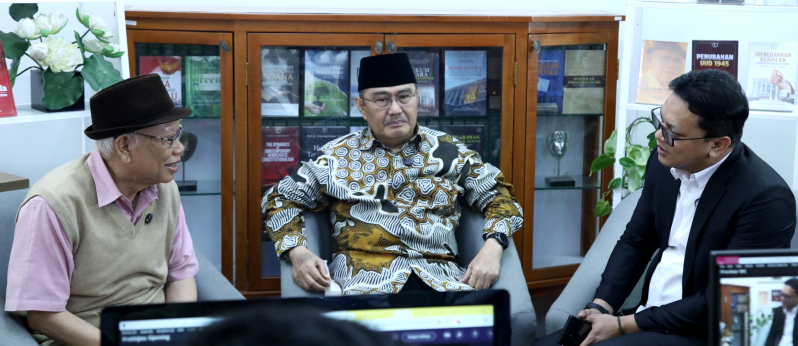
As part of the book launch series, the Constitutional Literacy Podcast was also held, featuring speakers Jimly Asshiddiqie and Bagir Manan, moderated by Head of the Legal Affairs and Registrar’s Bureau of the Constitutional Court, Fajar Laksono. Photo: Public Relations/Fauzan.
Taking Part in Improving Literacy, Constitutional Court Launches 26 Books
JAKARTA, MKRI PUBLIC RELATIONS-The Constitutional Court (Mahkamah Konstitusi/MK) launched a total of 26 books written by constitutional justices as well as employees of the Registrar’s Office and the Secretariat General of the Constitutional Court on Wednesday (17 December 2025) at the Auditorium of the National Library of Indonesia, Jakarta. On this occasion, Constitutional Justice Arief Hidayat delivered a keynote lecture.
Arief stated that Indonesia was once a great and civilized nation, serving as a center of culture and trade. Therefore, he invited those present to once again write and rebuild a glorious civilization. He further said that although Indonesia has a strong oral tradition, this culture must transform into a culture of literacy.
According to Arief, the current culture of writing and literacy at the Constitutional Court began with the writing of theses and dissertations by employees participating in educational advancement programs, which in turn motivated the constitutional justices themselves to write. This culture of literacy also serves as an antidote to the spread of information circulating on social media. The National Library was chosen as the venue for the book launch because it represents the center of civilization and intellectual life of the Indonesian nation.
Also present at the event was Chairman of the Constitutional Court for the 2008-2013 period, Mahfud MD, who stated that while books cannot compete with the speed of the internet, they excel in depth. Mahfud expressed his respect for writers in an era that is entirely digital and instant, who continue to write despite the onslaught of the internet.
Writing books remains important, Mahfud said, because books present deep thought, clear sources, theoretical consistency, and carry moral accountability, requiring authors to be responsible for their content. He emphasized that those who write books are responsible individuals because they dare to express and stand by their opinions.
“Books may not be able to match the speed of the internet, but they fight superficiality and resist instant and spontaneous explanations,” Mahfud said. Writing books, he added, is a form of contribution to civilization, not merely publication, but a legacy that can be passed on to future generations.
As part of the book launch series, the Constitutional Court also held a Constitutional Literacy Talk Show, featuring speakers Constitutional Justice for the 2014-2019 period Aswanto, Deputy Editor-in-Chief of Harian Kompas Paulus Agung Kristanto, and Constitutional Law expert from Andalas University Khairul Fahmi.
In his presentation, Aswanto appreciated the book launch and hoped that this tradition would continue, including the production of other writings related to constitutional issues beyond Constitutional Court decisions. Khairul Fahmi stated that books are able to provide in-depth explanations and counter opinions circulating on social media. Meanwhile, Paulus Agung Kristanto assessed that the Constitutional Court is writing its own history through the large number of books published each year. He noted a global shift in which sales of printed books have surpassed those of electronic books, a trend that has begun to emerge after the COVID-19 pandemic.
Previously, Head of the National Library of Indonesia Aminuddin Aziz, in his welcoming remarks, expressed his happiness that the National Library was chosen by the Constitutional Court as the venue for the book launch, talk show, and constitutional literacy podcast.
“The first function of a library is to serve as a center for the development of knowledge; the second is to be a place to foster creativity; and the third is to become a space or medium to fulfill the curiosity of library users,” Aminuddin said. According to him, the Constitutional Court is among the institutions that consistently and orderly submit its publications to the National Library as part of its national deposit and make them accessible to the public.
The 2025 Constitutional Court book launch was also attended by Chairman of the Constitutional Court for the 2003-2008 period Jimly Asshiddiqie, former Chief Justice of the Supreme Court (MA) Bagir Manan, both of whom also served as speakers in the 2025 Constitutional Literacy Podcast, as well as Chair of the Honorary Council of the Constitutional Court (MKMK) I Dewa Gede Palguna, MKMK Member Yuliandri, and Secretary General of the Constitutional Court Heru Setiawan.
As part of the same series of activities, the Constitutional Literacy Podcast featured Jimly Asshiddiqie and Bagir Manan, moderated by Head of the Legal Affairs and Registrar’s Bureau of the Constitutional Court, Fajar Laksono. In the podcast, both Jimly and Bagir Manan stated that the constitution is the highest agreement in the life of the nation and the state.
Jimly explained that the constitution is not only the highest law, but also the highest ethic, in other words, the supreme norm in national and state life. Furthermore, the constitution is not limited to the 1945 Constitution (UUD 1945), but also includes the state ideology Pancasila, which serves as the spirit of the Constitution. Ideally, Jimly said, the constitution encompasses shared aspirations, relations among branches of state power and between state institutions, as well as relations between the state and its citizens and every individual within a country’s territory.
Bagir Manan then explained that the constitution is not only the Constitution itself, but also the ethics of state governance. From a state perspective, the essence of the constitution lies in the willingness to limit power, while from the people’s perspective, it lies in the protection of citizens’ rights. A good constitution must also be supported by strong societal conditions, including a sound economy and a good level of education, challenges that remain central to strengthening constitutionalism.
Women’s Seminar
At the same time, the Constitutional Court also held a Seminar on Women and Constitutional Literacy. Constitutional Justice Enny Nurbaningsih delivered the keynote lecture and officially opened the seminar. She stated that women play a crucial role in building literacy from the earliest, closest, and most meaningful levels, through bedtime stories read by mothers to their children, advice on honesty given by grandmothers, and teachers who provide photocopies to underprivileged students, all of which demonstrate women’s capacity to safeguard literacy.
Enny noted that information technology has advanced beyond the past and that the flow of incoming information has no pause. “Most of our society lives in an information world without a sufficient literacy foundation to navigate it. We are in a situation where technology is widespread, but the ability to understand it is uneven,” Enny said.
Literacy, she continued, should no longer be understood in its traditional sense limited to reading, writing, and arithmetic. “Literacy today must include the ability to identify, understand, interpret, evaluate, verify, and create within the digital ecosystem,” Enny explained. She added that UNESCO has also emphasized literacy as the foundation of digital skills and the key to an inclusive digital transition. Despite rapid technological development, global realities still show stark disparities.
Enny further explained that women play a major role as the first guardians of constitutional values and as the earliest shapers of the nation’s moral character. What women instill today, she said, will determine the quality of the living constitution within society in the future.
She also highlighted that in a number of its decisions, the Constitutional Court has provided constitutional protection for women, including rulings on the minimum age of marriage for women and, most recently, decisions regulating the minimum number of women in the internal bodies of the House of Representatives (DPR).
The seminar also featured former General Elections Commission (KPU) Commissioner Valina Singka Subekti, Senior Expert Assistant to the Constitutional Justice Anna Triningsih, and President Director of PT Rajagrafindo Persada Nova Rasdiana. (*)
Author: Ilham W.M
Editor: Lulu Anjarsari P.
Translator: Siti Rosmalina Nurhayati/ASKI
Wednesday, December 17, 2025 | 17:58 WIB 214