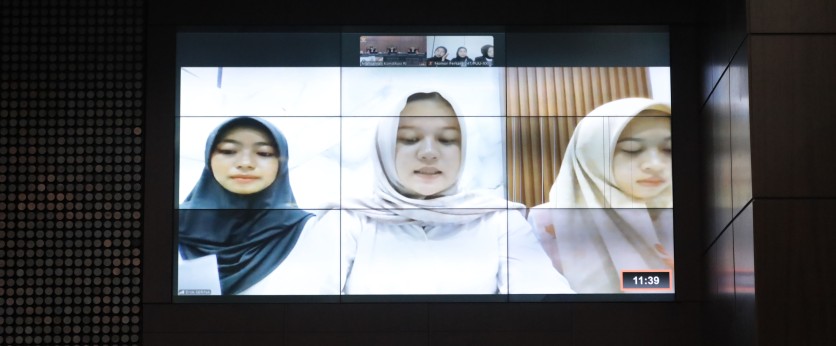
The petitioners for the judicial review of Law No. 12 of 2022 on Sexual Violence Crimes presenting the main points of their petition online. Photo by MKRI/Panji.
JAKARTA (MKRI) — Three students, Sherly Putri Yulia Santi, Nadhirotul Khumayroh, and Diva Serina Keisha Putri, filed a material judicial review of Article 67 paragraph (2) of Law No. 12 of 2022 on Sexual Violence Crimes (TPKS Law) against the 1945 Constitution of the Republic of Indonesia with the Constitutional Court. The first preliminary hearing for Case No. 250/PUU-XXIII/2025 was held before a panel of justices chaired by Chief Justice Suhartoyo, with Constitutional Justices Daniel Yusmic P. Foekh and M. Guntur Hamzah, on Wednesday (12/17/2025).
Article 67 paragraph (2) of the TPKS Law stipulates that “the fulfillment of victims’ rights is a state obligation and shall be carried out in accordance with the conditions and needs of the victims.”
According to the Petitioners, this provision contravenes Article 28D paragraph (1), Article 28G paragraph (1), and Article 28I paragraph (4) of the 1945 Constitution. They argued that the phrase “in accordance with the conditions and needs of the victims” in Article 67 paragraph (2) of the TPKS Law creates an overly broad legal space for the state, both the central and regional governments, to evade or reduce their responsibility in providing recovery to victims of sexual violence. Such justification, they contended, could be based on factors such as limited regional budgets, inadequate supporting facilities, or difficult geographical conditions. This concern is further reinforced by the enactment of Government Regulation No. 29 of 2025 on the Sexual Violence Victim Assistance Fund.
The regulation serves as an expression of the state’s commitment to provide compensation to victims who suffer losses that cannot be fully borne by the perpetrators of criminal acts. However, the existence of this Government Regulation should not be used as a pretext for the state to rely solely on restitution from perpetrators. Instead, the state must actively and proactively ensure that victims’ rights are fully realized and not contingent upon the capacity or readiness of regional governments.
“The direct consequence of the use of the phrase ‘in accordance with the conditions and needs of the victims’ is the emergence of constitutional harm to the Petitioners, namely legal uncertainty and the lack of decisiveness on the part of the state in fulfilling victims’ rights comprehensively. This phrase allows officials or relevant institutions to justify neglecting the fulfillment of victims’ rights under the pretext of inadequate regional financial conditions or the absence of facilities and infrastructure, resulting in victims’ rights to handling, protection, and recovery not being implemented optimally and fairly,” Nadhirotul explained to the panel of justices during the online hearing.
Nevertheless, the Petitioners maintained that the norm is not accompanied by clear limitations or accountability mechanisms in the implementation of victims’ rights when actions detrimental to such fulfillment occur. This absence of boundaries, they argued, gives rise to excessively broad interpretations. In practice, Article 67 paragraph (2) of the TPKS Law is often applied unilaterally by the state or relevant institutions to justify the neglect of victims’ rights without transparent processes, clear procedures, or adequate recovery as mandated by regulations.
Accordingly, the Petitioners requested the Court to declare Article 67 paragraph (2) of the TPKS Law, which reads, “The fulfillment of victims’ rights is a state obligation and shall be carried out in accordance with the conditions and needs of the victims,” unconstitutional and not legally binding insofar as it is not interpreted to mean: “The fulfillment of victims’ rights is an absolute obligation of the state, the implementation of which shall be prioritized and may not be set aside on the grounds of limitations in budgetary conditions, facilities, or infrastructure.”
Victim Protection
In his advice, Constitutional Justice Daniel urged the Petitioners to ensure the clarity of technical regulations governing the protection and fulfillment of victims’ rights. “You may also include principles, theories, and comparative practices from other countries in the implementation of such protection,” Daniel suggested.
Constitutional Justice Guntur further emphasized the need for the Petitioners to clearly establish their legal standing, particularly for those who are not direct victims. “For instance, a Petitioner could potentially face sexual violence when returning home late from study group activities, and as a woman, be at risk if there is no guarantee of victim protection. This must be clearly explained and genuinely connected to the characteristics of the Petitioners in relation to the provision being challenged,” Guntur elaborated.
At the conclusion of the hearing, Chief Justice Suhartoyo stated that the Petitioners were granted 14 days to refine their petition. The revised petition must be submitted no later than Tuesday, December 30, 2025, at 12:00 p.m. WIB to the Court’s Registrar’s Office. The Court will subsequently hold a second hearing to hear the main points of the revised petition.
Explore the case: Case No. 250/PUU-XXIII/2025
Author: Sri Pujianti
Editor: N. Rosi
Translator: Yuanna Sisilia
Disclaimer: The original version of the news is in Indonesian. In case of any differences between the English and the Indonesian versions, the Indonesian version will prevail.
Wednesday, December 17, 2025 | 13:52 WIB 92