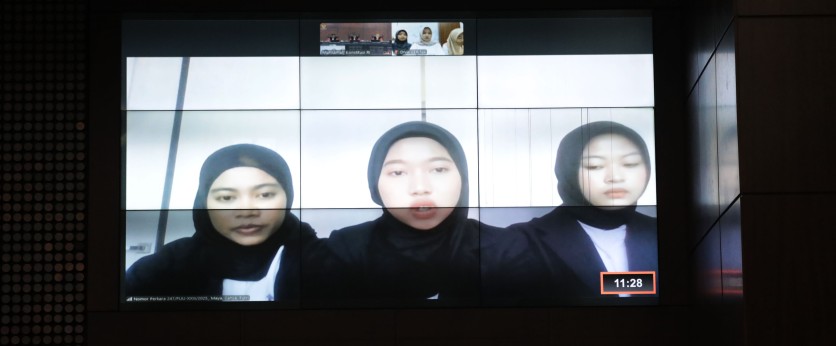
The Petitioners presenting the petition for judicial review of the Election Laws remotely, Wednesday (12/17/2025). Photo by MKRI/Panji.
JAKARTA (MKRI) — Three citizens who are also students—Maya Novita Sari, Cahya Camila Evanglin, and Putri Tania Rahmadani—have filed a judicial review petition of Article 245 of Law No. 7 of 2017 on General Elections, as last amended by Law No. 7 of 2023 on the Stipulation of Government Regulation in Lieu of Law No. 1 of 2022 on the Amendment to Law No. 7 of 2017 on General Elections into Law, before the Constitutional Court. The preliminary hearing for Case No. 247/PUU-XXIII/2025 on Wednesday, December 17, 2025 was presided over by a panel comprising Chief Justice Suhartoyo alongside Constitutional Justices Daniel Yusmic P. Foekh and M. Guntur Hamzah.
Article 245 of the Election Law provides that “The list of nominated candidates as mentioned in Article 243 shall consist of at least 30% (thirty percent) female candidates.”
Presenting the petition at the hearing remotely, Putri Tania Rahmadani stated that Article 245 of Law No. 7 of 2017 explicitly requires a minimum of 30% women’s representation in legislative candidate lists. However, the provision loses its binding force because it does not stipulate clear sanctions for violations. As a result of the absence of sanctions, the General Elections Commission (KPU) interprets the 30% women’s quota merely as an administrative requirement, rather than as a legally binding condition for the validity of candidacy, and therefore often approves political parties that do not meet the quota.
This situation ultimately forces voters to cast their votes for candidates that do not comply with the statutory requirements and undermines the purity of voters’ electoral rights. According to the Petitioners, this condition damages the integrity of the exercise of popular sovereignty, which should be guaranteed by Article 1 paragraph (2) of the 1945 Constitution.
The main focus of the Petitioners in submitting the review of the provision, Cahya Camila Evanglin continued, is the absence of a firm and adequate sanction mechanism for political parties or election organizers that fail to fulfill the minimum requirement of 30% women’s representation in the list of prospective candidates. “This harm is actual and potential due to the weakening of law enforcement, which directly causes the Petitioners as voters to lose their rights to fair treatment, equality before the law, and equal opportunity to obtain adequate women representatives,” Cahya stated.
Accordingly, in their petitums, the Petitioners request that the Court declare Article 245 of Law No. 7 of 2017 on General Elections, as last amended by Law No. 7 of 2023 on the Stipulation of Government Regulation in Lieu of Law No. 1 of 2022 on the Amendment to Law No. 7 of 2017 on General Elections into Law, contrary to the 1945 Constitution of the Republic of Indonesia and without binding legal force insofar as it is not interpreted to mean: “The list of prospective candidates as referred to in Article 243 shall contain women’s representation of at least 30% (thirty percent). In the event that the list of prospective candidates does not meet this requirement, the KPU, Provincial KPU, and Regency/City KPU shall reject the registration of prospective candidates from the relevant Political Party in the respective Electoral District.”
Justices’ Advice
In his advice, Justice Foekh stated that the Petitioners must understand the structure of a judicial review petition in accordance with the Constitutional Court Regulation (PMK) No. 7 of 2025 on procedural law for judicial review of laws. “These provisions are simpler and the petition should be adjusted accordingly. Furthermore, there needs to be strengthening of legal standing as students, with a degree of specificity—at least potential—so that the Court can proceed to examine the merits of the case,” he explained.
Justice Guntur further noted the absence of differences in the legal standing of each Petitioner in relation to the applicability of the challenged norm, for example as members of the KPU, prospective party members, and others. “Each Petitioner should have distinguishing characteristics if any exist, but if all conditions are the same, then it is sufficient for the Petitioners to proceed under a single status,” Guntur clarified.
Before adjourning the hearing, Chief Justice Suhartoyo communicated to the Petitioners that they would have 14 days to revise the petition. The revised petition must be submitted by 12:00 WIB on Tuesday, December 30, 2025 to the Registrar’s Office. The Court will then hold a second hearing to examine the petition’s revisions.
Explore Case No. 247/PUU-XXIII/2025 (in Indonesian).
Author : Sri Pujianti
Editor : N. Rosi
Translator : Yuniar Widiastuti (NL)
Disclaimer: The original version of the news is in Indonesian. In case of any differences between the English and the Indonesian versions, the Indonesian version will prevail.
Wednesday, December 17, 2025 | 13:18 WIB 364