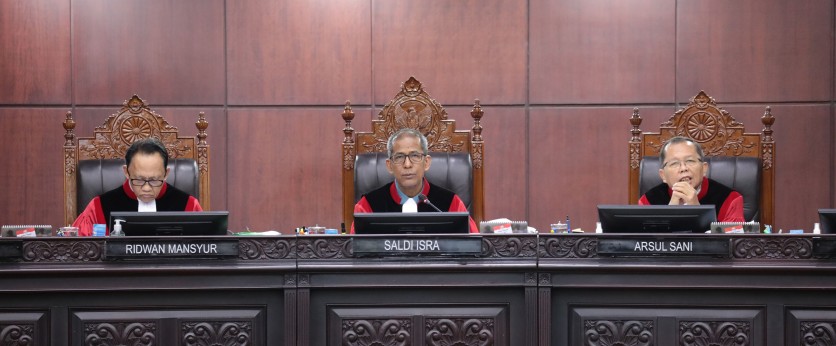
Constitutional Justice Saldi Isra, Constitutional Justices Ridwan Mansyur and Arsul Sani, presiding over judicial review hearing on Police Law, not attended by Petitioner. Photo by MKRI/Panji.
JAKARTA (MKRI) – The material judicial review hearing for Article 3 paragraph (1) letter c and the Elucidation of Article 3 paragraph (1) letter c of Law No. 2 of 2002 on the Republic of Indonesia National Police (Polri Law) against the 1945 Constitution of the Republic of Indonesia (UUD NRI 1945) was held at the Constitutional Court (MK), Wednesday, December 17, 2025. The Petition No. 251/PUU-XXIII/2025 was filed by Saymsul Jahidin.
The hearing was initially scheduled for a preliminary examination to hear the main points of the petition. However, by the time the hearing opened, the Petitioner had not appeared.
"Because he has not appeared, it is considered that the Petitioner is not serious about filing this petition," Deputy Chief Justice Saldi Isra asserted during the hearing.
As additional information, Syamsul Jahidin (Petitioner) in Petition No. 251/PUU-XXIII/2025 challenges Article 3 paragraph (1) Letter c and the Explanation of Article 3 paragraph (1) Letter c of the Police Law. The Petitioner considers that the provisions regarding voluntary security in the Police Law are contrary to the principles of the rule of law and legal certainty as regulated in Article 1 paragraph (3), Article 27 paragraph (2), and Article 28D paragraph (1) and paragraph (2) of the 1945 Constitution of the Republic of Indonesia.
In their petition, the Petitioner questioned the phrase "forms of independent security" and its explanation, which includes "business entities in the security services sector" and states that regulating independent security falls under the authority of the Chief of Police. According to the Petitioner, these provisions give rise to multiple interpretations and legal uncertainty in practice.
The Petitioner argued that the elucidation of the article had expanded the meaning of the norm in the main article. However, under constitutional law, an elucidation of a law may not add to, reduce, or change the norms stipulated in the main article. Consequently, the norm was deemed to open up opportunities for conflicts of interest and potential abuse of authority.
Furthermore, the Petitioner believes the phrase places security guards (satpam) and security service companies under the full control of the Indonesian National Police. However, legally, security guards are private sector employees subject to labor laws and regulations.
The Petitioner then highlighted the impact of implementing these norms on the security guard profession, including high education and training costs, mandatory membership card (KTA) renewals, and the lack of adequate legal protection in carrying out field duties. These conditions are considered to have created unequal treatment compared to state officials.
Furthermore, the Petitioner argues that the regulation has the potential to create conflicts of interest, including the involvement of active police officers in the management of security services businesses. This is considered to blur the line between the police's function as an instrument of the state and business activities in the private sector.
On that reason, the Petitioner asked the Court to declare that Article 3 paragraph (1) letter c and the Elucidation of Article 3 paragraph (1) letter c of the Indonesian National Police Law do not have binding legal force because they are in conflict with the 1945 Republic of Indonesia Constitution.
Track case No. 251/PUU-XXIII/2025
Author : Utami Argawati
Editor : Nur R.
Translator : Donny Yuniarto
Disclaimer: The original version of the news is in Indonesian. In case of any differences between the English and the Indonesian versions, the Indonesian version will prevail.
Wednesday, December 17, 2025 | 09:30 WIB 177