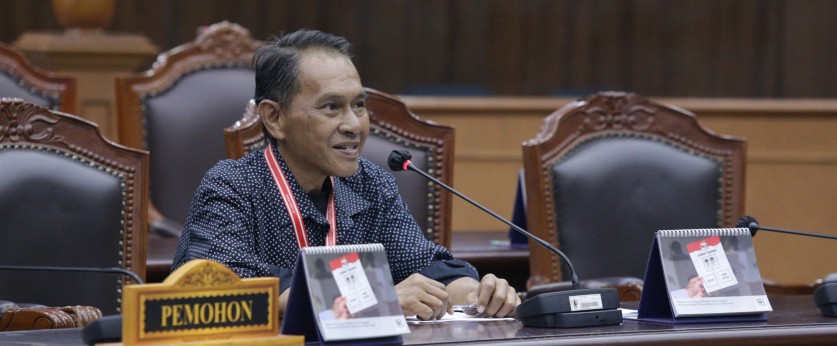
Donaldy Christian Langgar challenges provisions of the Human Rights Law concerning the right to receive fair assistance and protection from the judiciary.
JAKARTA, MKRI – Indonesian citizen Donaldy Christian Langgar has filed a constitutional challenge against Article 5 paragraph (2) of Law Number 39 of 1999 on Human Rights (Human Rights Law) before the Constitutional Court (MK). The preliminary hearing for Case Number 254/PUU-XXIII/2025 was held on Wednesday (17 December 2025) in the Panel Courtroom of the Constitutional Court. The panel was chaired by Deputy Chief Justice Saldi Isra, accompanied by Constitutional Justices Ridwan Mansyur and Arsul Sani.
Article 5 paragraph (2) of the Human Rights Law stipulates: “Every person has the right to receive assistance and fair protection from an objective and impartial court, ensuring equal access to justice and freedom from bias for all citizens within the Indonesian legal system.” Donaldy argued that this provision contravenes Article 28D paragraph (1) and Article 28H paragraph (2) of the 1945 Constitution of the Republic of Indonesia.
Explaining his petition before the panel, Donaldy recounted his concrete experience following a final and binding court decision in his favor. “The decision had obtained permanent legal force, (the Petitioner, ed.) received process compensation from the Industrial Relations Court amounting to Rp14,600,000.00. An application for execution was then submitted, but it turned out that there was an additional requirement for a certificate of heirs from the company. Both managers or owners had passed away (the Petitioner’s employer, ed.). The court then issued a note requesting a certificate of heirs, yet when I went to the Population and Civil Registration Office, it could not be processed because it was considered confidential under their regulations,” Donaldy explained.
In his petition, Donaldy asserted that Article 5 paragraph (2) of the Human Rights Law is overly broad and general in nature. According to him, the principle of the rule of law grounded in bureaucratic reform within judicial institutions and formal authority derived from statutory provisions was not applied equally in his case. In the concrete circumstances he experienced, the Petitioner claimed he was treated differently during the execution process compared to similar cases.
Accordingly, the Petitioner requested the Court to declare Article 5 paragraph (2) of the Human Rights Law conditionally unconstitutional and non-binding insofar as it is interpreted as: “Every person has the right to receive assistance and protection from an objective and impartial court only selectively,” “Every person has the right to receive assistance and protection from an objective and impartial court that does not carry out the execution stage of monetary awards,” and “Every person has the right to receive assistance and protection from an objective and impartial court that does not pursue judicial review.”
Normative Contradiction
During the hearing, Constitutional Justice Ridwan Mansyur asked the Petitioner to clarify the concrete legal issue he had experienced. “It is true that there is a concrete experience, but the theoretical explanation makes the petition unclear. You must clearly describe and substantiate the contradiction between the challenged norm and the 1945 Constitution that affects your constitutional rights,” Ridwan advised.
Constitutional Justice Arsul Sani further explained that certificates of heirs are issued and legalized by local administrative authorities. “Therefore, since this concerns a sole proprietorship whose owner has passed away and left heirs, under inheritance law all rights and obligations are transferred to the heirs. However, this process is not simple. The question is whether your concrete case occurred due to an unclear norm. This needs to be carefully considered, because there are also legal avenues available. If the heirs are unwilling, they may be sued in a civil lawsuit. That option exists and does not require filing a constitutional review of this norm,” Arsul elaborated.
At the close of the hearing, Deputy Chief Justice Saldi Isra informed the Petitioner that he was granted 14 days to revise and refine his petition. The revised submission must be filed no later than Tuesday, 23 December 2025, at 12:00 WIB with the Registry of the Constitutional Court. The Court will then convene a second hearing to examine the substance of the revised petition. (*)
Writer: Sri Pujianti
Editor: Lulu Anjarsari P.
PR: Andhini S.F.
Translator: SO
Disclaimer: The original version of the news is in Indonesian. In case of any differences between the English and the Indonesian versions, the Indonesian version will prevail.
Wednesday, December 17, 2025 | 13:33 WIB 67