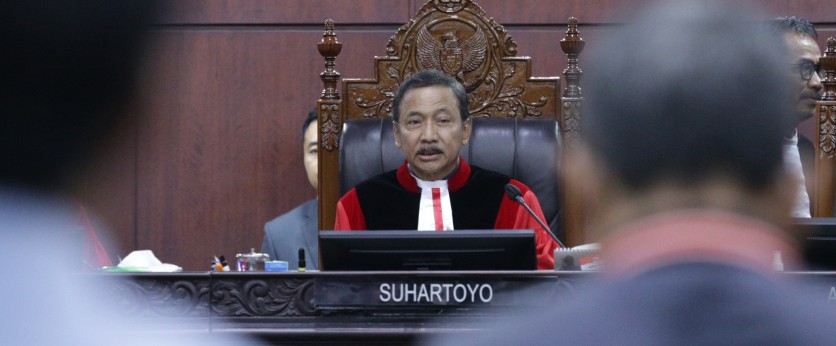
Decision/Decree Pronouncement Hearing of Case No. 220/PUU-XXIII/2025 on the material judicial review of Law No. 19 of 2019 on the Second Amendment to Law No. 30 of 2002 on Corruption Eradication Commission, Wednesday (17/12). Photo by MKRI/Bay.
Jakarta (MKRI) - The Constitutional Court (MK) has declared void a petition for judicial review of Law No. 19 of 2019 on the Second Amendment to Law No. 30 of 2002 on the Corruption Eradication Commission. The pronouncement hearing for Decree No. 220/PUU-XXIII/2025 was chaired by Chief Justice Suhartoyo together with the other constitutional justices on Wednesday, December 17, 2025, in the Plenary Courtroom.
Chief Justice Suhartoyo stated that the Court had received a petition submitted by Ahmad Rizaldi. In relation to this petition, on Monday, 24 November 2025, at 9:46 a.m. Western Indonesian Time, the summoning officer contacted the petitioner by text message regarding his attendance at the preliminary hearing and informed him that he was required to appear in the courtroom no later than 30 minutes before the hearing commenced, but the petitioner replied that he was outside the territory of the Republic of Indonesia.
At 10:02 a.m. the same day, the Court, through the summoning officer, contacted the petitioner again to confirm whether he could attend the hearing online. However, the petitioner stated that he could not participate in the proceedings, either in person or online, because he was working in Brunei Darussalam. When the hearing to examine the substance of Petition Number 220/PUU-XXIII/2025 was opened on Monday, 24 November 2025 at 2:10 p.m., the Panel Chair again confirmed on the record that the petitioner was not present.
In the Justices’ Deliberation Meeting on November 25, 2025, the Court concluded that the petitioner’s absence from the preliminary panel hearing without a valid reason, despite having been duly and properly summoned, indicated that he was not acting in good faith in pursuing the a quo petition. Accordingly, the petition was declared void, and the Court issued a decree.
“Declaring the petitioner’s petition void,” Chief Justice Suhartoyo stated in reading out the decree.
Also read:
Ahmad Rizaldi Fails to Attend the Material Judicial Review Hearing of the KPK Law
In petition No. 220/PUU-XXIII/2025, the Petitioner questioned the independence of the Corruption Eradication Commission (KPK) following the placement of investigators from other institutions within its organizational structure. According to the Petitioner, assigning investigators from external agencies creates potential conflicts of interest, ultimately undermining the principles of equality before the law and public accountability. Consequently, the Petitioner argued that the relevant provision is in contradiction with Article 28D paragraph (1) of the 1945 Constitution. Furthermore, in the petition's main arguments, the Petitioner asserted that the placement of KPK personnel as state civil servants (ASN) under the executive branch has eroded the institution’s independence.
The Constitutional Court Decision No. 36/PUU-XV/2017 has firmly established that the Corruption Eradication Commission (KPK) is an independent state institution that does not fall under the executive branch of government. The Petitioner argues that the change in the KPK’s status conflicts with Article 24 paragraph (1) of the 1945 Constitution, which mandates that judicial power be free from the influence of other powers, noting that the KPK performs judicial functions, such as investigation, inquiry, and prosecution.
Furthermore, the Petitioner asserts that the provisions allowing the placement of Police and Prosecutor members within KPK create a dual command system and potential conflicts of interest. The KPK should ideally have investigators with a civil, independent background, recruited through national merit-based recruitment. Accordingly, the Petitioner contends that assigning personnel from other institutions violates the spirit of Articles 3 and 4 of the KPK Law, which emphasize that the KPK must remain free from external influence.
For these reasons, the Petitioner requests the Constitutional Court to declare that the provisions in Law No. 19 of 2019 that change KPK personnel status to civil servants (ASN), authorize the Supervisory Board to permit wiretapping and pro-justitia actions, and enable Police and Prosecutor assignment to the KPK, conflict with the 1945 Constitution and are not legally binding. The Petitioner also seeks a declaration that the KPK is an independent state institution outside the executive branch, staffed through national civil recruitment based on merit and integrity principles.
Case tracking
Author: Sri Pujianti.
Editor: N. Rosi
PR: Raisa Ayuditha Marsaulina
Translator: Rizky Kurnia Chaesario
Disclaimer: The original version of the news is in Indonesian. In case of any differences between the English and the Indonesian versions, the Indonesian version will prevail.
Wednesday, December 17, 2025 | 19:21 WIB 536