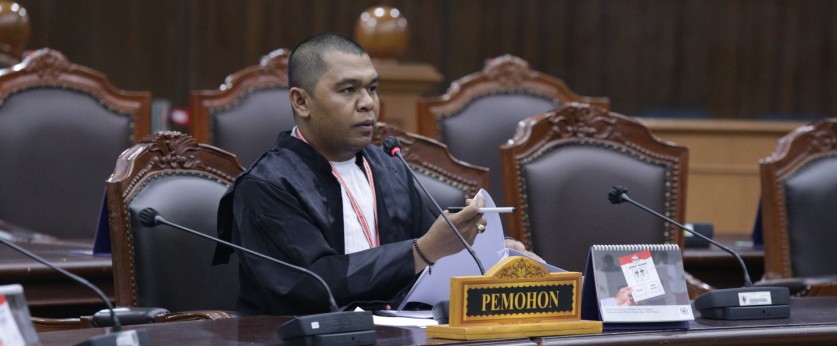
The Petitioner in case 232/PUU-XXIII/2025 at the petition revision hearing for the Anti-Corruption and Witness-Victim Protection Agency Laws, Tuesday (12/16/2025). Photo by MKRI/Bayu.
JAKARTA (MKRI) — La Hasidi, the Petitioner of Case No. 232/PUU-XXIII/2025, presented the revisions to petition of the material judicial review of Article 41 paragraph (1) of Law No. 31 of 1999 in conjunction with Law No. 20 of 2001 on the Eradication of Corruption Crimes (Anti-Corruption Law) and Article 5 paragraph (1) of Law No. 31 of 2014 on the Witness and Victim Protection Agency (LPSK). The hearing took place on Tuesday, December 16, 2025.
“I have made revisions, Your Honors. I made adjustments from the initial (petition),” the Petitioner said before Chief Justice Suhartoyo and panel members Constitutional Justices Daniel Yusmic P. Foekh and M. Guntur Hamzah.
The Petitioner revised the petitums, in which he requests the Court to declare Article 41 paragraph (1) of the Anti-Corruption Law unconstitutional and not legally binding if not interpreted as, “The State shall be obliged to provide immediate, preventive, operational, effective, and comprehensive legal protection to every whistleblower of corruption offenses from the moment a threat or potential threat is identified.”
The Petitioner also requests the Court to declare Article 5 paragraph (1) of the LPSK Law unconstitutional and not legally binding insofar as it is not interpreted as “The Witness and Victim Protection Agency (LPSK) shall be obliged to provide direct and immediate protection to whistleblowers of corruption offenses without waiting for administrative processes and/or a plenary decision whenever there is a real threat or potential threat to the safety of the whistleblowers.”
Also read: Facing Threats Reporting Alleged Corruption, Citizen Challenges Anti-Corruption, LPSK Laws
The Petitioner reported alleged corruption in the construction of an illegal corn-processing facility in Muna Regency to the Corruption Eradication Commission (KPK) and the High Prosecutor’s Office, but instead received death threats, kidnapping attempts, intimidation, social pressure, attempts at criminalization, and an unsafe environment. He argued that the Anti-Corruption Law encourages the public to make reports but does not regulate their protection.
Article 41 paragraph (1) of the Anti-Corruption Law reads, “The public shall participate in assisting efforts to prevent and eradicate corruption crimes by seeking information, data, and reporting corruption crimes.” Meanwhile, Article 5 paragraph (1) of the LPSK Law reads, “The LPSK shall provide protection to witnesses and/or victims upon the request of the person concerned.”
Its implementing regulation, Government Regulation No. 43 of 2018, only regulates reporting procedures and rewards, but not protection. Meanwhile, the LPSK Law provides protection only after administrative verification, and not immediately, resulting in a legal vacuum with regard to swift, emergency, preventive, and proportionate protection for whistleblowers.
Explore Case No. 232/PUU-XXIII/2025 (in Indonesian).
Author : Mimi Kartika
Editor : Lulu Anjarsari P.
PR : Raisa Ayuditha Marsaulina
Translators : Yuniar Widiastuti (NL)
Disclaimer: The original version of the news is in Indonesian. In case of any differences between the English and the Indonesian versions, the Indonesian version will prevail.
Tuesday, December 16, 2025 | 16:59 WIB 316