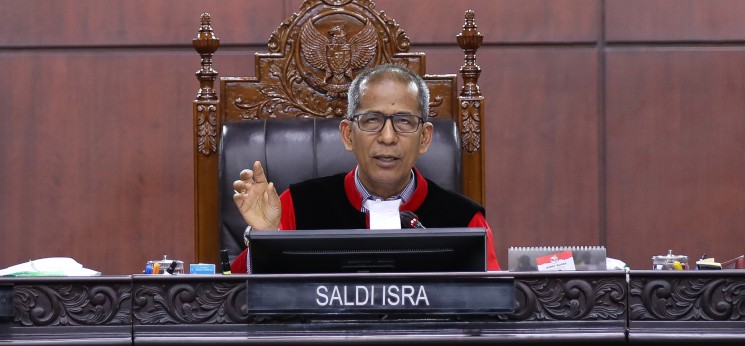
Deputy Chief Justice Saldi Isra chairing the petition revision hearing of the judicial review of Law No. 18 of 2003 on Advocates, Tuesday (12/9). Photo by MKRI/Ifa.
JAKARTA (MKRI) — The Constitutional Court convened another judicial review hearing of Article 2 paragraph (2), Article 4 paragraph (3), Article 9 paragraph (1), Article 10 paragraph (1)(c), and Article 30 paragraph (2) of Law No. 18 of 2003 on Advocates on Tuesday, December 9, 2025. This second hearing for Petition No. 227/PUU-XXIII/2025, filed by advocate and legal consultant Warsito Ahmad Qodlofi, was scheduled to hear the principal revisions he made to his petition.
Appearing online, the Petitioner conveyed that he had refined his arguments in accordance with the panel’s advice, including adjustments to his petitums.
He stated, among others, “To declare Article 2 paragraph (2) of Law No. 18 of 2003 on Advocates contradictory to the 1945 Constitution and not legally binding insofar as it is not interpreted to mean that the appointment of advocates shall be carried out by advocate organizations, while the issuance of advocate identification cards as professional attributes shall be delegated to the Supreme Court through the high courts.”
Also read:
Reviewing Provisions on Advocate Appointment, Dismissal, and Advocate ID Card Issuance
Warsito, an advocate and legal consultant, petitioned the Court to review the constitutionality of the aforementioned articles of the Advocates Law against the 1945 Constitution. Under Article 2 paragraph (2), “The appointment of advocates shall be conducted by Advocate Organizations.” Article 4 paragraph (3) requires the high court registrar to send the copy of the oath minutes to the Supreme Court, minister, and advocate organization. Article 9 paragraph (1) stipulates that advocates may resign or be dismissed by advocate organizations. Article 10 paragraph (1)(c) states that permanent dismissal may occur based on an advocate organization’s decision. Article 30 paragraph (2) obliges every appointed advocate to become a member of an advocate organization.
The Petitioner argued that these provisions confer excessively broad authority to advocate organizations to regulate appointment, membership, dismissal, and the legitimacy to appear before the court by issuing and extending the Advocate Identification Card (KTPA). Consequently, he contends, the provisions violate Article 27 paragraph (2), Article 28D paragraph (1), and Article 1 paragraph (3) of the 1945 Constitution.
He asserted at the first hearing on Wednesday, November 26, 2025, that the Advocates Law does not recognize the KTPA as a statutory requirement for courtroom practice. “The mandatory use of a KTPA arises solely from internal regulations and administrative custom within advocate organizations,” he noted.
The Petitioner further viewed the extension of the KTPA as an arbitrary instrument of professional control. In practice, he argued, advocate organizations, as private entities, decide the validity period and renewal of the card, which may prevent advocates who have been sworn in by the state from appearing in court solely because their KTPA has expired. This, he added, generates legal uncertainty and infringes the right to work.
He also warned of the potential for abuse of authority and unlawful levies. Entrusting the legitimization function to private organizations, he argued, creates opportunities for charges not governed by law, discriminatory treatment, and administrative pressure without state oversight.
Moreover, the norms allegedly produce a disharmony of authority between the high courts, representing the state, and advocate organizations. While the oath of office is administered by the High Court on behalf of the Supreme Court, the operative authority to determine whether an advocate may appear in court is transferred to private organizations through the KTPA system. This dualism, he claimed, creates legal uncertainty and harms the Petitioner.
For these reasons, the Petitioner requested the Court to declare Article 2 paragraph (2) of the Advocates Law contradictory to the 1945 Constitution and not legally binding insofar as it is not interpreted to mean that the appointment of advocates remains with advocate organizations while the production of the advocate identification card as a professional attribute is entrusted to the Supreme Court through the high courts.
Explore the Case: Case No. 227/PUU-XXIII/2025
Author: Sri Pujianti
Editor: N. Rosi
PR: Fauzan F.
Translator: Yuanna Sisilia
Disclaimer: The original version of the news is in Indonesian. In case of any differences between the English and the Indonesian versions, the Indonesian version will prevail.
Tuesday, December 09, 2025 | 16:52 WIB 174