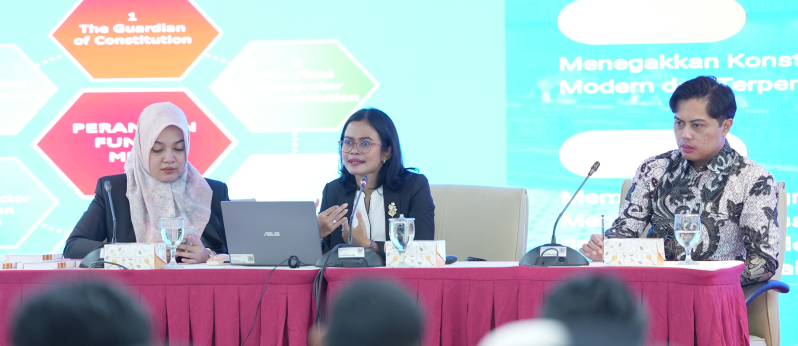
Court Legal Analyst Siswantana Putri Rahmatika as a speaker during the visit of students from the Faculty of Teacher Training and Education, Sultan Ageng Tirtayasa University, at the Auditorium of Building I of the Court. Photo by MKRI/Fauzan.
JAKARTA (MKRI) – The Constitutional Court of the Republic of Indonesia(MKRI) welcomed students of the Faculty of Teacher Training and Education, Sultan Ageng Tirtayasa University, on Thursday, December 4, 2025. The visit aimed to strengthen students’ understanding of the national constitutional system and the vital role of the Court in safeguarding the Constitution.
During the presentation session, Court Legal Analyst Siswantana Putri Rachmatika appeared as the main speaker. Through her presentation titled “Introducing the Constitutional Court of the Republic of Indonesia,” she outlined the background of the Court’s establishment, including various constitutional issues that prompted its formation, ranging from the absence of a judicial review mechanism against the 1945 Constitution to the need for resolving disputes between state institutions through legal rather than political means.
Siswantana explained that the Court is vested with five constitutional authorities: reviewing laws against the 1945 Constitution; adjudicating disputes over authorities between state institutions; deciding on the dissolution of political parties; resolving electoral and regional election result disputes; and issuing a decision on the House of Representatives(DPR)’ opinion regarding alleged violations committed by the President or Vice President. “These authorities are fundamental pillars that ensure the Constitution is upheld consistently,” said Siswantana.
She emphasized that the Court upholds the vision of “ensuring the supremacy of the Constitution through modern and trustworthy judicial processes,” which is realized through strengthening judicial integrity, improving decision quality, and enhancing constitutional awareness within society.
Students also received explanations regarding citizens’ constitutional rights, the distinction between formal and material judicial review of laws, and the parties eligible to file petitions to the Court. Siswantana further explained the Court’s 13 procedural stages, from case registration to ruling decision, along with key principles of the Constitutional Court’s procedural law, including decisions that are erga omnes and final and binding.
On this occasion, several landmark decisions of the Court were also highlighted, including Decision No. 69/PUU-XXII/2024 on the prohibition of regional head election campaigning on campus, as well as decisions concerning civil administration and age requirements for regional head candidates. Students appeared enthusiastic as they followed the session, which was delivered interactively and informatively.
The visit by students of the Faculty of Teacher Training and Education, Sultan Ageng Tirtayasa University, to the Court is expected to enrich their understanding of constitutional adjudication practices while fostering greater awareness of the importance of upholding the Constitution in the life of the nation and state (*)
Author : Adriana Airlia
Editor : Lulu Anjarsari P.
Translator : Aski V. Rumere/Donny Yuniarto
Disclaimer: The original version of the news is in Indonesian. In case of any differences between the English and the Indonesian versions, the Indonesian version will prevail.
Friday, December 05, 2025 | 09:26 WIB 214