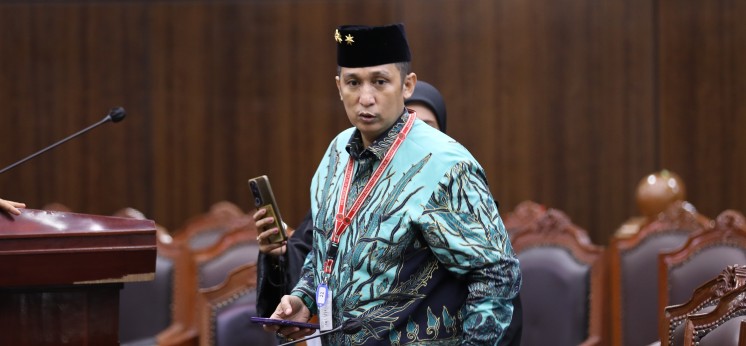
Petitioner Muhamad Firdaus Oiwobo attending the material judicial review haring of Law No. 18 of 2003 on Advocates on Tuesday (02/12). Photo by MKRI/Ifa.
Jakarta (MKRI) – The Constitutional Court resumed the material judicial review hearing of Law No. 18 of 2003 on Advocates (Advocate Law) on Tuesday, December 12, 2025, at the Plenary Courtroom. The second hearing of Case No. 217/PUU-XXIII/2025 filed by Muhamad Firdaus Oiwobo was presided over by Chief Justice Suhartoyo.
The hearing was scheduled to examine the main points of the revised petition. Legal Counsel Deolipa Yumara stated that the revision included an explanation of the DPP KAI Decree No. 007/DPP-KAI/SK/1/2025 dated February 8, 2025, on the Petitioner's expulsion as an advocate. However, the letter was not mentioned in the Decree that suspends the Petitioner’s oath minutes. The Petitioner also added an explanation of the mechanism for dismissing an advocate, disciplinary actions, and the consequences of suspension and dismissal.
“Although the Supreme Court, through the Banten High Court, suspended the Petitioner’s advocate oath minutes based on Article 4 paragraph (1) and paragraph (2) of the Advocate Law, it is a subjective interpretation and legally incorrect. The provisions of the Article a quo only regulate advocates' administrative obligation to take oath before an open hearing in the High Court before they can exercise their profession, so that the norm does not give the supervisory and advocate suspension authority,” Deolipa explained.
Also read:
Firdaus Oiwobo Challenges Advocate Suspension Mechanism
Muhamad Firdaus Oiwobo challenged Article 7 paragraph (3) and Article 8 paragraph (2) of the Advocate Law against the 1945 Constitution of the Republic of Indonesia.
Article 7 paragraph (3) of the Advocate Law states, “Before an advocate is subject to the actions referred to in paragraph (1), the person concerned must be afforded the opportunity to defend themselves.”
Article 8 paragraph (2) of the Advocates Law states, “In the event of disciplinary action in the form of temporary suspension as referred to in Article 7 letter c or permanent dismissal as referred to in letter d, the Advocates Organization as referred to in paragraph (1) shall convey the disciplinary decision to the Supreme Court.”
During the first hearing, legal counsel Sukma Murti Eka Cipta described the concrete case of the Petitioner, namely, the termination of membership in the Indonesian Advocates Congress (KAI) pursuant to DPP KAI Decree No. 007/DPP-KAI/SK/1/2025 dated February 8, 2025. The Petitioner was deemed to have violated the professional code of ethics following an unexpected incident in the courtroom of the North Jakarta District Court on February 6, 2025. At that time, the Petitioner was serving as Additional Counsel in a case involving Razman Arif Nasution. The Petitioner climbed onto the counsel’s table in the courtroom while the hearing had been suspended and the presiding judges had left the courtroom. This act was done unconsciously and spontaneously by the Petitioner, as a commotion was taking place in the courtroom and the Petitioner was focused on monitoring his client, who was being surrounded by parties engaged in a heated dispute.
According to the DPP KAI Decree, three sanctions were imposed on the Petitioner. First, the sanction of dismissal with dishonor. Second, the revocation of DPP KAI Decree Number 05969/011/SKADV/KAI/9/2015 regarding the Petitioner’s appointment as a member of KAI. Third, a strict prohibition against using or displaying any organizational attributes, names, logos, or flags in any form, whether for personal interests, organizations led by the Petitioner, or for clients represented by the Petitioner.
The Petitioner acknowledged that the imposition of ethical sanctions is understandable, provided there is clear evidence of an ethical violation and that disciplinary proceedings are conducted transparently, accountably, and in accordance with the Advocates Law. However, up to now, the Petitioner has never been summoned to provide clarification regarding the alleged code of ethics violation, nor has he been called to appear before the Honorary Council of the Advocates Organization for a fair and open ethics hearing, and at no time has he been given the opportunity to mount a defense.
In summary, the Petitioner was unilaterally dismissed from membership in the KAI Advocates Organization without any ethics hearing as mandated by law. Subsequently, the Petitioner also received a Determination Letter from the Chief Judge of the Banten High Court, Number 52/KPT.W29/HM.1.1.1/II/2025, on the Suspension of the Advocate Oath Minutes. As a result, the Petitioner has legally lost the legitimacy to exercise the legal profession before the courts and the public.
The Petitioner requested that the Court declare Article 7 paragraph (3) of the Advocates Law to be contrary to the 1945 Constitution and not legally binding, except insofar as it is interpreted to mean "an advocates’ organization must provide advocates accused of breaching the code of ethics with a fair, transparent, and proportional opportunity to present a defense before imposing any sanctions or measures of temporary or permanent dismissal."
The Petitioner also asked the Court to declare Article 8 paragraph (2) of the Advocates Law to be unconstitutional and not legally binding unless interpreted as:
a. "In cases involving disciplinary action in the form of suspension as referred to in Article 7 letter c, or permanent dismissal as referred to in letter d, the Advocates Organization as referred to in paragraph (1) must deliver the disciplinary decision to the Supreme Court for further action."
b. Once the Supreme Court receives the disciplinary decision from the Advocates Organization, the Supreme Court is to suspend the relevant advocate’s Oath Minute in accordance with the ethical decision of the Advocates Organization’s Honorary Council.
c. The sole body authorized to examine, adjudicate, and impose sanctions or take action against advocates is the Advocates Organization’s Honorary Council.
d. Any form of suspension of an advocate’s Oath Minute (BAS) not based on a disciplinary decision by the Honorary Council of the Advocates Organization must be void as a matter of law.
Additionally, the Petitioner requested that the Court declare the Decree of the Chief Judge of the Banten High Court Number 52/KPT.W29/HM.1.1.1/II/2025 to be unauthorized and contrary to the 1945 Constitution.
Case tracking
Author: Sri Pujianti.
Editor: N. Rosi.
PR: Andhini SF.
Translator: Rizky Kurnia Chaesario
Disclaimer: The original version of the news is in Indonesian. In case of any differences between the English and the Indonesian versions, the Indonesian version will prevail.
Tuesday, December 02, 2025 | 16:22 WIB 319