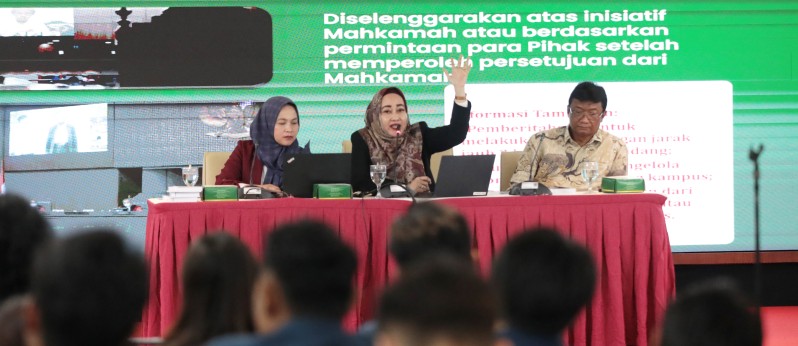
Senior legal counselor Rita Daniela delivering a presentation on “Introduction to the Constitutional Court: Guardian of the Constitution” to law students of Trisakti University, Monday (12/1/2025). Photo by MKRI/Ilham W.M.
JAKARTA (MKRI) — A group of fifth-semester law students from Trisakti University visited the Constitutional Court (MK) on Monday, December 1, 2025. They sought to gain a deeper understanding of the Constitutional Court, as this visit served as the final session of their course on the Constitutional Court’s Procedure for the semester.
“We brought the students to the Constitutional Court so they could directly understand the procedural law of the Constitutional Court, so [they] won’t be confused anymore if [they] want to appear before the Court,” said Wasis Susetio, a lecturer at the Faculty of Law, Trisakti University, in the auditorium of the Court’s main building.
The students were presented with a presentation on the ins and outs of the Constitutional Court as a judicial institution that safeguards the Indonesian Constitution by senior legal counselor Rita, moderated by senior legal counselor Erna Hasanah. Before the presentation began, Erna asked the students to recite the five precepts of the state ideology Pancasila one by one.
“We must know and implement the values of Pancasila because Pancasila is the foundation of the Indonesian state,” said Erna.
Next, Rita explained the formation of the Constitutional Court through amendments to the 1945 Constitution as a reinforcement of the democratic constitutional system. The Constitutional Court is one of the state institutions that exercises judicial power based on Article 24C of the 1945 Constitution and Law No. 24 of 2003 on the Constitutional Court, which was last amended by Law No. 7 of 2020.
Based on this law, the Constitutional Court has four powers and one obligation. The four powers of the Constitutional Court are to review laws against the 1945 Constitution, to decide on disputes over the authority of state institutions whose authority is granted by the 1945 Constitution, to decide on the dissolution of political parties, and to decide on disputes over election results, including regional head elections. The Constitutional Court is also obliged to issue a ruling on the House of Representatives’ (DPR) opinion regarding alleged violations by the president and/or vice president according to the 1945 Constitution.
“However, to date, the Constitutional Court has not yet ruled on the dissolution of political parties or presidential impeachment,” said Rita
She emphasized that the Constitutional Court’s decisions are final and binding, meaning that there are no other legal remedies and they are immediately applicable to all Indonesian citizens once they are pronounced. Therefore, these decisions are not only applicable to the parties directly involved in the case or the petitions submitted to the Constitutional Court.
She said that citizens who believe they have experienced violations of constitutional rights due to the enactment of a norm in a law can become petitioners in the Constitutional Court. Petitioners for judicial review of laws are individual Indonesian citizens or groups of people with common interests, customary laws communities that are still active and live in accordance with the development of society and the principles of the Unitary State of the Republic of Indonesia (NKRI) as regulated in the legislation, public legal entities or private legal entities, or state institutions.
The constitutional rights and/or authority of the petitioners that have been and/or will be harmed by the enactment of the law/government regulation in lieu of law (perppu) must be proven to strengthen the petitioners’ legal standing. The argument must be elaborated clearly and linked to the cause-and-effect relationship between the contested provisions and the provisions of the 1945 Constitution of the Republic of Indonesia, which serve as the basis for testing the petition.
Rita mentioned that some of the requests for judicial review were submitted by students, and some of them were even granted by the Court. The review process, from the submission of petition, the hearing, to the decision, can be accessed online through an online application.
“For fellow students who wish to file a petition for judicial review, there is no need to come directly to the Constitutional Court; it can be done through SIMPEL (electronic petition information system),” she said.
Author : Mimi Kartika
Editor : Lulu Anjarsari P.
Translator : N. Valentino Rahadityo/YW
Disclaimer: The original version of the news is in Indonesian. In case of any differences between the English and the Indonesian versions, the Indonesian version will prevail.
Monday, December 01, 2025 | 15:09 WIB 132