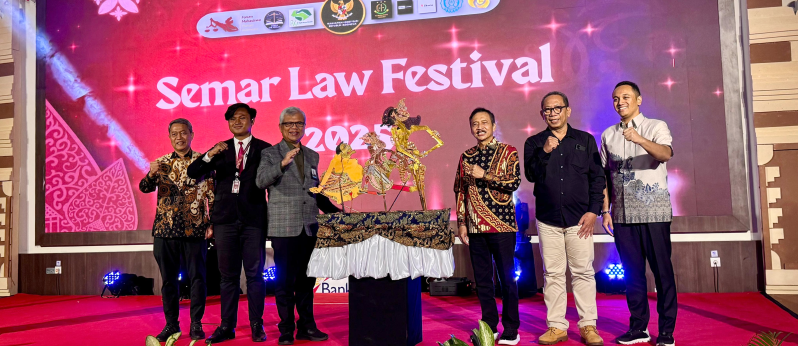
The 2025 Semar Law Festival (SLF) hosted by the Constitutional Court (MK) in collaboration with the Faculty of Law, Universitas Sebelas Maret (FH UNS).
SURAKARTA, (MKRI) – The Constitutional Court (the Court), in collaboration with the Faculty of Law, Universitas Sebelas Maret (FH UNS), once again held the 2025 Semar Law Festival (SLF), an annual intellectual forum that brings together law students from across Indonesia to explore contemporary legal issues. This year’s SLF highlights the strengthening of the legal profession’s role in responding to ecological challenges and the increasingly expansive industrial sector.
SLF 2025 carries the main theme “The Legal Profession as Protector of Living Space and Constitutional Rights: Responding to Industrial Expansion and Environmental Crisis in the Mining Sector.” Through this theme, SLF seeks to encourage students to understand environmental issues not merely as ecological concerns, but as constitutional problems requiring the active role of legal professionals in protecting citizens’ rights.
In addition, SLF 2025 sheds light on energy issues through the subtheme “Energy Self-Sufficiency in the Grip of Extractivism: Rethinking the Direction of National Downstreaming and Greenwashing Practices within the Framework of Ecological Justice.” Nickel downstreaming—often promoted as the future of renewable energy—is considered to contain serious issues including socio-ecological crises, resource-governance inequalities, and corporate greenwashing. The festival invites students to critically examine policy directions that are viewed as not yet fully aligned with sustainability and community welfare.
The event featured Chief Justice Suhartoyo as the keynote speaker. Also present were the Secretary-General of the Court, Heru Setiawan, and UNS Rector Hartono.
In his presentation, Chief Justice Suhartoyo emphasized the importance of placing economic development within the corridor of sustainability. “The Constitutional Court consistently affirms that national economic development cannot be separated from the principles of sustainability and environmental stewardship,” he stated.
Suhartoyo underlined that the Indonesian Constitution provides a strong foundation for environmental protection, particularly regarding the state’s control over natural resources. He cited Article 33 paragraph (3) of the 1945 Constitution of the Republic of Indonesia (UUD 1945), which mandates that the utilization of natural resources must aim for the greatest prosperity of the people. “Natural resource management cannot be driven solely by efficiency or the interests of a small group of capital owners, but must improve people’s welfare fairly,” he stressed.
The Chief Justice also highlighted the relevance of the SLF theme to a recent constitutional ruling on environmental issues, specifically Constitutional Court Decision Number 119/PUU-XXIII/2025. In the ruling, the Court emphasized the importance of public participation in protecting the environment. Such participation may take various forms, including expressing opinions in public forums, reporting to authorities, or filing legal actions against policies or actions harmful to the environment.
According to Suhartoyo, public participation is an essential element in ensuring fair and transparent environmental governance. “Community involvement and legal protection of environmental rights are central considerations of the Constitutional Court in that decision,” he emphasized.
Suhartoyo further explained that the Court’s authority to review laws provides broad avenues for the public to defend their constitutional rights, including those related to environmental protection. Through judicial review, the public may challenge regulations deemed to ignore principles of sustainability or potentially harm citizens' living space.
With the Court’s presence in academic forums such as SLF, students are expected to understand environmental issues not only from the perspective of public policy, but also as an integral part of protecting constitutional rights. SLF 2025 thus becomes a significant moment for the next generation of legal practitioners to strengthen ecological perspectives within the legal profession, while responding to the growing challenges of extractivism in Indonesia.
Author : Fauzan F.
Editor : N. Rosi.
Translator : Aski Violeta Rumere /Agusweka Poltak Siregar
Disclaimer: The original version of the news is in Indonesian. In case of any differences between the English and the Indonesian versions, the Indonesian version prevails.
Friday, November 28, 2025 | 21:15 WIB 104