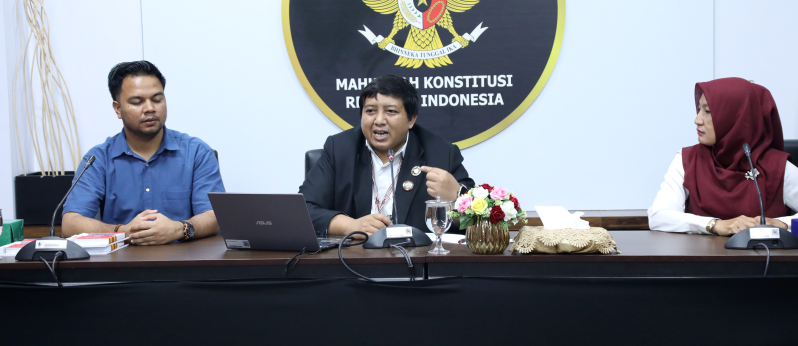
Achmad Junaedi welcomed field study visit to the Constitutional Court (MK), Thursday (27/11/2025) at the Hall of Building 2. Photo by MKRI/Fauzan.
JAKARTA, MKRI PUBLIC RELATIONS – Law students from Universitas Pahlawan Tuanku Tambusai, accompanied by the Vice Dean of the Law Faculty, Yuli Herianti, conducted a field study visit to the Constitutional Court (MK) on Thursday, November 27, 2025. The delegation was received by Achmad Junaedi, a legal counselor at the Constitutional Court, in the hall of Building 2.
In her opening remarks, Yuli stressed the importance of students understanding the Constitutional Court's institutional role, noting that regular coursework does not sufficiently expose them to the Court itself. The field study aimed to broaden students’ understanding of the Constitutional Court's role and function within Indonesia’s constitutional system. During the visit, the students were expected to gain a clearer understanding of constitutional proceedings and the Court's institutional management practices.
In his presentation, Achmad Junaedi—known familiarly as Jun—explained the fundamental changes in the state structure following the amendments to the 1945 Constitution. He noted that Indonesia no longer adheres to the concept of a “highest state institution”; instead, all state organs now stand on an equal footing under a system of checks and balances.
Jun also elaborated on the powers of the Judicial Commission (KY). He emphasized that the KY has no authority to adjudicate alleged ethical breaches by Constitutional Court justices, as such matters fall under the jurisdiction of the Constitutional Court’s Ethics Council (MKMK). The KY’s oversight mandate extends only to judges within the Supreme Court's court system, including Supreme Court justices.
Jun then highlighted two Constitutional Court powers that have never been exercised to date: the impeachment of the President or Vice President and the dissolution of political parties. A motion for impeachment must be submitted by the House of Representatives (DPR), while a petition to dissolve a political party may only be filed by the Government. Because no formal petitions have ever been submitted, the Court has not yet examined such cases.
Jun went on to describe the Court’s experience in adjudicating election result disputes. He recalled that in previous periods, there was no limit on the number of witnesses, which often led to proceedings running very long. “One of the longest hearings the Court has ever handled was an election dispute—both in presidential and regional elections—because at that time there was no cap on the number of witnesses and experts presented by the parties. Hearings could run from morning until five thirty the next morning, yet by seven o’clock the Court had to reconvene,” Jun recounted. Such situations, he added, arose in several election disputes, including the 2019 general election, which became known for marathon sessions that stretched into the early hours due to the sheer number of witnesses and experts.
In the next session, Jun outlined the requirements to become a Constitutional Court justice. Under Law Number 7 of 2020, a justice must hold a doctoral (S3) degree in law, be at least 55 years old at the time of appointment, and have at least 20 years of professional experience in the legal field. In addition, prospective justices must possess high integrity, an unimpeachable character, and a deep understanding of constitutional law.
He added that justices are prohibited from holding concurrent positions that could compromise their independence and must be physically and mentally fit. These requirements are intended to safeguard the quality of the Court’s decisions and the institution’s credibility. Jun then underscored the importance of judicial independence in the Constitutional Court, particularly in the context of regional election (Pilkada) disputes. “Once appointed, a justice must be free from interference by the nominating institution and may not be a member of a political party. Any conflict of interest must be avoided, including any potential bias toward a particular party,” he explained.
He noted that the Court has rules prohibiting justices from hearing cases originating from their own home regions. Although there is no explicit prohibition relating to family ties with political parties, the Code of Ethics for Constitutional Court Justices requires them to maintain objectivity and avoid situations that could give rise to conflicts of interest.
Through this comprehensive presentation and the ensuing interactive discussion, the field study provided students with deeper insight into the structure, powers, and procedural dynamics of the Constitutional Court.
Author: Fauzan Febriyan
Editor: Lulu Anjarsari P.
Translator: Rizky Kurnia Chaesario
Disclaimer: The original version of the news is in Indonesian. In case of any differences between the English and the Indonesian versions, the Indonesian version will prevail.
Thursday, November 27, 2025 | 15:16 WIB 170