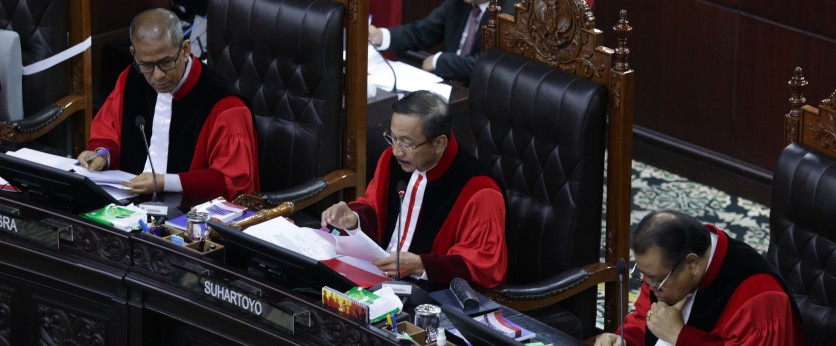
Decision Pronouncement Hearing of Case No. 205/PUU-XXIII/2025 on the Material Judicial Review of Law No. 3 of 2006 on the Amendment to Law No. 7 of 1989 on Religious Court, Thursday (27/11). Photo by MKRI/Bay.
Jakarta (MKRI) – The Constitutional Court (MK) declared the petition on the material judicial review of Law No. 3 of 2006 on the Amendment to Law No. 7 of 1989 on Religious Court unacceptable. The pronouncement of Decision No. 205/PUU-XXIII/2025 filed by Eddy Mahadi was held in the Plenary Courtroom on Thursday, November 27, 2025.
Pronouncing the Court’s legal considerations, Deputy Chief Justice Saldi Isra stated that the Petitioner did not elaborate on the Court’s authority to adjudicate the petition. On the contrary, the Petitioner mentioned other things unrelated to the Court’s authority.
Moreover, in the legal standing, the Petitioner did not explain his constitutional rights guaranteed by the 1945 Constitution of the Republic of Indonesia, nor did he explain the causal relationship between the enactment of the norms and the constitutional harms. “The absence of an explanation on legal standing means that the Petitioner’s petition cannot be assessed for fulfillment of the requirements as a Petitioner,” Deputy Chief Justice Saldi explained.
In addition, the petition's reasoning does not present a clear legal argument regarding the contradiction between the norm being tested and the article used as the basis for testing in the 1945 Constitution. This omission prevented the Court from assessing whether there was a conflict between the norm sought to be reviewed and the basis for review in the 1945 Constitution.
“Because the petition reasoning is vague, unclear, and the formulation of the petitum is not appropriate, hence, the Court opines that the Petitioner’s petition is unclear or obscure,” Deputy Chief Justice Saldi stated.
Also read:
Inheritance Law Options under the Religious Court Law
Hearing on Inheritance Provisions Review Postponed
During the Preliminary Hearing on Friday, November 7, 2025, Petitioner Eddy Mahadi stated that with the adoption of this law, particularly Article 49 letter b of the Religious Court Law, as it pertains to “inheritance”, he, as a Muslim Indonesian citizen, lost his right to choose between Islamic inheritance law or civil law. He asserted that this provision violates Article 28E paragraph (2) of the 1945 Constitution, as it removes his freedom to choose which inheritance law to apply.
The Petitioner said that this law obliges all muslims to follow the Islamic inheritance law. He did not ask for this law to be changed, but rather for the option to use national law.
Case tracking
Author: Sri Pujianti.
Editor: N. Rosi
PR: Fauzan F.
Translator: Rizky Kurnia Chaesario
Disclaimer: The original version of the news is in Indonesian. In case of any differences between the English and the Indonesian versions, the Indonesian version will prevail.
Thursday, November 27, 2025 | 13:43 WIB 134