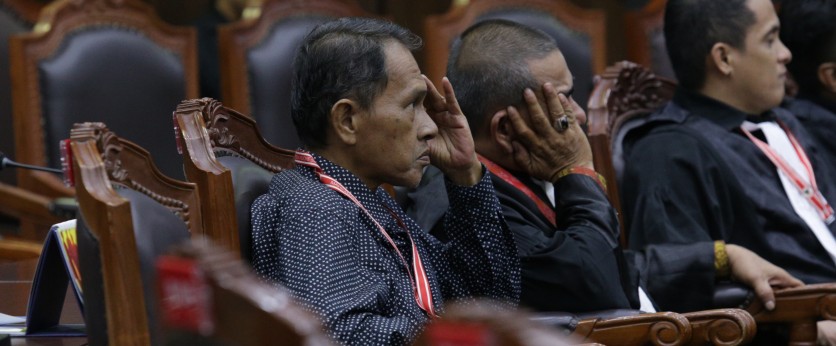
The Petitioners attend the Pronouncement of Decision Hearing for Case Number 194/PUU-XXIII/2025 concerning the Judicial Review of Law Number 2 of 2008 on Political Parties in conjunction with Law Number 2 of 2011 on the Amendment to Law Number 2 of 2008 on Political Parties, Thursday (11/27/2025). Photo by MKRI/Bay.
JAKARTA, (MKRI) – Article 22 of Law No. 2 of 2008 on Political Parties (as amended by Law No. 2 of 2011) - which mandates that party leadership at every level be elected democratically through deliberation - reflects the legislature’s intent to prioritize deliberation (musyawarah) to reach consensus (mufakat) in the internal selection of party officials. However, the Court emphasised that this mandate must be spelled out in a party’s articles of association and/or bylaws so that members have an explicit institutional avenue to improve and refine the leadership selection process.
That was the Court’s legal reasoning in reviewing Article 22 and Article 33(1) of the Political Parties Law in the judicial review brought by Imran Mahfudi. The Judgment Reading for Case No. 194/PUU-XXIII/2025, chaired by Chief Justice Suhartoyo, was held on Thursday (11/27/2025) in the Plenary Courtroom, Building I, MKRI.
Distinguishing Advocacy Organizations and Political Parties
In his reading of the Court’s opinion, Justice Daniel Yusmic P. Foekh noted that an advocate organization—whose functions relate to judicial power under Article 24(3) of the 1945 Constitution—cannot be equated wholesale with other types of organizations, including political parties. Therefore, the petitioner’s attempt to import reasoning from the Court’s Decision No. 91/PUU-XX/2022 regarding term limits for the leadership of the advocates’ organization was inappropriate.
Models for Filling Party Leadership
Justice Daniel added that possible models for filling party leadership positions must be set out explicitly in a party’s articles of association and/or bylaws. At that point, every party member should have the opportunity to participate in drafting or improving those internal rules. Given this institutional route, the petitioner’s argument seeking constitutionally mandated term limits for party leadership-by analogizing to the advocates’ organization decision-was legally unfounded.
Internal Dispute Resolution
Regarding the petitioner’s challenge to the phrase “not reached” (“tidak tercapai”) in Article 33(1), which the petitioner claimed is ambiguous and open to multiple interpretations, the Court recalled its prior reasoning in Decision No. 78/PUU-XIII/2015. Article 33(1) must be read together with Article 32, which envisages internal party disputes being resolved by a party’s own tribunal (Mahkamah Partai) and indicates a 60-day timeframe for resolution.
The Court clarified that the 60-day period functions as a statutory outer limit for a party tribunal to decide an internal dispute from the date it is brought. If the dispute is not resolved within that period, the disputing parties may seek other remedies, including turning to the courts. Although the petitioner offered different factual arguments about when a state court becomes competent to hear such internal disputes, the Court found no compelling legal basis to depart from the reasoning in Decision No. 78/PUU-XIII/2015. The petitioner’s claim that the phrase “not reached” renders Article 33(1) constitutionally defective was therefore rejected.
Disposition
“Rejecting the petition in its entirety,” declared Chief Justice Suhartoyo in the Court’s operative ruling.
Read also:
PKB Aceh Member Challenges Absence of Term Limits for Political Party Leadership.
Aceh PKB Regional Board Member Strengthens Argument in Judicial Review of the Absence of Term Limits for Political Party Leadership.
Background
The Petitioner previously asserted that Article 22 of the Political Parties Law has caused constitutional harm because it diminishes his opportunities to serve as a party chair at either the provincial or national level. According to the Petitioner, the absence of statutory term limits for party leadership enables incumbent party chairs to retain their positions indefinitely. As a result, by delegating the entire mechanism of leadership formation to a party’s articles of association and bylaws (AD/ART), political parties have intentionally designed rules that allow a single individual to occupy the position of chairperson without temporal restriction. In the Petitioner’s view, this situation makes it nearly impossible for other party members - including himself - to compete fairly, as internal party dynamics often discourage or even preclude challengers from nominating themselves against long-standing incumbents.(*)
Author : Sri Pujianti.
Editor : Lulu Anjarsari P.
PR : Raisa Ayuditha M.
Translator : Agusweka Poltak Siregar
Disclaimer: The original version of the news is in Indonesian. In case of any differences between the English and the Indonesian versions, the Indonesian version prevails.
The full decision: Decision in Case Number 194/PUU-XXIII/2025
Thursday, November 27, 2025 | 14:19 WIB 131