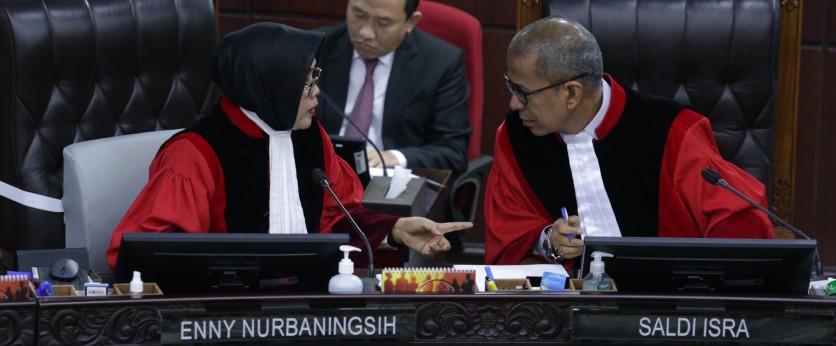
Ruling hearing of Case No. 209/PUU-XXIII/2025 on the material judicial review of Law No. 3 of 2025 amending Law No. 34 of 2004 on the Indonesian National Armed Forces, Thursday (11/27/2025). Photo by MKRI/Bay.
JAKARTA (MKRI) — The Constitutional Court (MK) declared the petition in Case No. 209/PUU-XXIII/2025 on the material judicial review of Law No. 3 of 2025 on the Indonesian National Armed Forces (TNI Law) inadmissible on Thursday, November 27, 2025. The Court found that the signatures of the Petitioners as the grantors of power of attorney were not original (wet) signatures but scanned images. They did not qualify as electronic signatures affixed with a valid duty stamp, and several attorneys listed as grantees had not signed the petition at all.
“Such a power of attorney does not satisfy the formal requirements and does not comply with Article 7 paragraph (2) Constitutional Court Regulation (PMK) No. 7 of 2025. Consequently, the grantees are not legally authorized to represent the Petitioners before the Court,” said Deputy Chief Justice Saldi Isra.
He elaborated that under Article 7 paragraph (2) of PMK No. 7 of 2025 on the Rules of Procedure for Judicial Review Cases, a specific power of attorney must bear a duty stamp in accordance with statutory regulations and must be signed directly by both the grantor and the grantee. However, at the petition revision hearing on Thursday, November 20, 2025, the Petitioners admitted that their powers of attorney had been signed only by scanning their signatures.
The Court emphasized that the phrase “signed by the grantor and the grantee” in Article 7 paragraph (2) PMK No. 7 of 2025 must be interpreted as directly signed by the principal and the appointed legal counsel, and cannot be substituted by a third party or by a scanned signature. In other words, the signatures must be original (wet signatures) or other legally recognized forms of signature under Indonesian law.
Because the power of attorney failed to meet these formal requirements, the Court held that the attorneys could not legally represent the Petitioners.
To safeguard procedural integrity, the Court must ensure the authenticity and orderly execution of signatures on all documents submitted to the Court, including petitions and powers of attorney, so that judicial proceedings rest upon legally valid documents. The Court stressed the importance of this formality because when a judicial review is granted, its decision not only affects the enforceability of the reviewed statute but also binds the public and state institutions at large (erga omnes).
Given these far-reaching consequences, the Court may not issue a ruling based on questionable or invalid documentation. Since the Petitioners’ own admission confirmed the authenticity issues with their powers of attorney, issues that formed the very basis of filing the petition, their application failed to meet the formal requirements for submission.
“Based on the foregoing legal considerations, although the Court has the authority to adjudicate the petition, the Petitioners’ application does not meet the formal requirements; therefore, their legal standing and the merits of the case are not examined,” Saldi stated.
The petition was filed by four attorneys, Marina Ria Aritonang, Yosephine Chrisan Eclesia Tamba, Syamsul Jahidin, and Ratih Mutiara Louk Fanggi. They challenged Article 47 paragraph (1) of the TNI Law, which provides that “Soldiers may assume positions in ministries/agencies responsible for coordinating political and national security affairs, national defense including the National Defense Council, the state secretariat dealing with presidential and military secretariat affairs, national intelligence, cybersecurity and/or cryptography, the national resilience agency, national search and rescue, national narcotics agency, border management, maritime and fisheries, disaster management, counterterrorism, maritime security, the Attorney General’s Office, and the Supreme Court.”
The Petitioners argued that the provision grants overly broad authority and risks human rights violations against Papuans residing within the Unitary State of the Republic of Indonesia (NKRI). In their view, aside from occupying positions within the listed ministries and agencies, soldiers may also assume other civilian posts after resigning or retiring from active duty.
They claimed that placing active or former soldiers in civilian positions without transparent and merit-based appointment procedures jeopardizes bureaucratic neutrality and hinders governance reforms grounded in good governance principles. It may also trigger discriminatory practices in the constitutional system by giving soldiers privileges to occupy civilian posts through procedures not applicable to ordinary citizens, thus creating substantive inequality before the law.
In their petitums, the Petitioners asked the Court to declare Article 47 paragraph (1) of the TNI Law unconstitutional and not legally binding, or alternatively, to declare it conditionally unconstitutional insofar as it is not interpreted to mean that “Soldiers may only occupy positions in ministries or agencies responsible for national security, national defense including the National Defense Council, national intelligence, cybersecurity and/or cryptography, the national resilience agency, search and rescue, border management, disaster management, counterterrorism, the Attorney General’s Office, and the Supreme Court.”
Author: Mimi Kartika
Editor: Lulu Anjarsari P.
PR: Raisa Ayuditha M.
Translator: Yuanna Sisilia
Disclaimer: The original version of the news is in Indonesian. In case of any differences between the English and the Indonesian versions, the Indonesian version will prevail.
Full Decision: Decision Case No. 209/PUU-XXIII/2025
Thursday, November 27, 2025 | 14:53 WIB 195