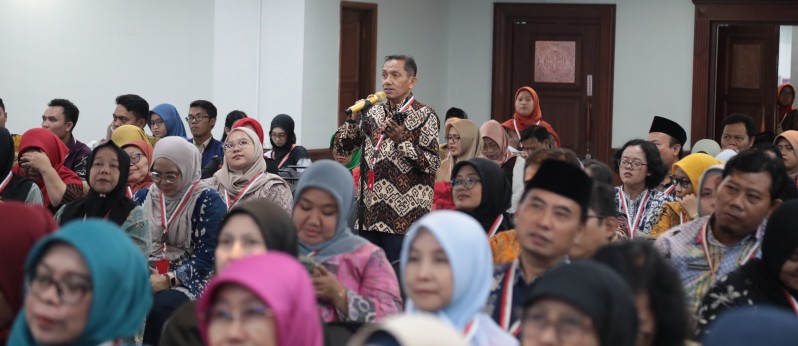
Board members of the DKI Jakarta Pancasila Education SMP Teachers Association visiting the Court, Thursday (11/27/2025). Photo by MKRI/Ilham W.M.
JAKARTA (MKRI) — On behalf of the Constitutional Court, senior legal analyst Rio Tri Juli Putranto welcomed the board members of the DKI Jakarta Pancasila Education SMP (junior high school) Teachers Association on Thursday, November 27, 2025.
Rio explained that the establishment of the Constitutional Court was inseparable from the need for a mechanism of constitutional review, the settlement of electoral results disputes, and the need for a constitutional forum to handle presidential impeachment, which had previously lacked a strong procedural basis.
“What existed at that time was only the Supreme Court, but even then, it was not statutes that were reviewed; only regulations below the level of statutes were reviewed. Learning from that experience, this became one of the reasons for establishing the Constitutional Court,” he said.
Another reason for establishing the Constitutional Court with its current powers was the dismissal of three Indonesian presidents for political reasons. President Sukarno, President Suharto, and President Abdurrahman Wahid were all dismissed based on political allegations without due opportunity to defend themselves.
The next reason underlying the establishment of the Constitutional Court is the adjudication of general election disputes. Previously, during the New Order era, the winner of elections was predictable, and there was no venue for other parties to challenge election results. Thus, through the amendments to the 1945 Constitution, becoming the 1945 Constitution of the State of the Republic of Indonesia (UUD NRI 1945), the Constitutional Court was granted the authority to decide disputes concerning election results.
Rio further explained that the three branches of state power—the House of Representatives (DPR), the president, and the Supreme Court—each nominates three candidates for constitutional justices. He emphasized that because this is regulated in the UUD NRI 1945, the Constitutional Court cannot refuse and must accept whomever has been selected by the nominating institutions.
The next authority of the Constitutional Court is to decide disputes over the authority of state institutions whose powers are regulated in the UUD NRI 1945. It is now unlike in the New Order era, when disputes over state institutional authority were resolved based on the president’s political discretion. Similarly, the Constitutional Court’s authority on the dissolution of political parties is grounded in past experiences when political parties could be dissolved by those in power without judicial process. Finally, Rio stated that the Constitutional Court is obligated to decide on the opinion of the House of Representatives asserting that the president and/or vice president has violated the UUD NRI 1945.
Author : Adriana Airlia Yusrin/Ilham W.M.
Editor : N. Rosi
Translator : Yuniar Widiastuti (NL)
Disclaimer: The original version of the news is in Indonesian. In case of any differences between the English and the Indonesian versions, the Indonesian version will prevail.
Thursday, November 27, 2025 | 15:40 WIB 172