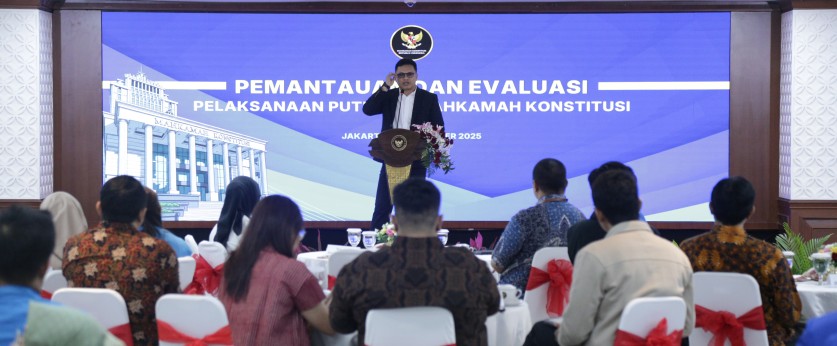
Court’s Head of the Legal Affairs and Registrar Administration Bureau Fajar Laksono Suroso, opening the “Monitoring and Evaluation of the Implementation of Court Decisions – Series 2” event on Wednesday, (11/26/2025). Photo by MKRI/Bay
JAKARTA (MKRI) – The Constitutional Court (MK) once again held a Focus Group Discussion (FGD) on the Monitoring and Evaluation of the Implementation of Court Decisions – Series 2 on Wednesday, November 26, 2025. This activity was attended by representatives of academics from Pamulang University and Esa Unggul University, as well as staff from the Court’s Legal Affairs and Registrar Administration Bureau. To discuss comprehensively the dynamics and challenges of implementing Court decisions, several speakers were present from the Directorate General of Legislation, the Ministry of Law; the Head of the Center for Monitoring the Implementation of Laws of the House (DPR) Expertise Agency; the General Elections Commission (KPU); the Ministry of Home Affairs; and the Supreme Court.
At the opening of the event, Head of the Legal Affairs and Registrar Administration Bureau Fajar Laksono stated that for Courts around the world, the issue of implementing decisions is something that inevitably occurs. The same is true for the implementation of Court decisions in Indonesia. In several writings, it is stated that out of 372 Court decisions that were granted, 63 of them were not implemented.
“Therefore, through today’s monitoring and evaluation of the implementation of Court decisions, the Court wants to see how these decisions are carried out in practice after they are handed down. Through this FGD, it is hoped that stakeholders can be brought together, so that a picture can be obtained from the Court’s partners here and conveyed to the leadership. In essence, no institution can enforce a legal norm alone; support from various apparatuses is certainly needed for every Court decision,” Fajar said in his opening remarks from the hall of the first building.
After the official opening, the FGD participants and speakers joined two classes, divided into Cluster I and Cluster II, focusing on Court Decisions Number 135/PUU-XXII/2024 and Number 23/PUU-XIX/2021. Each class consisted of the Petitioners, representatives of the Government such as the KPU, Supreme Court, and House, as well as the addressees of the relevant Court decisions.
Consequences of Choosing the Electoral System
In Group I, the FGD participants discussed Court Decision Number 135/PUU-XXII/2024. This decision ruled on separating national elections (President, House, and Regional Representative Council) from regional elections (Governor, Regent/Mayor, and Regional People’s Representative Council). This arrangement will be implemented starting from the 2029 general elections, with a time gap of two to two and a half years from the previous simultaneous regional head elections.
In the class moderated by Court Legal Analyst Syamsudin Noer, the Petitioner in Case Number 135/PUU-XXII/2024, represented by Heroik M. Pratama (Executive Director of Perludem), explained the process and dynamics of the Election Law that his organization had repeatedly submitted to the Court for review. Heroik acknowledged that since 2012, Perludem has conducted studies of several countries, including those in Latin America.
“When looking at their electoral design—even in Indonesia itself since the constitutional amendments—the debate over the design of the electoral system has long existed and become a topic of discussion. There are seven variables in an electoral system, including seat allocation magnitude, nomination and voting methods, representation threshold, vote-counting formula, determination of elected candidates, and the election schedule,” Heroik explained during the FGD held in the delegation room of the first building.
Meanwhile, a representative of the Directorate General of Regional Autonomy of the Ministry of Home Affairs presented the implications of separating elections based on the Court’s decision. One implication is the efficiency of election administration. Separating election schedules can reduce the workload of election organizers, minimize the potential for technical errors, and optimize the use of the state budget.
In Group II, participants discussed Court Decision Number 23/PUU-XIX/2021. This decision changed the rules by allowing an appeal (cassation) against decisions on the Suspension of Debt Payment Obligations (PKPU), but under certain conditions, one of which is that the PKPU application is filed by the creditor and the debtor’s settlement proposal is rejected.
The monitoring and evaluation discussions were divided into two clusters: Cluster I discussed Court Decision Number 135/PUU-XXII/2024, held in the Hall Room of the second building. The parties involved included legal representatives of the Petitioner, representatives of the Directorate General of Legislation of the Ministry of Law, the Head of the Center for Monitoring the Implementation of Laws of the House’s Expertise Agency, KPU, the Ministry of Home Affairs, and academics from Pamulang University. Meanwhile, Cluster II discussed Court Decision Number 23/PUU-XIX/2021 together with the Petitioner’s legal representatives, the Directorate General of Legislation of the Ministry of Law, the Center for Monitoring the Implementation of Laws of the House’s Expertise Agency, the Supreme Court, and academics from Esa Unggul University.
Author : Sri Pujianti
Editor : Lulu Anjarsari P
Translator : Jessica Rivena Meilania
Disclaimer: The original version of the news is in Indonesian. In case of any differences between the English and the Indonesian versions, the Indonesian version will prevail.
Wednesday, November 26, 2025 | 19:04 WIB 137