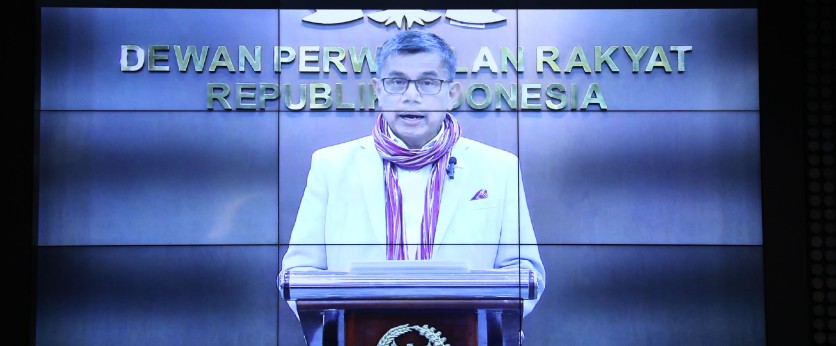
Member of the Third Commission of the House of Representatives, Hinca Pandjaitan, delivering testimony during the judicial review hearing of Minerba Law, Wednesday (26/11). Photo by MKRI/Panji.
Jakarta (MKRI) – The Constitutional Court (MK) resumed the material judicial review hearing of Article 51B paragraph (1) and paragraph (2) letter d, Article 60B paragraph (1) and paragraph (2) letter d of Law No. 2 of 2025 on the Fourth Amendment to Law No. 4 of 2009 on Mineral and Coal Mining (Minerba Law) against the 1945 Constitution of the Republic of Indonesia. The hearing was scheduled to hear testimony from the House of Representatives; meanwhile, the President was not yet ready to testify on Wednesday, November 11, 2025.
The House’s testimony was delivered by Member of the Third Commission, Hinca Pandjaitan. He stated that the granting of priority Mining Business License Areas (WIUP) as regulated under the tested articles is part of the downstreaming policy to include private companies. The policy aligns with the government’s downstreaming policy to enhance the added value of minerals and coal before they are sold.
“The Minerba Law regulates the obligation of the Mining Business Permit (IUP) or Special Mining Business Permit (IUPK) holders to increase the added value of minerals and coal through the production process by conducting processing, and/or refining activities as stipulated in Article 102 of the Minerba Law,” Hinca stated in relation to Petition No. 202/PUU-XXIII/2025 in the Plenary Courtroom.
He explained that granting priority WIUP to State-Owned Enterprises or private business entities is an integral part of the national downstreaming strategy. Downstreaming is a state policy designed to ensure that minerals are not exported in raw form, but are processed, refined, and industrialized domestically.
Hinca went on to explain that fulfilling this mandate requires substantial investment, certainty in supply chains, access to appropriate technology, and adequate managerial capacity, which, in practice, are not only available to state-owned enterprises but also to private business entities with sufficient financial, technical, and organizational capabilities. Therefore, only business entities that meet the required standards of technical, financial, and managerial capacity, as well as adequate technological competence, may be granted priority.
He explained that the mechanism for granting such priority is based on objective parameters set out in Article 51B paragraph (2) of the Minerba Law. The technical provisions on priority allocation are further regulated in Government Regulation No. 39 of 2025, which details the stages, requirements, and criteria for private business entities eligible to receive priority for WIUP.
The regulation also clarifies the criteria for private business entities that may obtain WIUP on a priority basis for downstreaming purposes. As an implementing regulation that is inseparable from the Minerba Law, Government Regulation No. 39 of 2025 provides certainty regarding the scope and qualifications of private business entities, which are not to be understood as a broad, open, or subjectively determined category, but as entities clearly defined through administrative, technical, financial, and operational parameters.
Hinca further stated that granting priority to private entities does not reduce Non-Tax State Revenue (PNBP), because all licensing mechanisms, whether for state-owned enterprises or private business entities, remain entirely under state control, including the setting of PNBP tariffs as regulated in Article 108A of the Mineral and Coal Law and its implementing provisions. Thus, in his view, the phrase “private business entities” in the article a quo cannot be interpreted as conferring special privileges or advantages that distort the market, diminish the role of state-owned enterprises, or reduce state revenue.
“On the contrary, the provision is designed to ensure that every business actor, whether state-owned or private, that meets objective requirements can contribute to national downstreaming. In practice, value enhancement through downstreaming by both state-owned and private entities actually broadens the scope of downstream activities and can even be mutually reinforcing through collaboration schemes and integrated supply chains,” Hinca explained.
Meanwhile, foreign business entities are not automatically free to own or conduct mineral and coal mining operations in Indonesia. Article 112 of the Minerba Law requires that holders of IUP or IUPK whose shares are owned by foreign parties must divest 51 percent of their shares in stages to the central government, regional governments, state-owned enterprises, region-owned enterprises, and/or national private business entities.
He stated that by providing room for state-owned enterprises and private business entities that meet objective criteria, Indonesia can accelerate the development of domestic management capacity so that it does not remain merely a global supplier of raw materials. Downstreaming based on domestic investment and carefully selected private participation strengthens Indonesia’s bargaining position in avoiding trade pressures that are often used as political instruments by global powers.
Also read:
Two Company Directors File for Judicial Review of Priority Mining Permit Provisions
Two Contract Teachers Join as Petitioners in Judicial Review of Minerba Law
The case was filed by the Director of PT Pinter Hukum Indonesia, Ilham Fariduz Zaman; the Director of PT Cipta Kemenangan Nusantara, Imam Rohmatullah; and two contract teachers, Iqro’ Katsir and Alif Alvian Mawaddi Hamid. They contended that the equal treatment of state-owned enterprises (SOEs) and private business entities in the a quo articles, in practice, allows certain private companies to obtain IUPs (Mining Business Licenses) without going through an open, competitive, and transparent auction process, as should be required for all private entities. In other words, the provisions in the a quo articles have created a priority mechanism for granting Mining Business Licenses (IUPs) that deviates from the principles of fair competition and equal opportunity among private business entities.
In other words, the provisions in the a quo articles have created a priority mechanism for granting Mining Business Licenses (IUPs) that deviates from the principles of fair competition and equal opportunity among private business entities. According to the Petitioners, the mechanism for granting IUPs on a priority basis to private companies, treated equally with state-owned enterprises (SOEs) as stipulated in the challenged provisions, essentially opens a broad avenue for unfair practices.
Granting priority IUPs without auction to private business entities is highly prone to subjectivity, excessive discretion, and interference from parties with vested interests. In this context, there is no adequate control mechanism to ensure that private companies obtaining IUPs through the priority mechanism are selected based on objective, measurable, and accountable criteria.
On the contrary, a mechanism without an auction opens opportunities for private business entities with close ties to the government, whether political, economic, or personal, to gain a privileged position or special treatment in acquiring mining permits. As a result, the granting of IUPs under the priority mechanism would no longer be based on merit or objective feasibility principles, but rather on factors unrelated to the company’s actual technical capacity or capability.
Therefore, in their petitum, the Petitioners requested the Court to interpret Article 51B paragraph (1) of the Minerba Law to read: “WIUP (Mining Business License Areas) for metallic minerals for downstreaming purposes may be granted to SOEs (state-owned enterprises) through a priority mechanism and to private companies through an auction via priority offering.” Similarly, they requested Article 60B paragraph (1) to be interpreted as: “WIUP for coal for downstreaming purposes may be granted to SOEs through a priority mechanism and to private companies through an auction via priority offering.” The Petitioners also sought new interpretations for other related provisions as stated in their petitum.
Case tracking
Author: Mimi Kartika
Editor: Lulu Anjarsari P.
Public Relations: Andhini S.F.
Translator: Rizky Kurnia Chaesario/Aski V. Rumere
Disclaimer: The original version of the news is in Indonesian. In case of any differences between the English and the Indonesian versions, the Indonesian version will prevail.
Wednesday, November 26, 2025 | 18:58 WIB 292