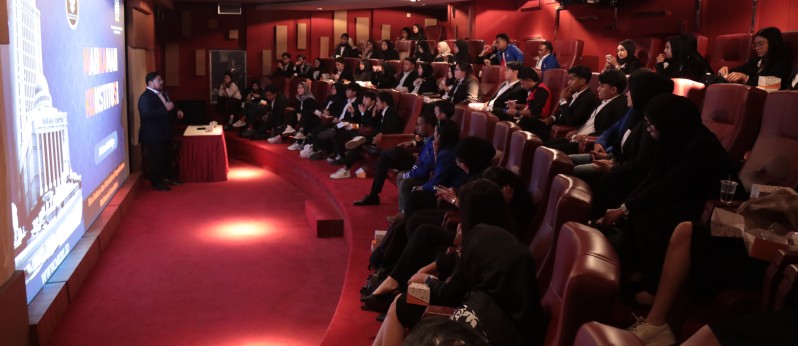
The 59 students from various universities participating in the Student Exchange Program of the Faculty of Law, Universitas Pancasila visited the Court on Wednesday, (11/26/2025). Photo by MKRI/IlhamWM.
JAKARTA, (MKRI) – The Constitutional Court (the Court) welcomed students participating in the Student Exchange Program (SEP) of the Faculty of Law, Universitas Pancasila (FHUP) as part of a series of constitutional education activities on Wednesday, (11/26/2025). During the visit, the students received a comprehensive presentation on the Court’s authorities, functions, and procedural mechanisms.
The students—coming from various universities within and outside Indonesia—were received by Arinta Sulistyo Eko Prabowo, Junior Legal Analyst at the Court. Tiyo, as he is commonly known, explained the historical development of the Court, the necessity of its establishment in the post-reform era, and its essential role in upholding the Constitution and safeguarding the principles of a constitutional state.
The Court as the Guardian of the Constitution
Tiyo explained that before the amendments to the 1945 Constitution—later formalized as the 1945 Constitution of the Republic of Indonesia (UUD NRI 1945)—Indonesia did not have an adequate constitutional review mechanism. As a result, problematic statutes could not be examined for their constitutionality. In addition, there was no clear judicial forum for resolving electoral disputes or authority conflicts between state institutions.
“After the amendments to the 1945 Constitution, the Constitutional Court was established as an independent holder of judicial power, authorized to adjudicate constitutional matters at the first and final instance, with decisions that are final,” Tiyo said during the session.
He elaborated that the Court’s authorities include reviewing statutes against the UUD NRI 1945, resolving disputes over constitutional authority among state institutions, deciding disputes over election results, ruling on the dissolution of political parties, and deciding on the House of Representatives’ (DPR) opinion regarding alleged constitutional violations committed by the President or Vice President.
Procedural Stages at the Court
The SEP students also received an explanation of the Court’s organizational structure, the composition of its nine Constitutional Justices, and the role of the Ethics Council in maintaining judicial integrity. Tiyo emphasized that the Court’s procedural framework upholds the principles of fairness, legal certainty, and transparency.
The session continued with an overview of the essential steps in filing a petition. The students learned about the types of hearings held at the Court—namely the preliminary hearing conducted by a panel of three Constitutional Justices and the plenary hearing conducted by all nine—followed by the examination of evidence and the reading of the decision. Tiyo also shared examples of judicial review petitions that attracted significant public attention, including election law reviews filed by university students.
Author : Adriana Airlia Yusrin/Ilham WM.
Editor : N. Rosi.
Translator : Aski Violeta Rumere /Agusweka Poltak Siregar
Disclaimer: The original version of the news is in Indonesian. In case of any differences between the English and the Indonesian versions, the Indonesian version prevails.
Wednesday, November 26, 2025 | 17:48 WIB 127