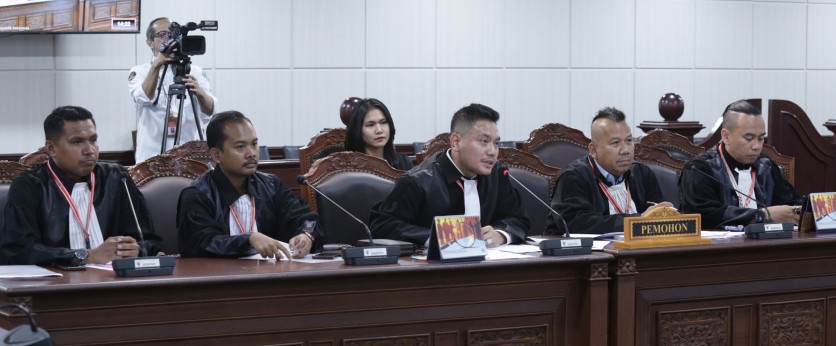
The Petitioner’s counsels at the preliminary hearing for case No. 225/PUU-XXIII/2025 on the Advocate Law, Wednesday (11/26/2025). Photo by MKRI/Bayu.
JAKARTA (MKRI) — The Constitutional Court (MK) held the preliminary hearing for the material judicial review of Law No. 18 of 2003 on Advocates on Wednesday, November 26, 2025. The petition in case No. 225/PUU-XXIII/2025 was filed by Togar Situmorang, an advocate.
In his petition, the Petitioner challenges Article 16 of the Advocate Law, which stipulates that “Advocates cannot be prosecuted either civilly or criminally in carrying out their professional duties in good faith for the defense of clients in or out of court.” He argues that several provisions of the Advocate Law, including the article under review, grant overly broad authority to advocate organizations concerning the appointment, membership, dismissal, and litigation legitimacy of advocates, including through the issuance of Advocate Identification Cards (KTPA). According to him, such regulation creates legal uncertainty and could potentially harm the constitutional rights of advocates.
Axl Mattew Situmorang, the Petitioner’s counsel, stated at a hearing presided over by Constitutional Justice Arief Hidayat that the Petitioner was named a defendant and detained while performing professional duties in defending a client. Yet, the petitioner believes he acted in good faith, as evidenced by his achievements in the effort to defend the client.
“What is meant by good faith in performing professional duties for the enforcement of justice based on law for the purpose of defending the client’s interests is something that should be assessed and decided by the ethics council of the relevant advocate organization, without reducing criminal or civil liability. In addition, there is urgency to the Petitioner’s current situation, as he is undergoing trial at the Denpasar District Court,” Situmorang stated.
In the petition, the Petitioner argues that several provisions of the Advocate Law violate Article 27 paragraph (2), Article 28D paragraph (1), and Article 1 paragraph (3) of the 1945 Constitution. He contends that the KTPA lacks any legal basis in the Advocate Law yet is used as an administrative requirement to appear in court, thus violating the legality principle. In addition, advocate organizations are deemed able to unilaterally determine the validity period, extension, and revocation of the KTPA, which may hinder advocates from practicing even though they have been sworn in by the High Court.
The Petitioner also argues that the broad powers of advocate organizations open opportunities for abuse, discrimination, and unlawful levies. The disharmony of authority between the High Court and advocate organizations is said to create a dualism of litigation legitimacy and contradict the principles of a rule-of-law state. As a result, the Petitioner claimed to have suffered concrete losses, including obstacles to appearing in court and the obligation to pay renewal fees for the KTPA.
Furthermore, the Petitioner challenges Article 16 of the Advocate Law as interpreted in Constitutional Court Decision No. 26/PUU-XI/2013. He argues that the use of the phrase “good faith” in that provision has become a basis for the criminalization of advocates, thereby violating Article 28D paragraph (1) and Article 28I paragraph (2) of the 1945 Constitution. He emphasizes that this petition does not constitute ne bis in idem because the constitutional benchmark, grounds of petition, constitutional harm, and petitums differ from previous petitions.
The Petitioner also highlighted the importance of the position of the ethics council of advocate organization (DKOA) as the body authorized to examine alleged ethical violations, including assessing the good faith of an advocate in performing professional duties. He believes the alleged criminalization against him—related to allegations of promises of victory and provision of operational funds—should first be examined by the DKOA based on the principle of due process of law.
The Petitioner asked the Court to declare the elucidation to Article 16 of the Advocate Law unconstitutional insofar that it is not interpreted to mean that the assessment of an advocate’s good faith is conducted by the DKOA without eliminating criminal or civil liability. In addition, he requested the Court to order the Denpasar District Court to postpone the criminal proceedings against him pending the pronouncement of the constitutional review decision.
At the hearing, Constitutional Justice Enny Nurbaningsih advised the Petitioner to clarify the object of the petition—whether the challenge is directed at Article 16, its elucidation, or both. She emphasized that the section on the subject matter of the petition must clearly and fully specify the object under review. “Because this appears as though what is sought is a review of Article 16, but in fact what is being requested is the review of the elucidation to Article 16, or both. There must be clarity about that, so in the subject section it must be spelled out explicitly to the very end,” she said.
The panel of constitutional justices gave the Petitioner 14 days to revise the petition. The revised petition must be received by the Court no later than Tuesday, December 9, 2025.
Track the Case No. 225/PUU-XXIII/2025 here.
Author : Utami Argawati
Editor : Lulu Anjarsari P.
PR : Fauzan Febriyan
Translator : Yuniar Widiastuti (NL)
Disclaimer: The original version of the news is in Indonesian. In case of any differences between the English and the Indonesian versions, the Indonesian version will prevail.
Wednesday, November 26, 2025 | 21:20 WIB 195