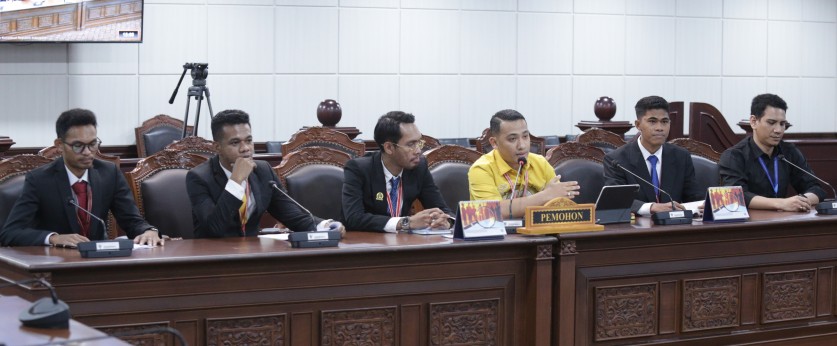
Petitioners attending the judicial review of Case No. 222/PUU-XXIII/2025 on the material judicial review of Law No. 40 of 2009 on Youth, Tuesday (25/11/2025). Photo by MKRI/Bay.
Jakarta (MKRI) – Six citizens have filed a petition on the material judicial review of Article 1 point 1 of Law No. 40 of 2009 on Youth against Article 28C paragraph (2), Article 28D paragraph (1), and Article 28D paragraph (3) of the 1945 Constitution of the Republic of Indonesia. The petitioners of Case No. 222/PUU-XXIII/2025 considered that defining youth as Indonesian citizens aged 16 to 30 has deprived them of their constitutional right to equal opportunity to participate in national life, particularly in youth policies and programs that form an integral part of national development.
“This norm has caused actual, potential, and structural constitutional harm by directly restricting the petitioners’ opportunity for participation as productive citizens who remain active, forward-thinking, and contributing members of society,” said Husnul Jamil (Petitioner I), together with Rizal Bakri Rahayaan (Petitioner II), Hamka Arsad Refra (Petitioner III), M. Isbullah Djalil (Petitioner IV), Yusril Toatubun (Petitioner V), and Heri Febrian (Petitioner VI), during the preliminary hearing on Tuesday, November 25, 2025.
Rizal went on to explain that this age restriction for youth has resulted in concrete harm, including preventing the petitioners from participating in the 2025 Youth Scientific Work Facilitation Program “Bina Insan Akademia,” organized by the Ministry of Youth and Sports. The program, which offers facilitation funds of up to Rp 10 million per recipient to undergraduate, master’s, and doctoral students across Indonesia, requires participants to be between 16 and 30 years old.
The petitioners argued that this incident is not a mere administrative rejection, but a concrete denial of the constitutional rights of Indonesian citizens to develop themselves and participate in national development. In their view, the state is effectively saying, “you are no longer youth,” even though the petitioners’ spirit, work, and idealism remain very much alive, just as those of people in their twenties.
“The state, through this irrational age restriction, has effectively closed the door for the petitioners to advance themselves scientifically and intellectually,” Rizal stated.
The petitioners argued that the age limit set out in Article 1 point 1 of the Youth Law lacks any rational legal basis and cannot be justified scientifically, as there is no empirical evidence or academic argument showing that, after the age of 30, a person loses their youthful spirit or capacity to engage in social, economic, or public policy activities. They note that, according to Statistics Indonesia (BPS) data as of July 2025, there are 43 million Indonesians aged 30 to 40, or around 15 percent of the country’s total population of 286 million.
Accordingly, in their petitum, the petitioners requested that the Court declare Article 1 point 1 of Law No. 40 of 2009 on Youth unconstitutional and without binding legal force. They ask the Court to reinterpret Article 1 point 1 of Law No. 40 of 2009 so that it reads: “Youth are Indonesian citizens entering a crucial period of growth and development who are between 16 (sixteen) and 40 (forty) years of age.”
The case has heard by a Panel of Justices chaired by Justice Arief Hidayat, accompanied by Justice Anwar Usman and Justice Enny Nurbaningsih. During the advisory session, Justice Enny emphasized that each petitioner must set out in detail the constitutional rights that have been or will be harmed by the enactment of Article 1 point 1 of the Youth Law.
“Are these harms specific, actual, or potential? Each must be described one by one, along with the causal link between the alleged harm and the implementation of the norm. Only then can you conclude, for example, that if the harm is actual, it will cease to occur if the petition is granted, or if it is potential, it will no longer materialize. All of this must be explained point by point,” Justice Enny said.
Before adjourning, the Panel of Justices granted the petitioner 14 days to revise their petition. The revised petition must be submitted no later than Monday, December 8, 2025.
Case tracking
Author: Mimi Kartika
Editor: Lulu Anjarsari P.
PR: Raisa Ayuditha M.
Translator: Rizky Kurnia Chaesario
Disclaimer: The original version of the news is in Indonesian. In case of any differences between the English and the Indonesian versions, the Indonesian version will prevail.
Tuesday, November 25, 2025 | 17:49 WIB 206