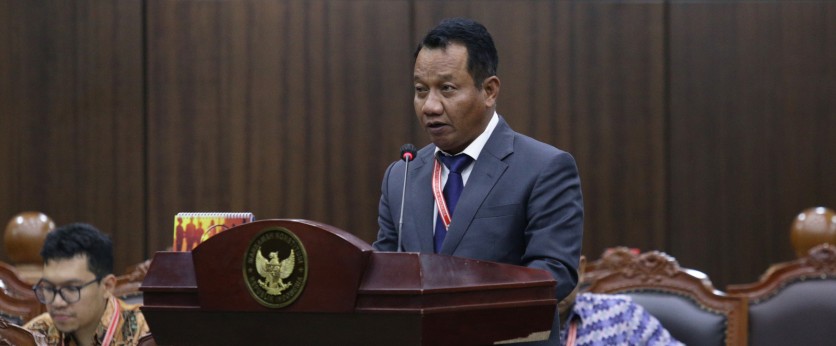
Government’s Statement in Case 182/PUU-XXIII/2025 on the Judicial Review of the Mineral and Coal Mining Law, Tuesday (25 November 2025). Public Relations/Bay.
JAKARTA, MKRI – The Constitutional Court (MK) held another hearing in the judicial review of Law No. 4 of 2009 on Mineral and Coal Mining (the Minerba Law), as most recently amended by Law No. 2 of 2025. The session, convened on Tuesday (25/11/2025) in the Court’s main courtroom, examined Petition No. 182/PUU-XXIII/2025 filed by two curators—Kevin Gorga Kennedy Hutagalung and Bob Humisar Simbolon, and an advocate, Anton Febrianto.
During the hearing which scheduled to hear the statement of the President/Government, the Director General of Mineral and Coal, Tri Winarno, underscored that the Government’s authority to revoke Mining Business Licenses (IUP) or Special Mining Business Licenses (IUPK) as regulated under Article 119(c) of the Minerba Law is neither automatic nor arbitrary. Instead, he said, this authority is exercised within a framework of transparency, accountability, and prudence.
Tri emphasized that a permit may be revoked only when an evaluation shows that the substantive requirements for the permit are no longer met. The revocation procedure, he added, is thoroughly regulated in statutory instruments to ensure that every government action remains legally grounded, reviewable, and accountable.
He reiterated that IUP and IUPK are public licenses derived from the state’s authority and are not private assets belonging to a bankrupt debtor. Mining permits, he said, originate from an administrative decision issued by a competent official based on assessments of administrative, technical, financial, and environmental feasibility.
“IUP and IUPK are public licenses derived from the authority of the state, not private assets of the debtor. In principle, mining permits are born from an administrative decision of an authorized official based on administrative, technical, financial, and environmental feasibility assessments,” he stated.
Safeguarding Constitutional Control Over Natural Resources
The Government further argued that Article 119(c) of the Minerba Law was designed to implement Article 33(3) of the 1945 Constitution, particularly the state’s obligation to control and ensure that natural resources are utilized for the greatest benefit of the people. This provision provides a legal basis for the state to ensure that mineral and coal resources are managed only by capable, qualified, and responsible parties.
Tri also noted that the provision aligns with the principle of contrarius actus and the mandate of Article 33(3) and Article 28D(1) of the Constitution.
“The authority to revoke permits based on the contrarius actus principle is not only administratively valid, but represents a constitutional obligation of the state to safeguard the integrity, feasibility, and sustainability of natural resource management,” he asserted.
The Government maintained that Article 119(c) of the Minerba Law does not conflict with the 1945 Constitution; rather, it embodies constitutional principles governing the management of natural wealth for the greatest prosperity of the people.
Also read:
Petitioners Seek Legal Certainty on Revocation of Mining Permits for Bankrupt Companies
Petitioners Refine Challenge to Mining Law Over Permit Revocation for Bankrupt Companies
DPR Clarifies Government’s Authority to Revoke Mining Licenses of Bankrupt Companies
Previously, the Petitioners, represented by Janses, argued that Article 119(c) of the Minerba Law violates Article 28D(1) of the Constitution because it fails to provide legal certainty, guarantees, or adequate legal protection for creditors or debtors in bankruptcy proceedings.
Article 119(c) states:
“An IUP or IUPK may be revoked by the Minister, governor, or regent/mayor in accordance with their authority if: … c. the holder of the IUP or IUPK is declared bankrupt.”
Janses contended that this provision creates legal uncertainty, particularly for companies deemed going concern, bankrupt corporations that, based on a commercial court’s determination, remain viable and must continue operating.
“The government’s revocation of a permit from a bankrupt debtor that has received a going-concern determination renders the court’s ruling unenforceable and risks harming both the state and creditors,” Janses argued during the preliminary hearing on Wednesday (15/10/2025) in the Constitutional Court’s panel courtroom.
In their petitum, the Petitioners requested that the Constitutional Court declare Article 119(c) unconstitutional and nonbinding insofar as it is not interpreted to provide an exemption “in cases where the holder of an IUP or IUPK declared bankrupt has been determined by the Commercial Court to continue operating (going concern).”
Writer: Utami Argawati
Editor: N. Rosi
Public Relations: Fauzan F.
Translator: SO
Disclaimer: The original version of the news is in Indonesian. In case of any differences between the English and the Indonesian versions, the Indonesian version will prevail.
Tuesday, November 25, 2025 | 19:07 WIB 242