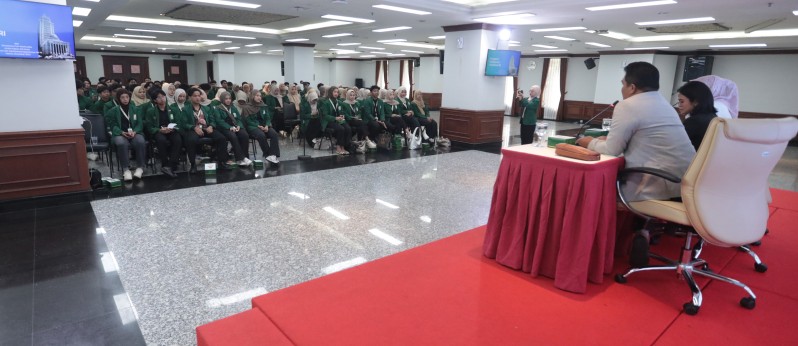
Ninety-nine students of the Student Association of the Constitutional Law Study Program at UIN Sunan Kalijaga visited the Constitutional Court on Monday (11/24/2025). Photo by MKRI/IlhamWM.
JAKARTA, MKRI – The Constitutional Court (MK) received a study visit from the Student Association of the Constitutional Law Study Program (HMPS HTN), Faculty of Sharia and Law (FSH), Universitas Islam Negeri Sunan Kalijaga (UIN Suka), on Monday, November 24, 2025. The group of 99 students was welcomed by Constitutional Court Legal Analyst Siswantana Putri Rahmatika in the Auditorium of Building I.
Legal Analyst Siswantana Putri Rahmatika, commonly known as Tika, explained that the establishment of the Court was driven by the absence of a state institution authorized to resolve constitutional issues, including the judicial review of statutes against the 1945 Constitution of the Republic of Indonesia (1945 Constitution).
Tika then discussed the impeachment of the President and/or Vice President, which in the past had been carried out without proper legal procedures; disputes over the authority of state institutions that were previously resolved politically by the president; and the lack of a clear mechanism to adjudicate election result disputes. She also highlighted the dissolution of political parties, which used to be determined solely by the ruling political powers at the time.
Tika further explained that the Court’s authority to review statutes is similar to the authority held by the Supreme Court (MA). The difference lies in the object of review: the Constitutional Court examines statutes against the 1945 Constitution, whereas the Supreme Court reviews regulations beneath statutes.
Another authority of the Court is to adjudicate disputes over the authority of state institutions whose powers are expressly provided in the 1945 Constitution. The Court is also empowered to decide on the dissolution of political parties, where previously such decisions were based on the interests of the ruling government, now, as a rule-of-law state, dissolution must be based on a judicial ruling. The Court further adjudicates disputes over election results, a matter that typically becomes prominent every five years. Lastly, the Court is mandated to issue a decision regarding the opinion of the House of Representatives that the President and/or Vice President has committed a constitutional violation.
Tika also explained that even before the existence of modern video-conferencing technology, the Court had already provided video conference facilities at several state universities, enabling anyone to access hearings remotely. The Court also uploads every judgment immediately after its pronouncement in the judgment hearing, making the decisions freely accessible to the public.
Earlier, Head of the Constitutional Law Study Program at UIN Suka, Gugun El Guyanie, in his opening remarks stated that most of the participants had already taken the Constitutional Court procedural law course. According to him, today anyone, including students, frequently files judicial review petitions. In contrast, in the past, only political elites submitted such petitions.
“The Court has become an open stage for democracy,” said Gugun.
Author: Ilham Wiryadi M.
Editor: N. Rosi.
Translator: Aski V. Rumere/SO
Disclaimer: The original version of the news is in Indonesian. In case of any differences between the English and the Indonesian versions, the Indonesian version will prevail.
Monday, November 24, 2025 | 15:28 WIB 79