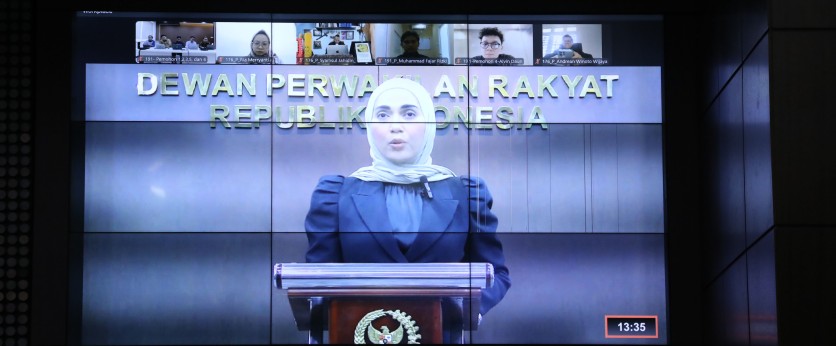
The member of Commission III of the House of Representatives (DPR RI), Sari Yuliati, delivered the House’s statement virtually during the judicial review hearing of Law Number 12 of 1980 on the Financial/Administrative Rights of Leaders and Members of the Highest/High State Institutions as well as Former Leaders of the Highest/High State Institutions. Photo by MKRI/Panji.
JAKARTA, (MKRI) — The House of Representatives (DPR) explained that the mechanism for granting pension allowances to the families of the DPR’s leaders and members is carried out proportionally and in a way that does not burden the state budget.
Under Article 17 paragraph (1) of Law Number 12 of 1980 on the Financial/Administrative Rights of Leaders and Members of the Highest/High State Institutions as well as Former Leaders and Members of the Highest/High State Institutions (Law 12/1980), pensions for the families of House leaders and members are provided only when the officeholder passes away-and the amount is limited to half of the pension previously received. This structure is designed to ensure proportionality and fiscal prudence.
This clarification was delivered by House representative Sari Yuliati during the judicial review hearing of Article 12, Article 16 paragraph (1)(a), Article 17 paragraph (1), Article 18 paragraph (1)(a), and Article 19 paragraphs (1) and (2) of Law 12/1980 on Monday (11/24/2025). The hearing for Case Number 191/PUU-XXIII/2025 was scheduled to hear the statements of the House and the Government. The Government, however, requested a postponement before delivering its statement regarding the petition filed by Ahmad Sadzali (Petitioner I), Anang Zubaidy (Petitioner II), Muhammad Farhan Kamase (Petitioner III), Alvin Daun (Petitioner IV), Zidan Patra Yudistira (Petitioner V), Rayhan Madani (Petitioner VI), and Muhammad Fajar Rizki (Petitioner VII).
Sari explained that pension distribution—both until the beneficiary passes away and to the beneficiary’s family upon their death—is a common practice in pension schemes regulated under numerous laws and regulations. Pension benefits serve to provide economic protection and welfare guarantees for surviving family members.
In practice, she continued, survivor pensions or continued pension benefits for lawful heirs are widely implemented, including through mechanisms such as pension continuation or death benefits. Eligible heirs are determined based on applicable regulations or employment agreements. Similar mechanisms can be found in provisions such as Government Regulation 4/2020, and they are also practiced in countries like Japan and South Korea.
“Pension benefits for House leaders and members are not restricted by a fixed period. The length of service cannot be used as the measure for how long pensions should be granted, but rather as a determinant of the amount of the pension received, as mandated by Law 12/1980,” Sari stated before the Plenary Bench led by Chief Justice Suhartoyo.
Read also:
Pension Allowance for House Members Protested
Petitioners Strengthen Arguments on Harm from DPR Members' Pension Benefits
During the Preliminary Hearing on Monday (10/27/2025), the Petitioners argued that the provisions regarding pension payments harm their constitutional rights. Taxes paid by the Petitioners, they argued, should instead be allocated toward the fulfillment of basic public rights and essential infrastructure, rather than pension benefits for officeholders of the Highest/High State Institutions.
One of the Petitioners' concerns is that based on Article 16 paragraph (1)(a) of Law 12/1980, pension payments to high-ranking state officials cease when the beneficiary passes away. However, Article 17 paragraph (1) of the same law mandates that if the pension recipient dies, the surviving spouse is entitled to half of the pension previously received.
The Petitioners deem this arrangement unfair when compared with national pension schemes, which rely on contributions—whereas DPR pensions are fully funded by the State Budget (APBN) despite the relatively short five-year political term. As a result, they argue, such pension privileges amount to a misuse of public funds. The Petitioners urged Indonesia to adopt pension mechanisms similar to those implemented in other countries, especially given the pressing national priorities such as education and healthcare to promote social welfare.
“One calculation shows that the amount received is on average nearly 42 times the monthly minimum wage in Jakarta, which is Rp5,390,000. With the substantial income already enjoyed by DPR members while in office, additional lifetime pensions create a disproportionate allocation between individual benefits and the broader public interest,” one of the Petitioners stated.
Based on these arguments, the Petitioners asked the Court to declare Article 12 paragraphs (1) and (2) of Law 12/1980 unconstitutional or conditionally unconstitutional insofar as they include officeholders elected through general elections. They also requested that Article 16 paragraph (1)(a), Article 17 paragraph (1), Article 18 paragraph (1)(a), and Article 19 paragraphs (1) and (2) be declared unconstitutional or conditionally unconstitutional insofar as they relate to the phrase “upon death.”
Case Track: Number 191/PUU-XXIII/2025
Author : Sri Pujianti
Editor : Nur R.
PR : Tiara Agustina
Translator : Agusweka Poltak Siregar
Disclaimer: The original version of the news is in Indonesian. In case of any differences between the English and the Indonesian versions, the Indonesian version prevails.
Monday, November 24, 2025 | 16:31 WIB 338