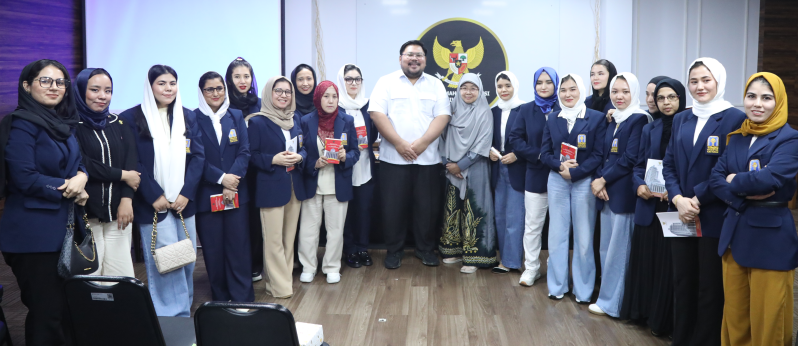
18 international students from Master of Law Program (PSHPM), Faculty of Law, Universitas Islam Indonesia (UII), visiting the Court on Thursday (11/20/2025). Photo by MKRI/Fauzan.
Academic visit by PSHPM UII students to see firsthand how the Court works.
JAKARTA (MKRI) – Students of the Master of Law Program (PSHPM), Faculty of Law, Universitas Islam Indonesia (UII), visited the Court on Thursday, November 20, 2025. The visit attended by 128 regular students and 18 international students, aimed to deepen their understanding and firsthand experience of constitutional adjudication practices.
UII Faculty of Law Vice Dean for Resources Sri Hastuti Puspitasari explained that the visit was part of the students’ academic process to observe how the Court works, both institutionally and in terms of legal implementation. “This institution (MK/ The Court) was established from the spirit of reform. Seeing its practice directly can serve as inspiration and even as thesis material for students,” she said.
During the presentation session, Constitutional Court Legal Analyst Puguh Apriyanto explained several provisions concerning the tenure of constitutional justices, including the duration of service and restrictions on holding concurrent positions.
“The tenure of a constitutional justice is one term of up to 15 years, with a minimum age of 55 and mandatory retirement at 70,” said Puguh.
He also explained the prohibition against concurrent positions as regulated under Article 17 of the Constitutional Court Law. The article states that constitutional justices are prohibited from simultaneously serving as other state officials, members of political parties, business actors, advocates, or civil servants.
“This regulation is designed to prevent conflicts of interest. For example, Justice Arsul Sani, who previously belonged to a political party, relinquished his membership after being appointed as a justice,” he said.
Puguh also encouraged students to actively file judicial review petitions, as some students had done in the Judicial Review of the Mining Law. “Decisions No. 70 and 74 of 2025 originated from student petitioners. Filing a judicial review petition is guaranteed to be free, from consultation to the hearing process,” he said, emphasizing that consultations do not involve the substance of the petition, as substantive review falls under the justices’ authority.
He further elaborated on the Court’s decision-making process, including the role of the Justices’ Deliberation Meeting (RPH). “The RPH is confidential. At least seven justices must be present in the decision-making process. If there is a leak, the Ethics Council (MKMK) is authorized to take action. One hour after a decision is delivered, the decision file document can be downloaded from the Court’s website,” he explained.
In a separate room, the 18 international PSHPM students held a discussion with Constitutional Court Legal Analyst Arinta Sulistyo (Tyo) and UII International Law Program Head Sefriani to gain a deeper understanding of Indonesia’s constitutional adjudication system. It turned out that all 18 students were from Afghanistan.
In his presentation, Tyo outlined the Court’s six main functions, one of which is its role as the Guardian of Democracy. He explained the Court’s constitutional powers as mandated by the 1945 Constitution: reviewing laws against the Constitution, settling disputes over the authority of state institutions, deciding on the dissolution of political parties, resolving electoral disputes, and ruling on the House of Representatives’ opinions regarding alleged violations by the President or Vice President.
“The Court also handles impeachment proceedings as provided under Article 7A of the 1945 Constitution,” Tyo stated.
Tyo also explained that the Court consists of nine constitutional justices, each nominated by three state institutions: the President, the House of Representatives, and the Supreme Court. “This mechanism ensures balance in the appointment of constitutional justices,” he added.
After the discussion session, the students visited the Constitutional History Center located on the 5th and 6th floors of the Court building to view archives and documentation on the development of Indonesia’s constitutional history.
Through this visit, Master’s students are expected to gain comprehensive insight into the potential adoption of a constitutional complaint mechanism and strengthen their knowledge and skills in the practice of constitutional law in the future.
Author: Fauzan F.
Editor: N. Rosi.
Translator: Aski V. Rumere/Donny Yuniarto
Disclaimer: The original version of the news is in Indonesian. In case of any differences between the English and the Indonesian versions, the Indonesian version will prevail.
Thursday, November 20, 2025 | 21:15 WIB 240